
What Is Attachment Trauma? And How Do You Heal From It?
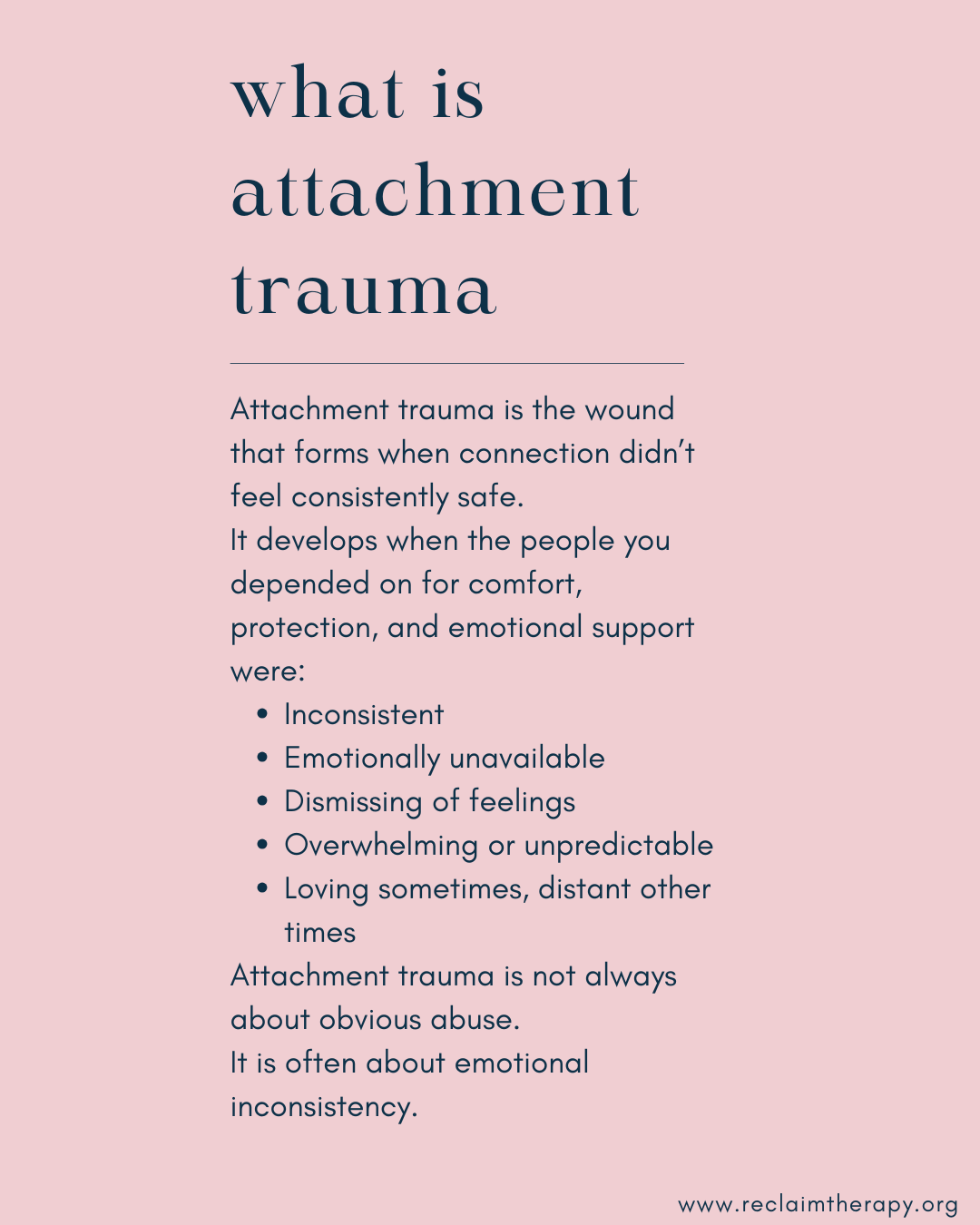
Attachment trauma happens when the people you depended on for safety, comfort, and emotional connection were inconsistent, unavailable, frightening, or emotionally immature.
Not necessarily abusive. Not necessarily chaotic. Sometimes it really did look “fine” on the outside.
But on the inside? You were alone with your feelings.
Attachment trauma may lead to difficulties with emotional regulation, trust, and forming healthy relationships later in life.
Understanding Attachment Trauma
Attachment trauma is not about one event. It’s about patterns.
It forms when your nervous system learns that closeness isn’t fully safe. That your needs are too much. That you have to earn love. That if you relax, you’ll get hurt. That if you show emotion, connection disappears.
Over time, that learning wires into your body.
So now, as an adult, you might overanalyze texts. Feel panicked when someone pulls away. Shut down when someone gets too close. Feel needy and ashamed at the same time. Pick emotionally unavailable partners or avoid relationships entirely. These patterns often lead to relationship difficulties in adulthood, making it challenging to accept love as a trauma survivor and form and maintain healthy connections.
How Attachment Trauma Shows Up in Your Attachment Style
Attachment trauma doesn’t look the same for everyone. Poor or incomplete attachment in childhood can contribute to the development of these relational strategies. Depending on what your nervous system learned about connection, you might have developed different relational strategies.
Anxious Attachment
If you have anxious attachment tendencies, your nervous system learned that connection was possible but unpredictable. Sometimes your caregiver was available. Sometimes they weren't. So, you learned to amplify your distress to get noticed.
Now that might look like: constantly checking your phone for texts, feeling panicked when someone seems distant, needing a lot of reassurance, or feeling like you're too much but also terrified of being left.
You didn't become clingy. You became hypervigilant to relational cues because inconsistency taught you that connection could disappear at any moment.
Avoidant Attachment
If you lean toward an avoidant attachment style, your nervous system learned that emotional needs weren’t welcome. Vulnerability led to dismissal, so you learned to minimize your needs and handle things alone.
Now that might look like: feeling uncomfortable with too much closeness, pulling away when someone wants more intimacy, priding yourself on independence, or feeling bored in stable relationships.
You didn’t become cold. You learned that needing people wasn’t safe, so you built a life where you wouldn’t have to risk it.
Disorganized Attachment
If you have disorganized attachment tendencies, your nervous system got the most confusing message of all. The person who was supposed to be your source of safety was also the source of fear or chaos.
Now that might look like: craving closeness but panicking when you get it, swinging between anxious and avoidant strategies, feeling like you can't trust your own instincts in relationships, or sabotaging connection right when it starts to feel good.
You likely learned that love and danger came from the same place, and your nervous system is still trying to solve that impossible equation.
Here's What Matters about Attachment Styles
Attachment isn’t a fixed thing, we like to think of them more as tendencies. You can have different patterns with different people. You can shift over time. And most people with attachment trauma have some mix of these strategies depending on the situation.
What they all have in common is that your nervous system is doing its best to keep you safe based on what it learned about relationships early on. The problem is, those old strategies don’t always work in adult relationships where the people around you might actually be safe. Early attachment trauma can also influence later relationships, including both romantic and social connections.
How Attachment Trauma Forms
From a trauma and nervous system perspective, attachment trauma develops when connection and safety were inconsistent. You needed co-regulation but got unpredictability. You needed attunement but got dismissal, distraction, or emotional distance. The way a caregiver responds to a child's needs, by providing comfort, reassurance, and consistent support, is crucial for healthy child development and brain development. When these responses are lacking or unpredictable, it can disrupt emotional growth and affect how the brain develops, influencing stress regulation and future behavioral patterns.
In Adult Children of Emotionally Immature Parents, Lindsay Gibson describes how emotionally immature parents often meet physical needs but struggle with emotional intimacy. That gap creates what she calls emotional loneliness. You weren’t necessarily neglected in obvious ways. You were emotionally unseen.
And for a child, that lands as: Something must be wrong with me.
So your nervous system adapted. You started fawning to keep connection. Overachieving to stay valued. Becoming hyperindependent. Shutting down needs. Becoming hyper independent in relationships. Monitoring everyone’s mood.
These were brilliant adaptations. They just don’t feel so great in adult relationships.
Signs You Might Be Living With Attachment Trauma
Attachment trauma can show up in subtle but exhausting ways. You feel anxious when someone doesn’t respond quickly. You assume conflict means abandonment. You struggle to trust healthy love or feel bored and restless in stable relationships. You feel responsible for other people’s emotions but don’t actually know what you need.
Attachment trauma can also contribute to mental health conditions and may result in overwhelming distress that affects daily functioning, including emotional flashbacks and other PTSD symptoms.
You crave closeness but also feel suffocated by it. You confuse intensity with intimacy.
It often overlaps with complex trauma, especially if emotional neglect was chronic.
Why Attachment Trauma Feels So Personal
Attachment wounds don’t just live in thoughts, they live in the body.
When someone pulls away, your system doesn’t say: “Oh, this reminds me of childhood inconsistency.”
It says: Danger. We are about to lose connection. Fix it. Now.
That urgency is nervous system memory. It’s procedural. Preverbal. Protective. These bodily responses can be understood as symptoms of traumatic stress resulting from early attachment wounds.
And if you grew up needing to stay in good graces to feel safe, that wiring can run deep.
Incomplete Attachment: When Bonds Are Never Fully Formed
Incomplete attachment happens when the essential bond between a young child and their primary caregiver is never fully established. This can occur if the caregiver is emotionally unavailable, inconsistent, or unpredictable, leaving the child without a reliable sense of safety or comfort. When a child’s basic needs for emotional support and connection go unmet, they may develop an insecure attachment style, such as avoidant or disorganized attachment.
As these children grow, the effects of incomplete attachment can ripple into adult life. You might find it difficult to trust others, struggle with self-esteem, or feel disconnected in relationships. Forming healthy relationships can feel challenging, and you may notice patterns of emotional regulation difficulties, anxiety, depression, or even substance abuse as ways to cope with emotional pain. Without a secure attachment bond in early childhood, it’s common to feel unsure of your own emotions or to seek validation in unhealthy ways.
Treating attachment trauma and incomplete attachment is possible. Healing often involves working with a therapist to build a secure attachment style, learning new ways to regulate emotions, and developing self-compassion. With support, you can begin to rewrite old patterns, improve your mental health, and create the foundation for more secure, fulfilling connections.
How to Heal Attachment Trauma
Now the part everyone asks. How do you heal attachment trauma?
Not by thinking harder. Not by reading another attachment style quiz.
Healing attachment trauma happens relationally and somatically. Here’s what actually helps. The healing process is a journey that supports emotional recovery and enables individuals to form healthy relationships.
Safe, Consistent Relationships
Your nervous system heals through repeated experiences of being heard, not being abandoned for having feelings, staying connected through conflict, and not having to perform to be loved.
This can happen in therapy, friendships, partnerships. Consistency is medicine.
Especially if you’re working with a trauma-informed therapist trained in approaches like EMDR and its 8 stages, Somatic Experiencing, or Internal Family Systems. These approaches help your body update old relational predictions. Trauma focused therapy and talk therapy are also effective approaches for healing attachment trauma, providing professional support to process and recover from past experiences.
Building Capacity for Emotion
If attachment trauma taught you that feelings threaten connection, you likely learned to minimize, intellectualize, numb, or over-function.
Healing involves slowly increasing your capacity to feel sadness without collapsing, feel anger without panicking, feel longing without shame, and stay present when intimacy increases. This process supports affect regulation and self regulation, which are often disrupted by attachment trauma.
This is slow work. It’s nervous system training.
Repairing Self-Trust
Attachment trauma often damages self-trust. You learned to track others more than yourself.
So part of healing is asking: What do I actually want? What feels safe to me? What feels off? Where do I override myself?
And then experimenting with honoring those signals in small ways.
Grieving What You Didn't Get
This one matters.
You may need to grieve the parent who couldn’t emotionally show up. The childhood that required you to be the mature one. The years spent chasing unavailable people. This grieving process may also involve coming to terms with childhood trauma and other traumatic experiences that shaped your attachment patterns.
Grief is not self-pity. It’s integration.
The Role of Therapy in Healing Attachment Trauma
Therapy is a powerful tool for healing attachment trauma because it offers a safe, consistent space to explore your past experiences and build new relational skills. In the context of a therapeutic relationship, you can experience what it’s like to be truly seen, heard, and supported, sometimes for the first time. This process helps you develop a more secure attachment style and strengthens your ability to regulate emotions.
A skilled therapist can help you identify patterns that may be holding you back, such as trauma blocking behaviors or impulsive behaviors that once kept you safe but now create barriers to connection. Through therapy, you can increase your self-awareness, learn to trust your own feelings, and practice healthier ways of relating to others. Trauma-focused therapies, like EMDR, are especially effective for treating attachment trauma, as they help you process and integrate painful memories that may still be affecting your present relationships.
Healing attachment trauma in therapy isn’t just about talking—it’s about experiencing new ways of being with another person. Over time, this can help you break free from old attachment issues, improve your mental health, and build the confidence to form secure, supportive relationships in your life.
Building Resilience After Attachment Trauma
Building resilience after attachment trauma is a journey that involves nurturing your sense of self, developing healthy ways to manage emotions, and seeking support when you need it. Resilience doesn’t mean you never struggle, it means you have the tools and support to move through challenges and grow from them.
One key step is learning about attachment theory and understanding your own attachment style. This self-awareness can help you recognize patterns in your relationships and make conscious choices about how you want to connect with others. Practicing self-compassion is also essential; treating yourself with kindness, especially when old wounds are triggered, can help you heal and build self-confidence.
Developing a supportive network, whether through friendships, support groups, or therapy, can provide the emotional support you may have missed earlier in life. Engaging in activities that promote emotional regulation, like mindfulness, physical movement, or creative expression, can also strengthen your resilience.
Remember, healing attachment trauma and building resilience is a process. It takes time, patience, and often the guidance of a mental health professional. By embracing a growth mindset and being gentle with yourself, you can gradually develop a secure attachment style, improve your mental health, and create healthier, more fulfilling relationships.
What Attachment Trauma Healing Actually Feels Like
It does not feel like “I never get triggered again.”
It feels like: I can stay in my body when I’m scared. I don’t spiral for days after minor conflict. I can ask for reassurance without hating myself. I notice red flags earlier. I tolerate healthy love without sabotaging it. Part of the healing process is building relationships that feel safe and supportive.
Healing attachment trauma is less about becoming secure overnight. It’s about widening your window of relational safety.
If you've spent your life feeling too much, not enough, clingy, distant, or exhausted by relationships, attachment trauma might be part of the picture.

And the good news? Your attachment system is adaptive.
Which means it can learn something new. With safety. With repetition. With the right support.
You are not asking for too much by wanting emotional intimacy. That is a basic human need.
And it makes sense that your nervous system still cares deeply about connection.
If you're struggling with attachment trauma and want support, our team of trauma-informed therapists specialize in approaches like EMDR, Somatic Experiencing, or Internal Family Systems. And, we would be honored to support you.
🧡,

If you're in the Montgomery County area and struggling with attachment trauma, we'd be honored to support you.
At Reclaim Therapy in Horsham, PA, we specialize in trauma-informed approaches like EMDR, Somatic Experiencing, and Internal Family Systems. Healing happens in relationship, and you don't have to do it alone. Schedule a consultation to see if we're a good fit.