
Understanding Your Window of Tolerance in Trauma Therapy Near Me
Trauma recovery is a process that invites patience, self-compassion, and an ongoing curiosity in understanding of yourself a little more deeply.
One concept that we often talk about here at Reclaim is The Window of Tolerance. In this blog post, we'll explore what the Window of Tolerance is, why it's an important concept to understand and how it can be a powerful tool on your path toward healing.
What is the Window of Tolerance and why is it important in PTSD Therapy?

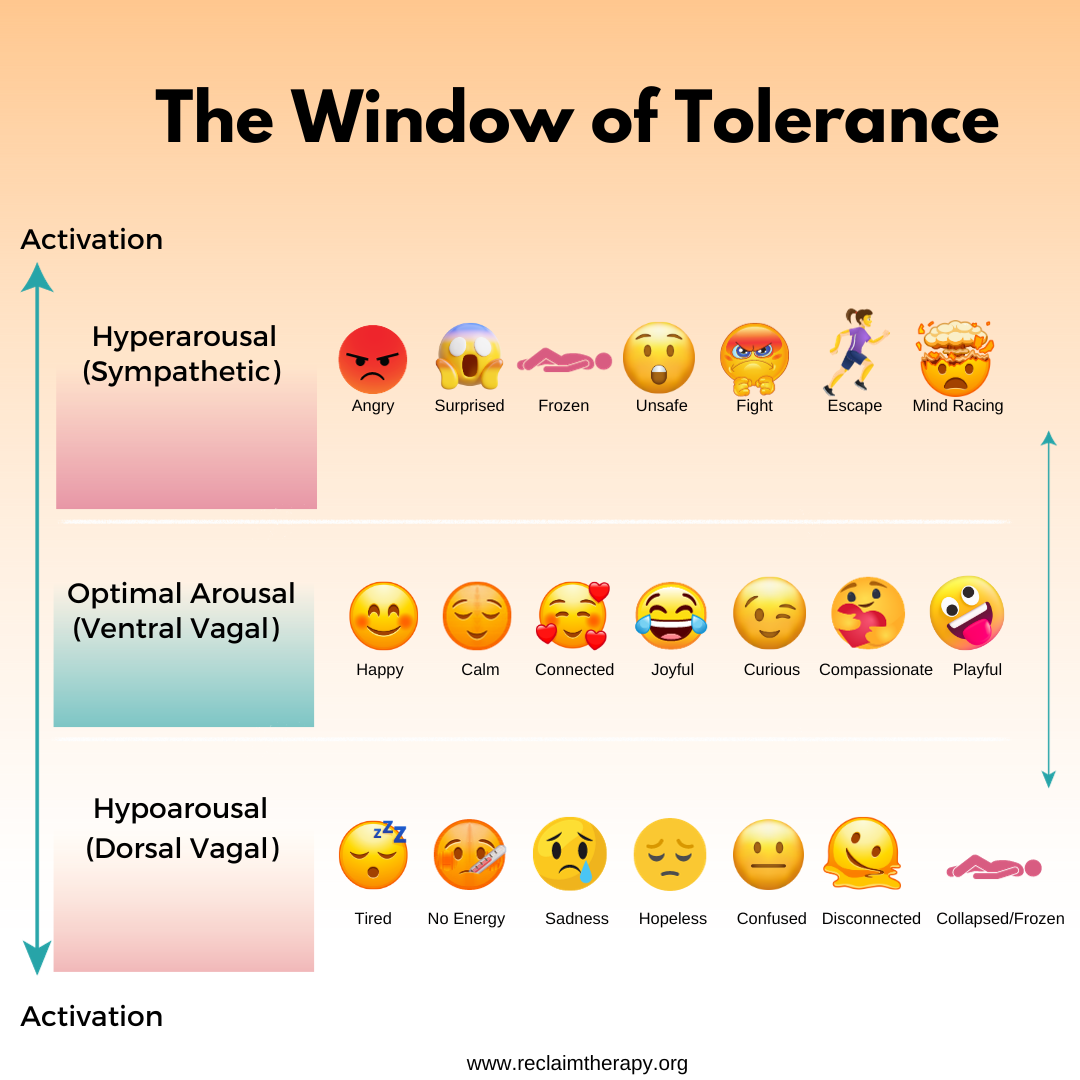
Dr. Dan Siegel coined the term, “window of tolerance,” a concept originally developed by him, to describe the state in which you can process emotions and thoughts comfortably and flexibly. When you’re in this window, you feel grounded, present, capable of handling stress, and can respond to life’s challenges with a varying sense of ease. This state is also referred to as the optimal arousal zone, where you experience just the right amount of stress for effective functioning. When you are in your window of tolerance, you are likely able to move through the world functionally and relationally.
The Impact of Trauma on the Window of Tolerance
When someone has experienced trauma, often times their window of tolerance becomes smaller, making it more challenging to feel, understand and manage intense emotions and life stressors. A traumatic experience can disrupt emotional equilibrium and lead to a narrowed window of tolerance.
Trauma, whether from a single event or prolonged exposure, can overwhelm your nervous system. These experiences disrupt your emotional equilibrium and your sense of safety, pushing your nervous system into a survival state (fight/flight/freeze/fawn). Complex trauma, often originating in childhood, can have a profound impact on emotional regulation and the window of tolerance. Undue stress and extreme stress can overwhelm the nervous system, leading to dysregulation and a range of physiological responses to trauma and stress.
After the experience of trauma, your body (gosh is it smart!) continues to try to prevent additional trauma and overwhelm by shrinking your window of tolerance, so that you stay on guard and protected. This can lead to everyday stressors pushing you outside of your window, often times leading to chronic emotional dysregulation, anxiety, or dissociation. Individuals may experience symptoms such as anxiety, panic, dissociation, and depression as a result of trauma. Recounting traumatic memories or being reminded of a traumatic memory can trigger physiological responses and push someone outside their window of tolerance.
It’s important to remember that your body’s primary job is to keep you alive. And if your body has experienced something, or a series of things, to make it feel chronically unsafe, it will continue to scan everything and everyone to protect itself. This is the impact of trauma. Dissociation can involve a disconnection from conscious awareness as a protective response. Avoidance behaviors, such as substance abuse, are common but maladaptive strategies that can hinder emotional resilience. Feelings matter—accepting and allowing feelings without judgment is important for recovery.
Accepting negative experiences and avoiding judgment or self-criticism helps support emotional regulation and resilience. Self regulation and regulating emotions are key to expanding the window of tolerance. An overloaded parasympathetic nervous system and too little arousal can lead to emotional numbness and shutdown (hypoarousal). Therapists support clients in building resilience and learning to navigate life's challenges. Engaging in activities that are mentally draining increase happiness, such as massage endorphin laughter, crying eating dark chocolate, spicy foods creating music, and sunshine outdoors cold showers, can help expand the window of tolerance. Building awareness focus is a key part of recovery. Read more about trauma triggers here.
The Nervous System’s Role
This reads like a textbook entry. It's informative but completely void of your voice. Let me rewrite it:
Your nervous system is running the show when it comes to how you experience stress, process emotions, and respond to the world around you. And understanding how it works? That's key to understanding your window of tolerance.
The autonomic nervous system has two main branches: the sympathetic nervous system and the parasympathetic nervous system. The sympathetic system is your gas pedal. It kicks in when your brain perceives a threat (real or imagined) and triggers that fight-or-flight response. Heart racing, muscles tensing, mind spinning. That's hyperarousal, and it's what anxiety and panic feel like in your body.
The parasympathetic system is your brake pedal. It helps you calm down, relax, and return to a state where you can think clearly and feel safe. When these two systems are working together well, you can handle stress without getting completely overwhelmed or shutting down entirely. You stay within your window of tolerance.
But here's what happens with trauma, especially complex trauma or PTSD: these systems get thrown out of balance. Your nervous system might get stuck on high alert, constantly scanning for danger even when you're safe. Or it might shut down completely, leaving you feeling numb and disconnected. Either way, your window of tolerance shrinks. Small stressors feel massive. Emotions feel unmanageable. You're either revved up or shut down, with very little middle ground.
This is where trauma therapy comes in. Approaches like somatic experiencing help you reconnect with your body, notice what's happening in your nervous system, and learn to regulate yourself. You start paying attention to physical sensations, using grounding techniques, and building awareness of your emotional responses without immediately reacting to them.
The goal isn't to never feel stressed or triggered. The goal is to expand your window of tolerance so you can handle more without going into fight-flight-freeze or shutting down completely. You learn to notice when you're approaching the edge of your window and use tools to bring yourself back to center.
Building this awareness takes practice. It means learning to observe your emotions and physical sensations without judgment. It means practicing self-compassion when you get dysregulated instead of beating yourself up for it. And it often means working with a therapist who understands trauma and nervous system regulation.
Your nervous system's response to trauma isn't a personal failure. It's a protective mechanism that developed to help you survive overwhelming experiences. But with the right support and tools, you can retrain your nervous system, expand your window of tolerance, and build more capacity to handle stress without falling apart or shutting down.
Healing isn't linear, and it takes time. But every small step you take toward understanding and regulating your nervous system matters.
Why Understanding the Window of Tolerance Matters
Understanding and getting curious about your Window of Tolerance is a helpful step in trauma recovery.
It allows you to:
Normalize Your Experiences: Understanding that your emotional responses make complete sense within the context of trauma can be empowering. It helps you understand that what you're going through is a natural reaction to an abnormal event, or series of events.
Enhance Self-Compassion: Recognizing that trauma can narrow your window of tolerance reminds you to be gentle with yourself. It's okay to have moments of emotional overwhelm; it doesn't mean you're weak or failing.
Develop Ways to Expand Your Window: Trauma therapy near me can help you expand your window of tolerance. By learning grounding techniques, ways to orient and find safety, mindfulness and meditation, and emotional regulation skills, you can widen your capacity to handle triggers and difficult emotions.
What’s On Either Side of Your Window Of Tolerance
Hyperarousal: The Sympathetic Nervous System and the Fight or Flight Response
Hyperarousal occurs when the sympathetic nervous system becomes overactive. This is the body's instinctive response to perceived threats, and it can manifest as:

Increased Heart Rate: Your heart pounds rapidly, preparing your body for action.
Rapid Breathing: You may start to breathe faster and shallower to oxygenate your muscles.
Muscle Tension: Muscles tense up, ready for action or defense.
Anxiety and Panic: An overwhelming sense of fear or panic can take hold.
Irritability: Heightened arousal can make you feel irritable and on edge.
Difficulty Sleeping: Falling and staying asleep can become challenging.
Difficulty Concentrating: It's hard to focus when your body is in this state.
For example, imagine a survivor of a car accident who experiences hyperarousal when they hear loud noises. Their heart races, and they feel a surge of adrenaline, feeling as if they are internally reliving a piece of the traumatic event.
Hypoarousal: The Freeze Response
Hypoarousal, on the other hand, occurs when the dorsal vagal branch of the nervous system takes over, leading to a "freeze" response. Symptoms of hypoarousal include:
Numbness: You may feel emotionally numb, disconnected from your surroundings.
Dissociation: Your mind may disconnect from the present moment, leading to a sense of unreality.
Fatigue: Hypoarousal can be mentally and physically exhausting.
Depression: Prolonged hypoarousal can lead to feelings of hopelessness and depression.
Difficulty Initiating Tasks: It becomes challenging to start or complete tasks.
Memory Difficulties: You might have trouble remembering details or events.
For instance, consider someone who survived a prolonged period of abuse. They may experience hypoarousal when they encounter a situation that triggers memories of their trauma, leading to emotional numbness and a sense of disconnection.
Expanding Your Window of Tolerance for Emotional Regulation
Expanding your window of tolerance is a part of trauma treatment that is a practice and most often invites patience and practice.
Here are some strategies that can help:
Mindfulness and Breathing: Learning to stay present and regulate your breath can be powerful tools. They anchor you in the moment and can prevent you from getting pushed outside your window.
Body Awareness: As trauma therapists, we know that trauma is stored in the body, which is why our nervous systems react in the ways that they do in the wake of traumatic experiences. Practices like yoga or somatic experiencing can help release stored tension and increase your bodily awareness.
Seeking Professional Help: Working with a trauma-informed therapist is essential. They can guide you through the process, providing support and strategies tailored to your unique needs.
Self-Care: Incorporate self-care routines into your life. Activities like journaling, art, or spending time in nature can help you stay within your window of tolerance.
Connecting with Supportive Communities: Engaging in safe, authentic and supportive relationships allows you to naturally come back into a portion of your window of tolerance. Imagine how you feel when you feel seen, heard, affirmed and validated. This is the power of supportive relationships and communities.
Grounding Exercises: Using grounding exercises, such as noticing your feet on the floor or focusing on objects around you, can activate your senses and help you reconnect with the present moment, especially when experiencing hypoarousal.
Remember, expanding your window of tolerance is not about eliminating distress but rather increasing your ability to manage activation and deactivation in your nervous system, noticing when you are experiencing hypervigilance and/or hypovigilance and supporting yourself to come back to sense of regulation, or your window.

Understanding and mapping your own Window of Tolerance is a tool that can help you navigate the ups and downs of your emotional experiences with greater understanding ease.
Grab our new worksheet, Mapping Your Window of Tolerance, here.
Recovery from trauma is a unique and deeply personal journey, and the team here at Reclaim is here to support you every step of the way. With a trauma therapist in Horsham, PA, you can explore the impact that trauma has had on your window, work to feel into and expand it, and help you reclaim just how strong, resilient and deserving of healing you always have been.
Here whenever you’re ready.
🧡,

Looking for a trauma therapist near me or an EMDR therapist ?
Working with a trauma therapist or an EMDR therapist can be support you in your healing from overwhelming life experiences. Here at Reclaim Therapy provide PTSD therapy near me and we believe in people’s worthiness to Reclaim their lives from traumatic life experiences. We provide EMDR therapy for trauma and EMDR therapy for eating disorders. We provide online therapy in Pennsylvania and in person therapy in Horsham, PA.
Ready to get started?