
Grounding Exercises vs Container Exercises in Trauma Therapy
Here’s something that comes up in my therapy office quite a bit: someone learns a grounding technique, tries to use it when they’re overwhelmed, and then feels frustrated because it “didn’t work.”
Or, they’ll tell me they’ve been putting everything in their mental container for weeks, and now they just feel like they’re avoiding their feelings.
Sound familiar?
The thing is, grounding exercises and container exercises aren’t interchangeable. Grounding techniques work by helping people stay present and disconnect from overwhelming emotions like anxiety, distress, or depression, using senses and visualization to interrupt stress responses and promote emotional regulation.
They do completely different things. And knowing which one to use when can make the difference between actually feeling better and spinning your wheels.
What Grounding Exercises Actually Do for the Present Moment
To begin grounding exercises, start by finding a comfortable position that allows you to relax and focus.
Grounding techniques bring you into the present moment. That’s it. That’s the whole job.
When you’re having a flashback, feeling anxious, stuck in a panic attack, or dissociating, your nervous system thinks the trauma is happening right now. Grounding exercises help your brain realize: no, you’re actually safe. You’re in your living room. It’s 2025. The threat isn’t here anymore.
Take a few moments to focus on your sensory experiences—notice what you can see, hear, or feel around you. This intentional pause can help you become more present and manage your emotions.
Think of grounding like this: you’re watching a horror movie in your mind, and grounding helps you remember you’re sitting in a theater. The movie’s not real. You can walk out into daylight whenever you’re ready.
There are various techniques for grounding, such as the 5-4-3-2-1 method, deep breathing, or holding a comforting object. Choose a technique that makes you feel comfortable and fits your needs.
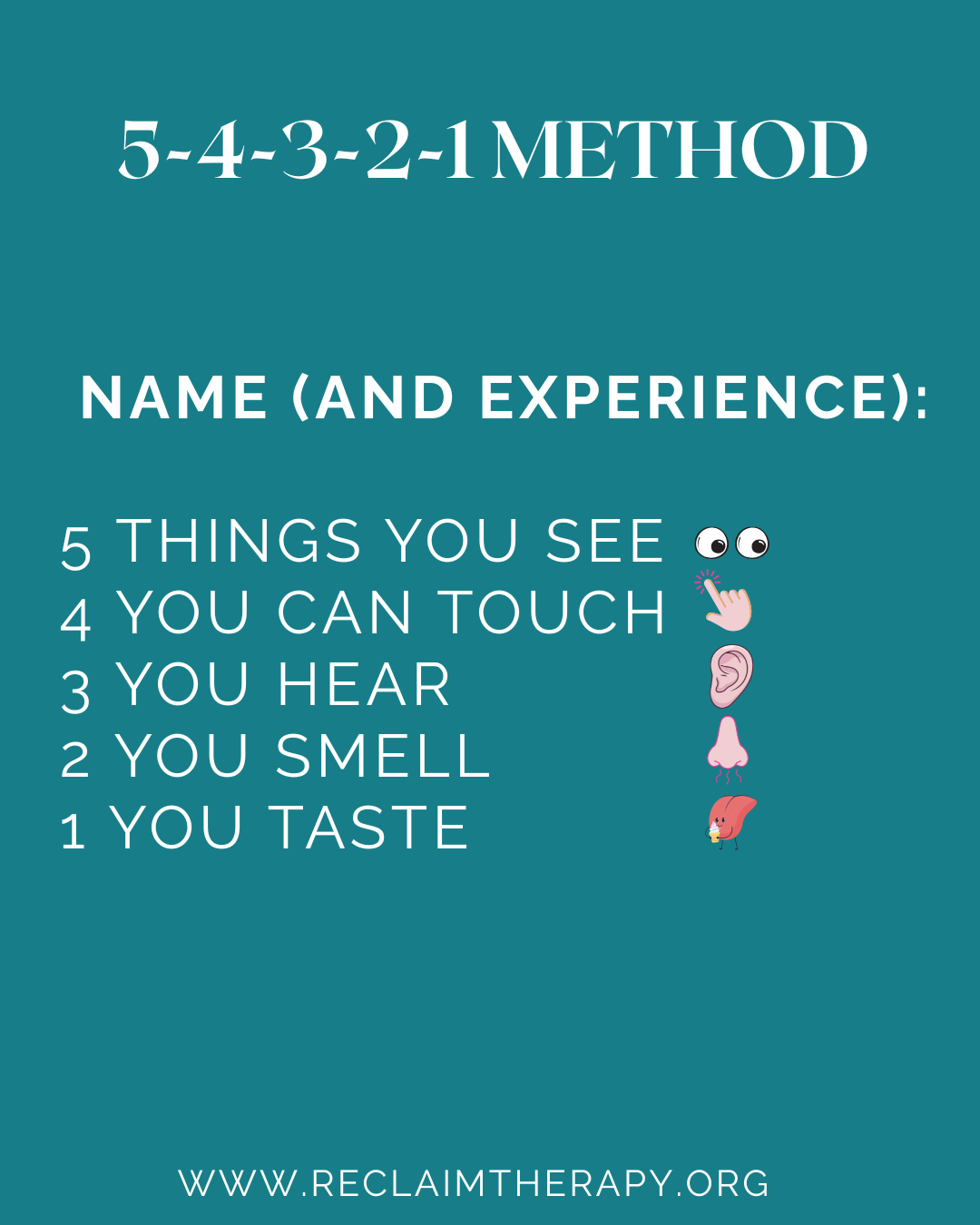
The 5 4 3 2 1 method is a common grounding technique. Here are some others:
The 5-4-3-2-1 method (name 5 things you see, 4 you can touch, 3 you hear, 2 you smell, 1 you taste). To make this exercise more engaging, you can choose categories—such as musical instruments, ice cream flavors, or types of animals—and identify items within those categories. For example, you might name 5 musical instruments you see in your room (like a guitar or piano), 4 textures you can touch (such as smooth wood or soft fabric), 3 sounds you hear (like a clock ticking or birds outside), 2 scents you notice (maybe coffee or fresh air), and 1 taste (such as mint gum).
Pressing your feet into the floor
Holding ice cubes
Describing your surroundings out loud
Focusing on your breath
These work because they activate your senses and pull your attention away from internal chaos and back to external reality. Whether you’re dealing with PTSD, complex trauma, or generalized anxiety, grounding techniques for anxiety help regulate your nervous system by proving to your body that you’re safe right now.
What Container Exercises Actually Do
Container exercises, also known as the container technique, do the opposite. They are a practical tool for emotional regulation, helping you temporarily set difficult emotions, memories, or thoughts aside so you can function right now.
This isn’t about avoiding your feelings forever. It’s about saying, “I see you, I know you’re there, but I can’t deal with you while I’m at work/driving/taking care of my kids. I’ll come back to you later.” The container technique is especially useful for managing emotional distress by providing a safe mental space to store overwhelming feelings until you are ready to address them.
In EMDR therapy, we use the container technique during the preparation phase to help people build a sense of control before they start processing trauma. You imagine a strong, secure container (a vault, a chest, a locked box, whatever feels right to you based on personal preference), and you visualize placing overwhelming material inside it until your next therapy session. It’s important that the container feels personal and meaningful to you. When the container feels like it’s truly yours, it enhances its calming effect on your nervous system. The container is used to store difficult emotions temporarily, allowing you to set aside challenging feelings or thoughts until you are ready to process them. You can also use the container to store good feelings or positive memories for later recall, making it a versatile tool for both soothing and support.
The container exercise helps with:
Intrusive thoughts between therapy sessions
Overwhelming emotions that pop up at inconvenient times
Racing thoughts when you’re trying to sleep
Managing triggers when you’re in public and can’t fully process what’s coming up
Here’s what’s important: the container is temporary storage. You’re not throwing things away. You’re parking them until you have the time, space, and support to actually deal with them.
Working with an EMDR Therapist
I'm not going to tell you that EMDR therapy is some magical cure-all, but I will say this: finding the right therapist who actually gets trauma? That changes things.
When you're drowning in overwhelming emotions and traumatic memories keep yanking you back to moments you'd rather forget, you need more than someone nodding along while you talk. You need actual tools. Real strategies that work when your nervous system is screaming and your brain won't shut up.
That's where something like the container exercise comes in. My EMDR therapist taught me this technique, and honestly, at first I thought it sounded a little woo-woo. The idea is basically this: you imagine putting all the heavy shit you can't deal with right now into a container. I pictured a locked trunk. Some people use a safe, a box, whatever works. The point isn't the container itself but what it gives you permission to set something down without abandoning it completely. You're not avoiding or shoving things away forever. You're just saying "not right now" so you can actually function today.
And here's the thing: it actually works. Not because it's some mystical practice, but because your brain needs boundaries around trauma. You can't process everything all at once without completely falling apart.
Grounding techniques became just as essential. My therapist would walk me through them during sessions, noticing where my feet touched the floor, taking intentional breaths, naming what I could see and hear around me. When you're triggered or anxious, your brain thinks you're in danger. Grounding reminds your body that you're here, now, and you're actually safe.
The more I practiced these techniques outside of therapy, the more automatic they became. Progressive muscle relaxation, guided visualization, all of it. These aren't quick fixes, but they do add up. You start to notice that you can create some space between yourself and the panic. Between yourself and the memories.
What I valued most about working with my EMDR therapist wasn't just learning techniques. It was having someone who treated me like a whole person, not a diagnosis. Someone who adjusted their approach based on what I actually needed, not what some treatment manual said should work.
Healing from trauma isn't linear. Some days you'll feel like you're back at square one. But when you've got the right support and you're actually using these tools, the container exercise, grounding techniques, all of it, you'll start to notice shifts. The intrusive thoughts lose some of their power. The anxiety doesn't take over quite as often. You get more moments of actual peace.
That's what I'm talking about when I say EMDR therapy and these techniques matter. Not because they're perfect, but because they give you back some agency in your own nervous system.
So When Do You Use Which One?
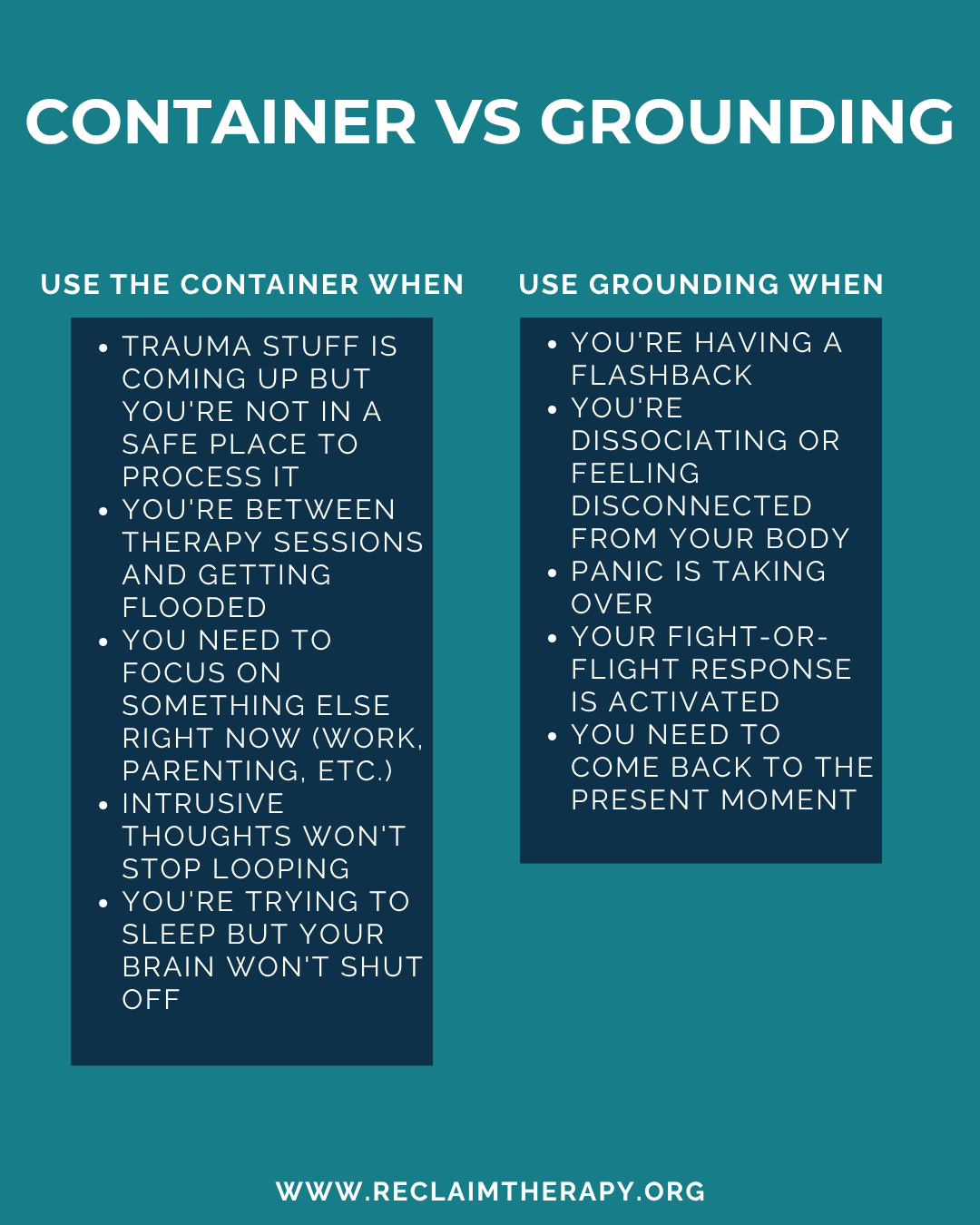
Use grounding when:
You’re having a flashback
You’re dissociating or feeling disconnected from your body
Panic is taking over
Your fight-or-flight response is activated
You need to come back to the present moment
You feel upset and need to manage emotional distress
Use the container when:
Trauma stuff is coming up but you’re not in a safe place to process it
You’re between therapy sessions and getting flooded
You need to focus on something else right now (work, parenting, etc.)
Intrusive thoughts won’t stop looping
You’re trying to sleep but your brain won’t shut off
Sometimes you’ll use both. You might use grounding techniques for PTSD symptoms first to calm your nervous system, then use the container to set aside what came up so you can keep moving through your day. This combination supports both emotional regulation and practical functioning. When you revisit what you stored in the container, it can provide valuable insights and support personal growth.
The Mistake People Make
One of the biggest issue I see? People use the container as their only tool. They get really good at shoving things down, and then they wonder why they feel numb or why everything eventually explodes.
The container isn't meant to replace feeling your feelings. It's meant to give you agency over the timing.
Military folks, first responders, doctors, people in high-stress jobs, they often become experts at compartmentalizing. And that skill saves them in the moment.
But if you never open the container and actually process what's inside, it catches up with you. That's why those professions have such high rates of PTSD, divorce, and burnout.
On the flip side, if you only ground and never contain, you might find yourself getting triggered at really inconvenient times and not having a way to temporarily manage it so you can get through your day.
Here's What Actually Helps
Practice both skills when you're calm.
Seriously.
Don't wait until you're in crisis to try grounding for the first time. It's like trying to learn how to swim while you're drowning.
Work with a trauma therapist who can help you know when to use each tool. Someone who understands that grounding isn't a cure and containment isn't avoidance. Both are just skills in your toolbox for nervous system regulation.
And remember, the goal isn't to never feel overwhelmed. The goal is to have options for what to do when you are.
Your nervous system has been through a lot. These techniques give you ways to work with it instead of against it. That's not about being perfect at regulating yourself. It's about having choices you didn't have before.
TLDR; Frequently Asked Questions
What's the difference between grounding and containment?
Grounding brings you into the present moment when you're dissociating, having flashbacks, or feeling panicked. Containment helps you temporarily set aside overwhelming emotions or memories until you're in a safe place to process them. Think of grounding as "come back to now" and containment as "save this for later."
Can I use the 5-4-3-2-1 technique for panic attacks?
Yes. The 5-4-3-2-1 technique is one of the most effective grounding techniques for anxiety and panic attacks. By engaging all five senses, you interrupt the panic response and redirect your brain's attention to your immediate surroundings, which helps calm your nervous system.
Is using a container the same as avoiding my feelings?
No. Avoidance means never dealing with your feelings. The container is temporary storage with the intention of coming back to process those feelings later, ideally with support from a therapist. The key difference is that containment is intentional and time-limited, while avoidance is indefinite.
How often should I practice these techniques?
Practice both when you're calm, not just in crisis. Try grounding exercises daily for a few minutes, and familiarize yourself with the container visualization when you're regulated. This makes them much more effective when you actually need them during distressing moments.
Ready to Build Your Trauma Recovery Toolkit?

Learning these techniques is a start, but trauma recovery works best when you're not doing it alone.
If you're in the Montgomery County Pennyslvania area and looking for support with complex trauma, PTSD, or CPTSD, we’d love to help you figure out which tools actually work for your nervous system.
At Reclaim Therapy, we specialize in EMDR, and providing trauma therapy, and helping you move from just surviving to actually living.
🧡,

Reclaim Therapy is a small trauma therapy practice in Horsham, PA
We specialize in providing EMDR Therapy near me, therapy for complex PTSD, therapy for eating disorders and PTSD treatment. We are passionate about helping people reclaim their lives from the impact of trauma, disordered eating and toxic-shame.