
You've done it again.
You just spent two hours listening to your friend’s breakup drama, gave thoughtful advice, held space for all their feelings. And now you’re sitting in your car feeling… empty. Exhausted. Like you just ran a marathon you didn’t sign up for. It’s not just tiredness—you might notice a kind of mental confusion or 'brain scramble' as you try to make sense of your own feelings after these interactions.
And here’s the kicker: when they asked “But how are YOU doing?” you said “I’m good!“ without even thinking about it.
This isn’t the first time.
It’s every time.
You’re everyone’s safe person, the one people come to when they’re falling apart. But when it comes to your own feelings? They stay locked up tight.
And you’re not even sure why.
If this pattern feels painfully familiar, there’s a good chance you’re an adult child of emotionally immature parents.
And that phrase might feel too big, too clinical, too much like you’re making a problem out of nothing. Because your childhood wasn’t that bad, right? Your parents loved you. They provided for you. It could have been so much worse. Sometimes, you might even find yourself holding onto 'healing fantasies'—hoping your parents would change or finally become emotionally supportive.
Right?
But here’s what nobody tells you… emotional immaturity in parents doesn’t have to look dramatic to leave a mark. It doesn’t have to be abuse to create patterns that follow you into every relationship you have. In fact, these subtle patterns are often easy to overlook because they aren’t obvious, and people tend to turn a blind eye to them.
Sometimes it’s quieter. More subtle. The kind of thing that taught you to be the emotional caretaker while your own inner world went completely unseen.
What are Emotionally Immature Parent?
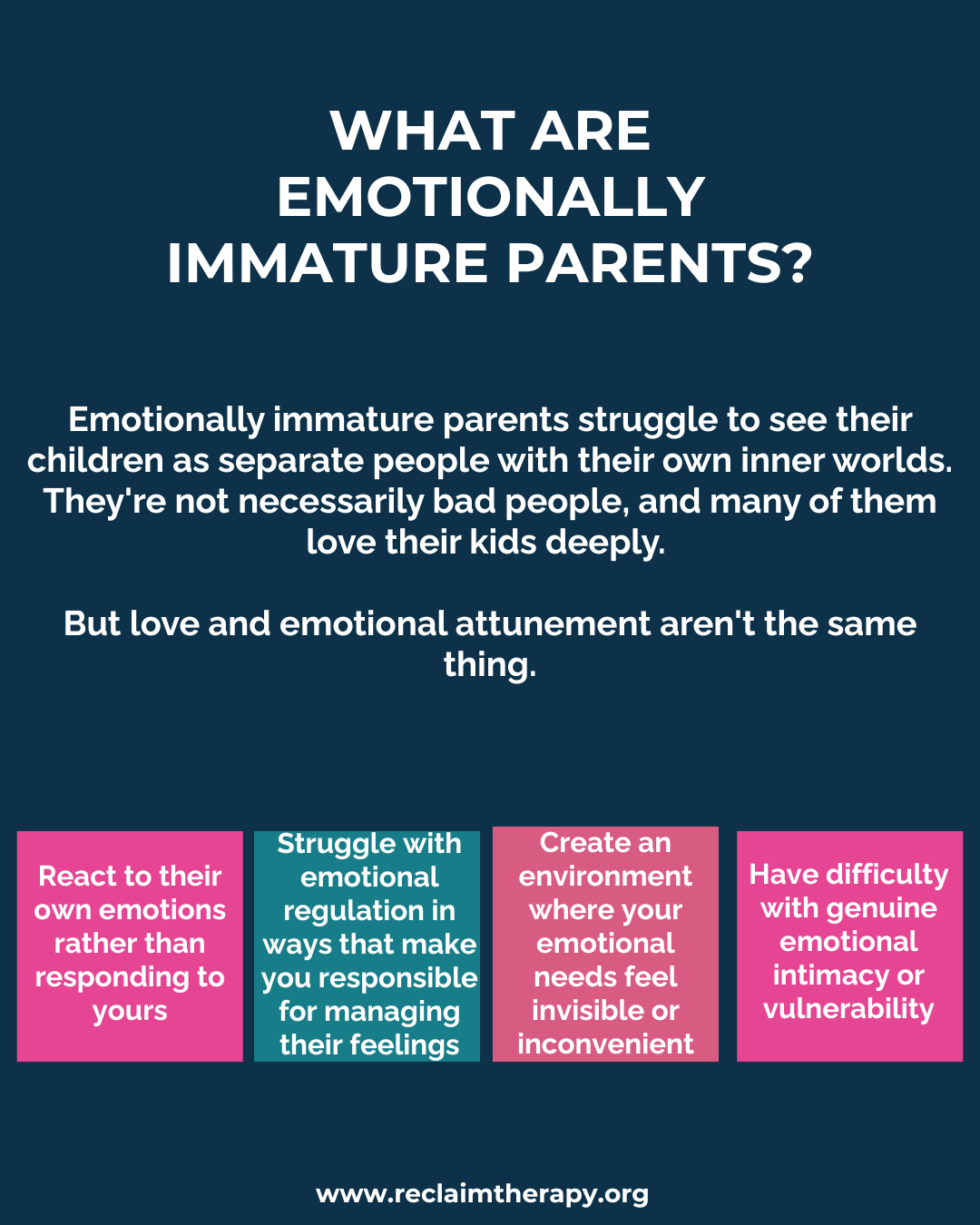
Emotionally immature parents struggle to see their children as separate people with their own inner worlds. They’re not necessarily bad people, and many of them love their kids deeply. But love and emotional attunement aren’t the same thing. Their emotional immaturity can show up in such a way that it’s hard to pinpoint, but the effects are lasting.
These parents often:
React to their own emotions rather than responding to yours
Struggle with emotional regulation in ways that make you responsible for managing their feelings
Create an environment where your emotional needs feel invisible or inconvenient
Have difficulty with genuine emotional intimacy or vulnerability
The result?
Kids who grow up learning to dismiss their own emotions, manage everyone else’s feelings, and wonder why they feel so lonely even when they’re not alone.
Psychologist Lindsay Gibson, who wrote the book on this (Adult Children of Emotionally Immature Parents), a New York Times bestseller, identified four distinct types of emotionally immature parents.
And understanding which type (or types) you grew up with can help you make sense of patterns you’re still carrying. Gaining these new insights into your childhood can be transformative, helping you validate your experiences and move toward healing.
Understanding Emotionally Immature Parents
Sometimes I wonder if the enemy gets ahold of our hearts when we're little, you know? Growing up with parents who couldn't handle their own feelings... Lord, it was like living in a house where the emotional weather changed without warning. My mama and daddy, bless their hearts, they just couldn't seem to get close to us kids. Instead of drawing near, they'd pull back, leaving me feeling invisible and so desperately lonely. When your own parent is too wrapped up in their own world to really see you - I mean truly see your little heart - it creates this emptiness that's hard to put into words.
I've been thinking a lot lately about how many of us grew up this way. Whether your parent was the emotional type who couldn't control their feelings, or the driven one always chasing something else, or maybe the passive one who just checked out, or even the rejecting one who pushed you away... the common thread is that we never got that real connection our souls were crying out for. These parents, God love them, they just didn't have the empathy or self-awareness to recognize that we were our own little people with our own big feelings and needs. It breaks my heart thinking about all the children who grew up feeling unseen.
The thing is, this kind of childhood doesn't just stay in childhood - it follows you around like a shadow well into your grown-up years. I see it in myself and so many others: that low sense of worth, that persistent ache of loneliness, the struggle to form healthy relationships because you never learned what that looked like. But here's what I'm learning - recognizing these patterns is where healing begins. Jesus sees what we went through, even if our parents couldn't. Understanding how our childhood is still whispering lies in our adult hearts? That's the first step toward freedom, friend.
You learned to make room for everyone else. You can learn to make room for yourself, too.
Growing up with an emotionally immature parent can shape how you respond to conflict, closeness and your own needs long after childhood.
Our trauma therapists help adults understand these patterns, reconnect with their own emotional experience and build relationships that feel safer and more mutual.
In-person in Horsham, PA and virtually throughout Pennsylvania.
The Four Types of Emotionally Immature Parents
1. The Emotional Parent
This is the type of emotional parents whose feelings flood the room. Everything is big, intense, reactive. Their emotional state becomes the weather system the whole family has to track, and the parents' moods affected the whole house. It may seem like they crave emotional closeness, but they typically aim to support their own life over others.
Maybe your mom would go from laughing to sobbing to raging within an hour, and you learned to read her mood the second you walked in the door. Maybe your dad’s anxiety meant you were constantly reassuring him, telling him it would be okay, managing his fear about… everything.
These emotional parents struggle with emotional regulation in a way that puts their kids in the position of being the emotional caretaker. You weren’t allowed to be the child with big feelings, because there wasn’t room. Someone had to be the stable one, and that someone became you.
This creates a specific kind of emotional unavailability where the parent is drowning in their own emotions but can’t actually attune to yours. You learned early that your job was to stay calm, be the grown-up, and keep everything from falling apart.
It’s a textbook setup for parentification, where kids end up parenting their own parents.
2. The Driven Parent
Driven parents are a specific type of emotionally immature parent. The driven parent is all about achievement, productivity, performance. Everything is a project. Every conversation has an agenda.
Feelings are inefficient.
This parent might have been successful, respected, admired by everyone outside the family. But at home? Emotional intimacy felt like pulling teeth. They were busy, focused, always working toward the next goal. And your worth became tied to what you accomplished, not who you were.
Maybe your dad only seemed proud when you brought home good grades or won the game. Maybe your mom was so focused on her career that you learned not to bother her with “small” things like how you were feeling about the fight with your best friend.
Driven parents are often highly goal-oriented, controlling, and enmeshed with their children’s achievements. This can lead to perfectionism, guilt, and emotional detachment in their children. These parents often create an invalidating environment where emotions are seen as distractions from what really matters: doing, achieving, performing. You learned that love was conditional on productivity. That being “too much” emotionally was a problem. That your feelings were obstacles to overcome, not signals to pay attention to.
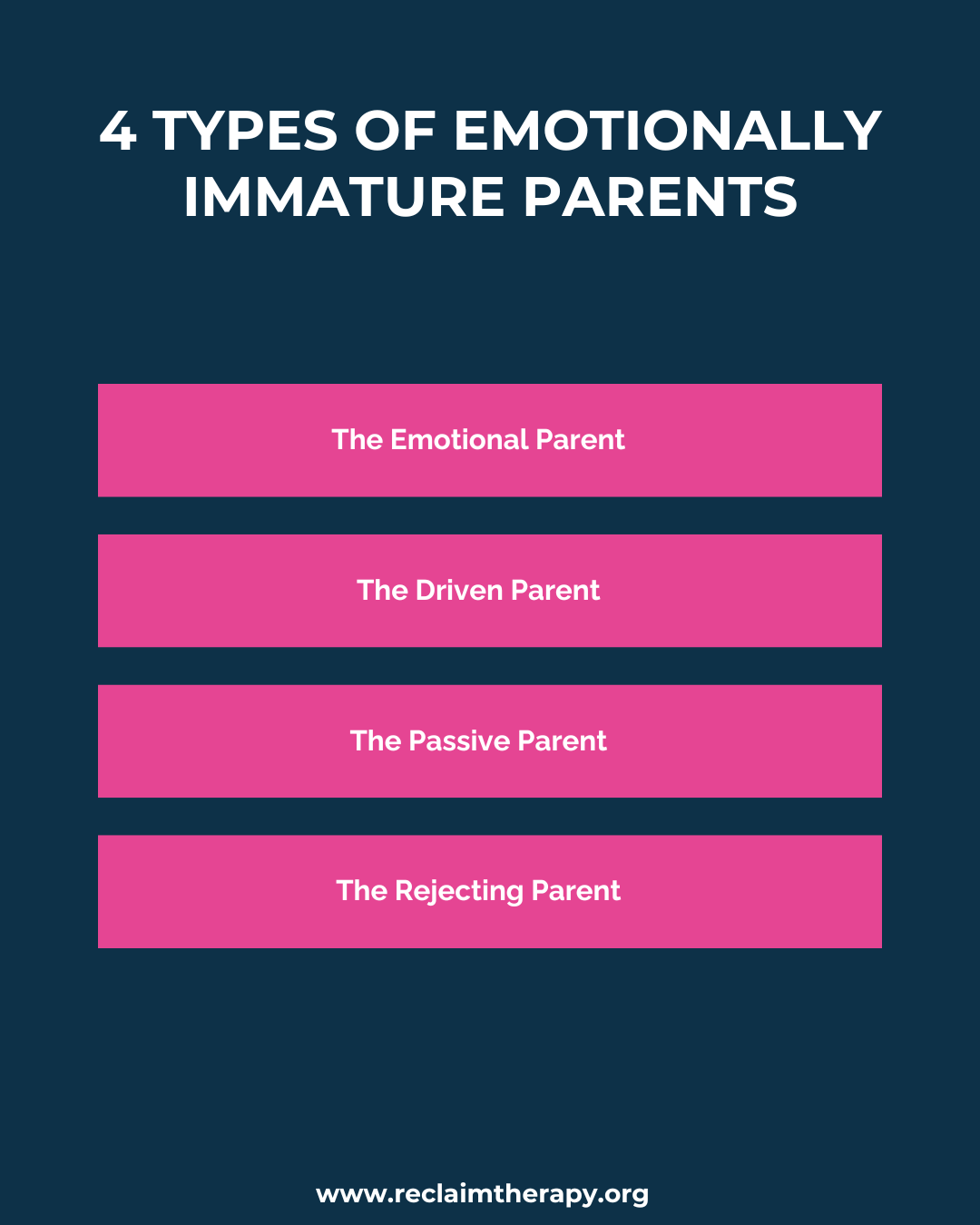
3. The Passive Parent
This is the parent who's... there, but not really there.
Physically present but emotionally checked out. The one who didn't protect you from the other parent's emotional immaturity. The one who "kept the peace" by going along with whatever, even when it hurt you.
Maybe your mom knew your dad's anger was a problem but never stepped in. Maybe your dad watched your mom criticize you relentlessly and said nothing. Maybe they were so conflict-avoidant that you learned your needs weren't worth the discomfort of standing up for you.
Passive parents often seem like the "nice" parent, the easier one. But their emotional unavailability is just as damaging because you learned that no one was going to show up for you. That you were on your own. That your feelings and needs weren't important enough to fight for.
This type of parenting can create deep emotional loneliness because you're living in a house with people who love you, but you're still fundamentally alone with your inner world.
4. The Rejecting Parent
Rejecting parents are a type of emotionally immature parent who are emotionally unavailable or dismissive, often detaching from their children and rejecting emotional connection. The rejecting parent is the one who makes you feel like you’re too much, too needy, too sensitive, too everything. They’re critical, dismissive, sometimes openly hostile to your emotional needs, and may show signs of mockery or quick anger.
Maybe your parent rolled their eyes when you cried. Maybe they told you to “toughen up” or “stop being so dramatic” when you were hurt. Maybe they made jokes at your expense and called it “just teasing” when you said it bothered you.
These parents create shame around having needs at all. You learned that reaching out for connection or comfort was a risk. That being vulnerable meant being ridiculed or rejected. That the safest thing to do was to need nothing from anyone.
This is often the most obvious form of emotional immaturity, but it’s also the one that makes people feel the most guilt for being angry about it. Because these parents often had their own trauma, their own hard childhoods. And you learned to excuse their behavior even as it wounded you.
How Emotionally Immature Parenting Creates Emotional Loneliness
Here's what happens when you grow up with self-involved parenting: you learn to be alone with yourself even in relationship with others.
You develop this deep belief that your inner world is either too much or not interesting enough to share. You become hypervigilant about other people's emotions while being disconnected from your own. You're the friend everyone calls in a crisis, but you're not sure how to ask for help yourself.
This is emotional loneliness. Not the absence of people, but the absence of being truly seen and known.
And it doesn't just go away when you become an adult. It shows up in your relationships, your work, your parenting. It shows up in that moment at dinner when your partner asks how you're feeling and you freeze.
Signs You May Have Grown Up with an Emotionally Immature Parent
You might still be carrying the effects of emotionally immature parenting if:
You struggle to identify or express your own emotions. Someone asks how you feel and you genuinely don't know. Or you know, but sharing it feels dangerous or pointless.
You're constantly managing other people's emotions. You can read a room in seconds. You know what everyone needs. But your own needs feel foggy or impossible to articulate.
You feel responsible for other people's feelings. When someone's upset, you immediately think about what you did wrong or how you can fix it, even when it has nothing to do with you.
You minimize your own experiences. "It wasn't that bad." "Other people have it worse." "I don't want to make a big deal out of nothing." These phrases are on repeat in your head.
You have a hard time trusting that people actually want to hear about your life. You share the highlights, the funny stories, the stuff that makes you seem fine. But the messy, vulnerable, stuff? That stays hidden.
Relationships feel like you're performing rather than connecting. You know how to be the partner, the friend, the employee everyone wants. But you're not sure anyone knows the real you.
You experience physical symptoms of stress without understanding why. Your body keeps score even when your mind has moved on. Headaches, stomach issues, muscle tension, all showing up without an obvious cause.
The Experience of an Adult Child
Sometimes you catch yourself wondering how much of who you are today comes from those early years when your parents couldn't handle their own emotions, let alone yours.
Now, as an adult, you struggle with things that seem so simple to everyone else. Setting boundaries feels impossible. Putting your needs first triggers this immediate guilt, like you're doing something wrong just by taking up space.
You spent years managing everyone else's moods, trying to keep the peace so things wouldn't spiral into chaos. You learned fast that your feelings didn't matter as much as keeping everyone else comfortable. So you shoved them down. Way down. Because expressing what you actually felt meant risking an outburst, a guilt trip, or being told you were too sensitive, too much, too dramatic.
That weight shows up everywhere now. In relationships where you lose yourself trying to keep the other person happy. In friendships where you're always the one accommodating. In a nervous system that's constantly scanning for danger, waiting for the next emotional explosion even when there isn't one coming.
The research is pretty clear on this: people who grew up in emotionally volatile or neglectful homes are at higher risk for anxiety, depression, and complex trauma responses. You learned early that your job was to regulate everyone else's emotions, not your own. And that pattern doesn't just disappear when you turn 18.
But, recognizing this pattern is the first step toward changing it. It's uncomfortable, yeah. Sometimes it feels worse before it feels better because you're finally seeing how much you've been carrying. But you can't heal what you can't see.
You can learn that your feelings actually do matter. That your needs are valid. That you're allowed to put yourself first without being selfish. It takes time, and it takes work, but it's possible.
How to Heal from Emotionally Immature Parenting
Healing from childhood emotional neglect isn’t about blaming your parents or dwelling in the past. It’s about learning to do for yourself what wasn’t done for you growing up.
Start noticing your own emotional experience. This sounds simple, but it’s revolutionary if you’ve spent your whole life dismissing your feelings. Set a timer three times a day and just check in: What am I feeling right now? Where do I notice it in my body? No judgment, no fixing, just noticing.
Practice emotional validation with yourself. When you notice a feeling, try saying “It makes sense that I feel this way” instead of “I shouldn’t feel this way.” Your feelings don’t need to be logical or convenient to be valid.
Find relationships where emotional intimacy is possible. This might mean therapy (EMDR Therapy and somatic work can be particularly helpful for rewiring these old patterns). In therapy, a skilled clinician will hold space for you, providing a supportive and non-judgmental environment where you can heal and grow. It might mean finding friends who can handle your real feelings, not just your highlight reel. It might mean slowly learning to share more of yourself with your partner.
Grieve what you didn’t get. You deserved parents who could see you, attune to you, make space for your inner world. You didn’t get that, and that loss matters. Letting yourself feel sad or angry about it isn’t self-pity. It’s honoring your experience.
Learn that enmeshment isn’t intimacy. If you grew up with an emotional parent, you might confuse intensity with connection. Real intimacy isn’t about managing someone else’s emotional state. It’s about two people showing up as themselves, seeing each other clearly, and choosing to stay.
Work with a therapist who understands developmental trauma. Because here’s the truth: you can’t think your way out of patterns that were wired into your nervous system before you had words for what was happening. Look for a therapist with a background in clinical psychology and specialized training in trauma or childhood emotional neglect. Somatic therapy, EMDR, and Internal Family Systems work can help you heal at the level where the wound actually lives.
Your childhood might not have looked traumatic from the outside.
Looking for a trauma therapist in Pennsylvania to support you?

Your parents might have been good people doing their best.
But if you grew up feeling emotionally alone, managing everyone else's feelings, and learning that your inner world didn't really matter... that was real. And it shaped you in ways that deserve attention and care.
The good news?
You're not stuck with these patterns forever. Your nervous system is capable of learning new things. You can develop the emotional attunement that you didn't receive. You can learn to trust that your feelings matter, that vulnerability isn't dangerous, that you're allowed to take up space.
It just takes time, practice, and a lot of compassion for the kid you were who figured out how to survive in an emotionally immature environment.
You're not too much. You were never too much. You just needed more than they could give.
And now you get to learn how to give that to yourself. Reach out for a free consultation to get started with a trauma therapist who can support your healing.
🧡,

Looking for a trauma therapist near me to support you?
Reclaim Therapy is a specialized trauma therapy and EMDR Therapy practice in Horsham, PA. We provide trauma and EMDR Therapy for PTSD, CPTSD and eating disorders. We believe that all people are worthy of reclaiming their lives from the impact of trauma.
Ready to get started with a trauma therapist?