
How Childhood Emotional Neglect Creates CPTSD
If you grew up in a home where your feelings were ignored, minimized, brushed off, or simply too much for the adults around you, you probably already know what emotional neglect feels like in your body.
It shows up as a hollowness you can’t quite name. A loneliness you carry even when you’re surrounded by people who love you. A sense that you should be fine on paper, but inside… something still hurts.
Childhood emotional neglect is quiet. Invisible. Easy to dismiss.
Childhood Emotional Neglect (CEN) leaves an enduring imprint on an individual's mental well-being, often paving the way for Complex Post-Traumatic Stress Disorder (CPTSD) and impacting long-term mental health.
Which is exactly why so many adults don’t realize they lived through trauma.
Today we’re naming what really happened, what it did to your nervous system, and how chronic emotional neglect can develop into complex post traumatic stress (CPTSD) over time.
What Childhood Emotional Neglect Really Is
People often expect trauma to look like chaos, violence, or big explosive moments.
Emotional neglect is different.
It happens when no one sees your inner world. No one notices your fear, your confusion, your tears, or your joy. No one teaches you how to name what you feel or helps your little nervous system make sense of what is happening inside you. Emotional neglect is characterized by the absence of emotional attunement, leaving the child's emotional needs unmet. When a child's emotional development is shaped by this lack of attunement, they may grow up feeling emotionally neglected.
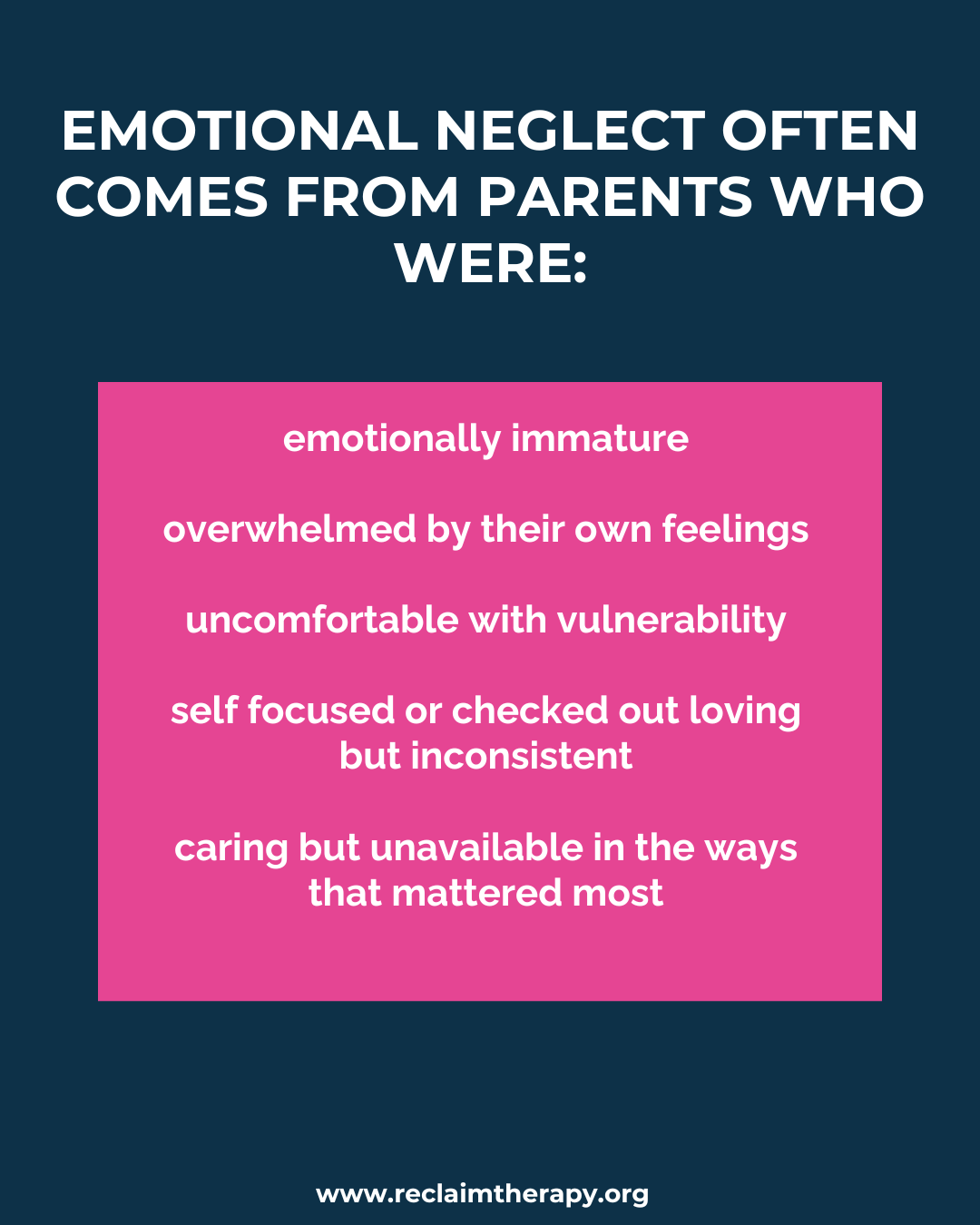
Emotional neglect often comes from parents who were:
overwhelmed by their own feelings
uncomfortable with vulnerability
self focused or checked out
loving but inconsistent
caring but unavailable in the ways that mattered most
You may have had clothes, food, birthday parties, and a ride to soccer practice.
What you might not have had was a parent who said:
“I see you.” “You make sense.” “I’m right here.”
That hunger for emotional connection gets carried into adulthood, long after the original moments of being unseen.
Is Childhood Emotional Neglect Trauma?
Trauma is not only what happened to you. It is also what should have happened but did not.
Children need emotional attunement. They need co-regulation. They need someone who helps their nervous system learn what safety feels like.
When that doesn’t happen, the body adapts in protective ways. Ongoing emotional deprivation can create a form of traumatic stress, and childhood emotional neglect can serve as a contributing factor to the development of CPTSD, as the emotional deprivation experienced becomes a chronic stressor. These adaptations kept you afloat as a child, but they take a toll over time.
Especially when repair never comes.
Emotional neglect is a chronic form of relational deprivation.
Chronic means repeated. Repeated means the nervous system rewires around it.
This is the foundation of complex trauma. Complex post traumatic stress disorder (CPTSD) emerges from prolonged exposure to traumatic events, particularly during childhood—a pattern often seen in cases of ongoing emotional neglect. This ongoing relational trauma is referred to as complex post traumatic stress.
Not a single event.
A lifetime of unmet emotional needs.
How Emotional Neglect Shapes the Developing Nervous System
A child’s nervous system grows inside a relational environment. When that environment is emotionally cold, inconsistent, or confusing, the body learns to survive instead of thrive. In response to chronic emotional neglect, the nervous system rewires its neural pathways, adapting to the lack of emotional support and safety.
The cumulative effect of childhood emotional neglect can manifest as a range of symptoms synonymous with CPTSD, including emotional dysregulation and challenges in forming and maintaining relationships.
Here are the three patterns we see most often.
Hyperarousal
The body stays on high alert. These symptoms can include:
chronic anxiety
hypervigilance
perfectionism
overthinking every interaction
trouble sleeping
the feeling of being “wired but tired”
emotional dysregulation
Hypoarousal
The body goes numb to cope. This becomes:
checking out
emotional numbness
fatigue
trouble identifying what you feel
difficulty regulating your emotions
Functional Freeze
Many high-functioning adults live here without realizing it. Functional freeze is one of the coping strategies developed in response to childhood emotional neglect, allowing individuals to survive by adapting their behavior.
Functional freeze looks like:
overfunctioning
caretaking everyone else
being the responsible one
looking capable while feeling disconnected
pushing through overwhelm without noticing
The Survival Responses Created by Emotional Neglect
Kids who grow up with emotionally unavailable or emotionally immature parents learn quickly that safety depends on staying small, helpful, quiet, or invisible. These strategies eventually become the trauma survival styles. However, these coping mechanisms can limit connection, self-worth, and emotional well-being in adulthood.
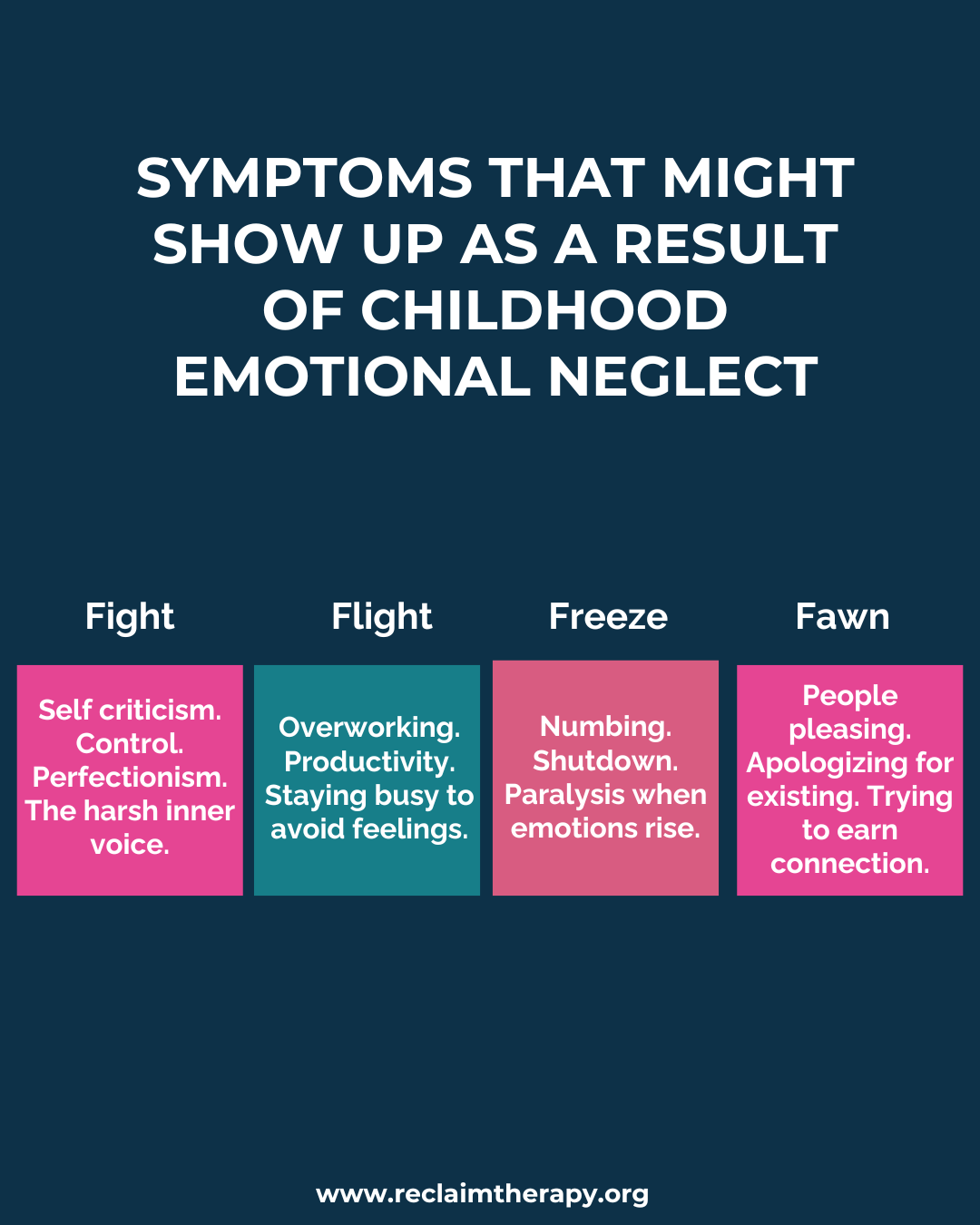
Fight Response
Self criticism. Control. Perfectionism. Self-blame. The harsh inner voice.
Flight Response
Overworking. Productivity. Staying busy to avoid feelings.
Freeze Response
Numbing. Shutdown. Paralysis when emotions rise.
Fawn Response
People pleasing. Apologizing for existing. Trying to earn connection.
These adaptations are brilliant.
They kept you connected to the adults you depended on.
But, they also become the scaffolding for CPTSD later in life.
How Childhood Emotional Neglect Creates CPTSD
CPTSD, also known as complex PTSD or c-ptsd, is what can happen when the nervous system grows inside chronic emotional deprivation. Unlike post traumatic stress disorder, which often results from a single traumatic event, complex ptsd develops from prolonged, repeated trauma such as ongoing childhood emotional neglect. Not because something dramatic happened once, but because something essential was missing again, again and again.
The characteristics of CPTSD include emotional dysregulation, challenges in forming and maintaining relationships, and a distorted self perception.
Here are the hallmarks of CPTSD that emotional neglect often creates.
Emotional Flashbacks
Sudden waves of shame, panic, or dread that feel out of proportion.
Your body remembers being alone with overwhelming feelings.
The emotional pain of neglect often goes unacknowledged, forcing the child to internalize painful messages about their feelings and needs.
Attachment Wounds
You crave closeness but pull away when someone gets too close.
Survivors of childhood emotional neglect often struggle with trust, emotional intimacy, or setting healthy boundaries in relationships, making it difficult to form and maintain healthy connections.
You fear abandonment and fear engulfment at the same time.
Fragmentation and Parts of Self
Younger parts hold unmet needs. Protector parts shut you down to survive.
The inner critic becomes the voice you internalized to stay safe.
Identity Confusion
When childhood required constant shape shifting, adulthood becomes guessing.
You struggle to know who you are outside of what others needed from you.
Chronic Dysregulation
Your body doesn’t default to calm. It defaults to survival mode. Disruptions in emotional regulation are common, making it difficult to manage and respond to emotions in a healthy way. Many adults who experienced emotional neglect may feel unworthy of love or care, especially during hard times.
This is complex trauma through the lens of emotional neglect.
Signs You May Have CPTSD From Emotional Neglect
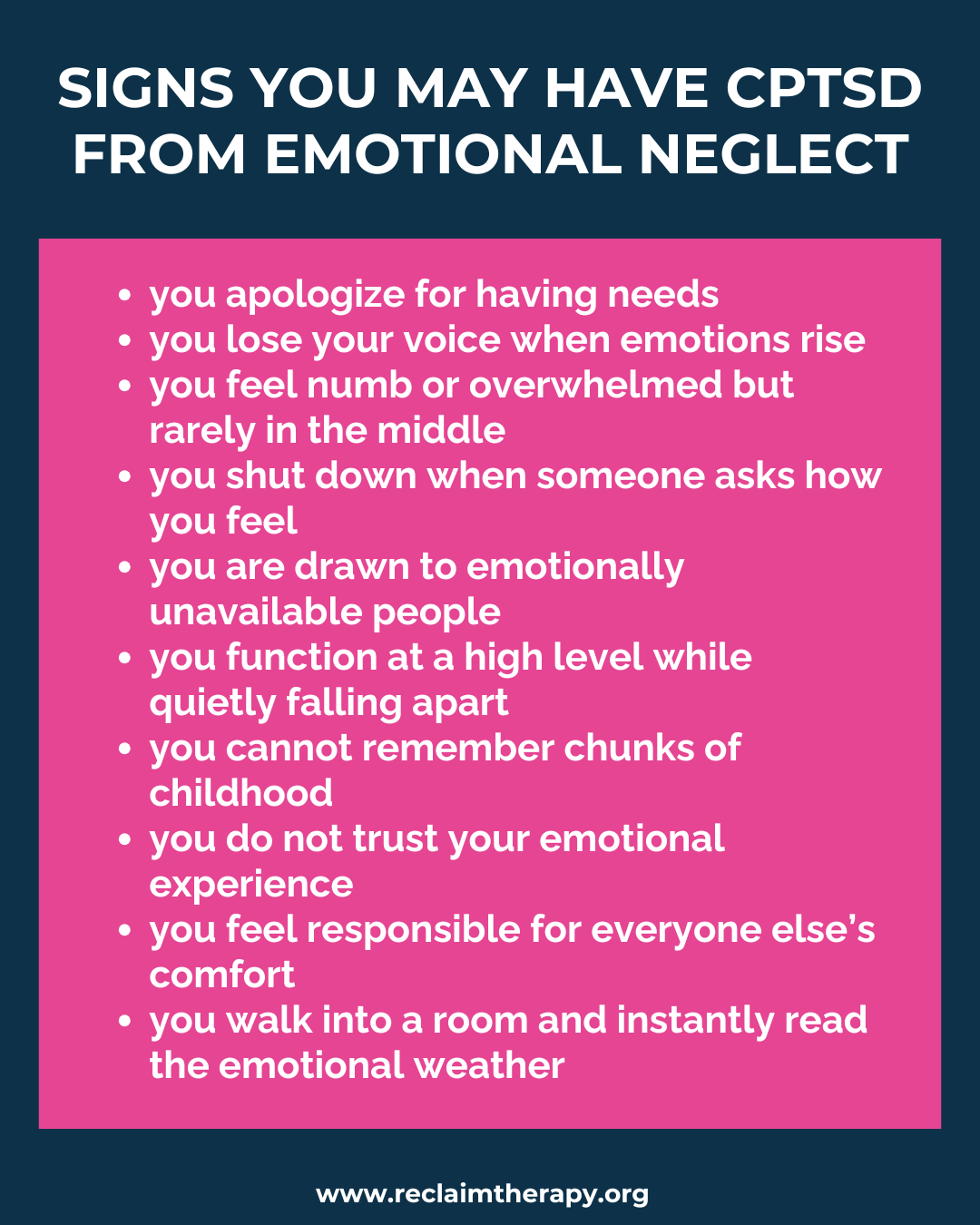
If any of these feel familiar, you are not imagining it.
you apologize for having needs
you lose your voice when emotions rise
you feel numb or overwhelmed but rarely in the middle
you shut down when someone asks how you feel
you are drawn to emotionally unavailable people
you function at a high level while quietly falling apart
you cannot remember chunks of childhood
you do not trust your emotional experience
you feel responsible for everyone else’s comfort
you walk into a room and instantly read the emotional weather
These are not overreactions. These symptoms are what the body does after years of emotional neglect. Emotional neglect can also lead to chronic shame or self-blame, causing individuals to internalize a sense of being unworthy or broken.
Healing Childhood Emotional Neglect and CPTSD
You’re not stuck here. The healing journey from childhood emotional neglect and CPTSD is an ongoing, nonlinear healing process that involves learning safety just as the nervous system once learned survival—through experience.
Healing from childhood emotional neglect also means reconnecting with parts of yourself that were never fully seen, heard, or nurtured. Empowerment through education is foundational in the healing process, helping you understand and navigate your recovery. Improving overall well-being is a key goal of this healing journey.
Rebuilding Safety in the Body
Therapeutic approaches such as trauma focused therapy and eye movement desensitization are essential for rebuilding safety in the body. Somatic therapy, EMDR, and co-regulation help your body learn what emotional safety feels like. Therapeutic interventions such as Trauma-Focused Cognitive Behavioral Therapy (TF-CBT) and Eye Movement Desensitization and Reprocessing (EMDR) are effective in treating the complexities of trauma.
Learning to Feel Your Feelings Safely
Slowly. Gently. In small doses.
This is not a cognitive task. It is embodied healing.
Mindfulness practices and grounding techniques are essential tools for managing heightened emotional states as you begin to explore your emotional world. These approaches help you stay present and safe while reconnecting with feelings that may have been suppressed due to childhood emotional neglect and CPTSD. Mindfulness practices and grounding techniques help manage heightened emotional states associated with CPTSD, supporting emotional regulation and stability during the healing process.
Repairing Attachment Patterns
Secure attachments and a strong therapeutic relationship are essential for repairing attachment patterns, especially for those healing from childhood emotional neglect and CPTSD. Building healthy relationships and meaningful relationships is crucial for recovery, as these connections foster emotional healing and growth. Developing safe interpersonal relationships with people who offer emotional safety can help retrain your nervous system, supporting your ability to form and maintain healthy, supportive bonds.
Safe people. Safe therapy. Safe connection. Not perfect. Just consistent.
Ending Self Abandonment
Listening for your needs.
Letting your voice back into the room.
Letting your body guide you instead of overriding it.
Practicing self-compassion and engaging in self-compassion practices.
Self-compassion is a crucial aspect of the healing process and can significantly contribute to emotional healing.
Healing emotional neglect is slow, beautiful work. You are not learning something new.
You are remembering something you were never given space to develop.

If emotional neglect shaped your childhood, the wound was never a lack of effort on your part. It was a lack of attunement on theirs.
You were missing a relationship. A mirror. A witness. A steady nervous system to anchor yours.
CPTSD is not proof that something is wrong with you.
It is evidence of what you lived through and how hard you worked to survive it.
And the fact that you are here, naming what happened, trying to understand your nervous system and your story with compassion, tells me something important.
Your healing has already begun.
🧡,

Looking for therapy for complex PTSD?
Here at Reclaim Therapy we specialize in providing therapy for CPTSD, emotional neglect and providing EMDR Therapy for people recovering from trauma. We are passionate about helping people reclaim their lives from the impact of trauma. If you’re ready to get started, schedule your free consultation!