
Many people don’t realize they grew up with emotionally immature parents because nothing looked obviously “bad” from the outside.
There may not have been abuse.
You may have been provided for.
Your parents may have worked hard, showed up physically, or even said “I love you.” They may have been physically present, but emotionally absent.
And still, something felt off. Passive parents can be physically present but emotionally unavailable, which can deeply affect a child's life, leading to feelings of loneliness, insecurity, and long-term emotional challenges.
If you’ve ever struggled to trust your feelings, felt emotionally lonely even in relationships, or wondered why adulthood feels heavier than it should, this conversation really matters.
Emotional immaturity isn’t about blaming parents or assigning some sort of label, it’s about naming patterns rooted in parents' emotional immaturity that shaped how your nervous system learned to survive. To learn more about the 4 types of emotionally immature parents, head here!
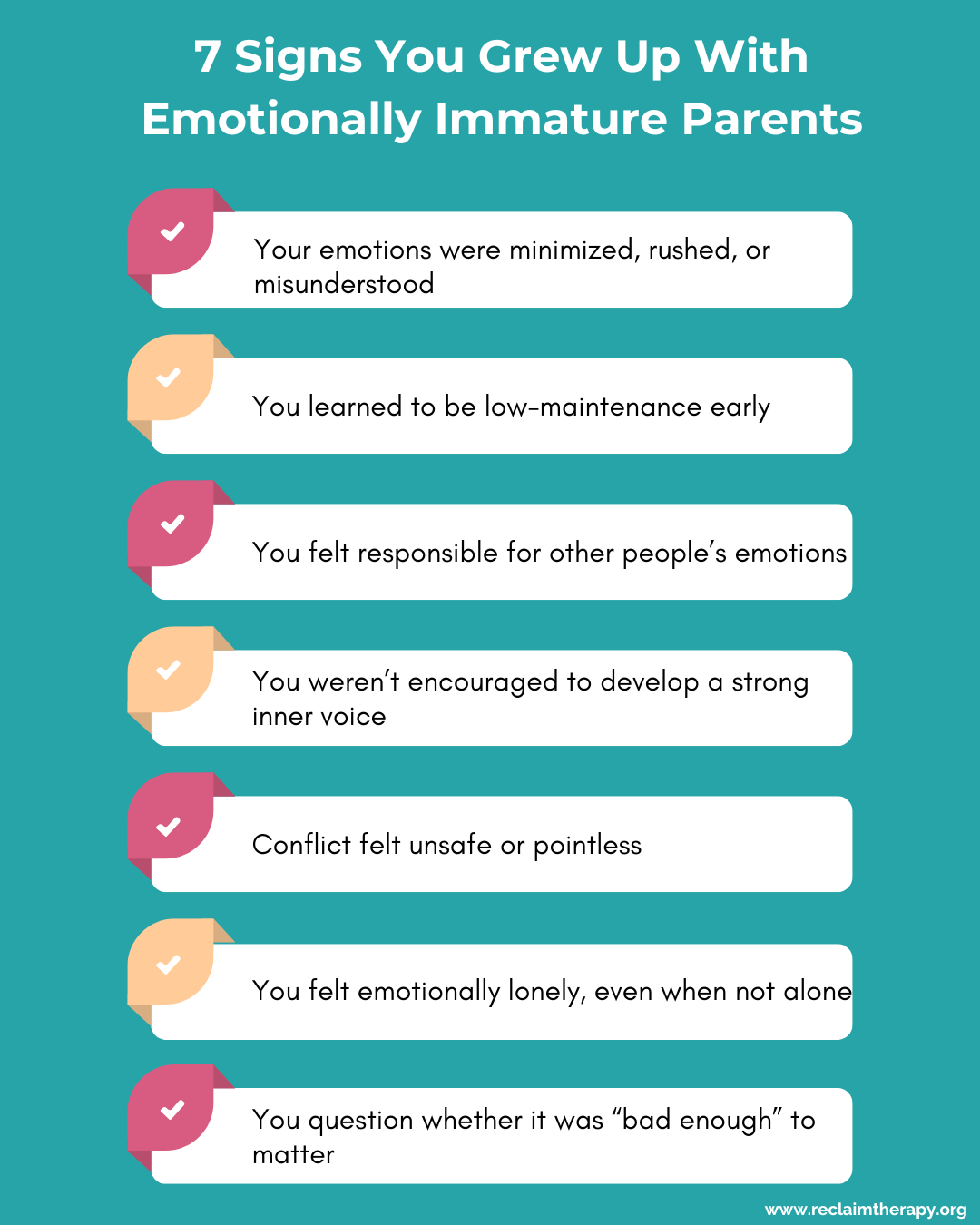
Below are seven experiences many adult children of emotionally immature parents recognize, along with why they still might still affect you today.
1. Your emotions were minimized, rushed, or misunderstood
You may have been told you were “too sensitive,” “overreacting,” or “dramatic.” Or your feelings were met with problem-solving instead of presence. Emotionally immature parents often lack empathy, making it difficult for them to validate their child's feelings.
Why this still affects you
When emotions weren’t met with curiosity or care, your nervous system learned that feelings were inconvenient or unsafe. The absence of emotional connection with parents can make it hard to form secure attachments later in life. As an adult, this often shows up as self-doubt, emotional shutdown, or needing external validation to know how you feel.
You might intellectualize instead of feel. Or apologize for having emotions at all.
2. You learned to be low-maintenance early
You noticed what stressed your parents out and adapted. You needed less. Asked for less. Took up less space. Driven parents, who prioritize achievement and productivity over emotional needs, may cause children to suppress their own inner world in order to meet expectations and gain approval.
Why this still affects you
This often turns into people-pleasing, overfunctioning, and difficulty expressing needs in adult relationships, sometimes even showing up as hyper-independence as a trauma response. Rest can feel uncomfortable. Receiving care may feel foreign or undeserved. Adapting to parental expectations can disconnect you from your own inner world, making it harder to recognize and honor your feelings as an adult.
Being “easy” once kept you connected. Now it can keep you exhausted.
3. You felt responsible for other people’s emotions
You learned to read the room quickly. You could sense shifts in mood before anyone said a word. As a child of emotionally immature parents, you may have felt responsible for other people's feelings, constantly monitoring and trying to manage the emotional climate at home.
Why this still affects you
Hypervigilance becomes a way of life. This hypervigilance can make you feel responsible for managing people's feelings and someone else's emotions, rather than your own. As an adult, you may feel responsible for keeping relationships stable, smoothing conflict, or managing other people’s discomfort.
This can look like anxiety, guilt, or staying in relationships long past the point of reciprocity.
4. You weren’t encouraged to develop a strong inner voice
Decisions may have been made for you, or your preferences were subtly overridden. Your own parents' emotional immaturity often contributed to this dynamic, shaping how you learned to suppress your needs. You adapted by going along with what was expected.
Why this still affects you
Many adult children of emotionally immature parents struggle with trusting themselves. You may second-guess choices, look outward for answers, or feel disconnected from your intuition.
This isn’t indecisiveness. It’s a nervous system that learned it was safer not to know what you wanted.
5. Conflict felt unsafe or pointless
Attempts to address issues may have led to defensiveness, shutdown, or emotional withdrawal from your parent. Emotional outbursts and mood swings from emotionally immature parents can make conflict feel unpredictable and unsafe.
Why this still affects you
You may avoid conflict entirely or swing between silence and emotional overwhelm. Boundaries can feel scary, selfish, or like they’ll cost you connection.
When conflict never led to repair, your body learned it wasn’t worth the risk.
6. You felt emotionally lonely due to childhood emotional neglect, even when not alone
You may have had family dinners, holidays, and routines. But emotional closeness felt missing. Emotionally immature parents often struggle to be emotionally present, which can leave children feeling isolated.
Why this still affects you
Emotional loneliness often follows people into adulthood. You can be surrounded by others and still feel unseen. This can lead to choosing emotionally unavailable partners or friendships that recreate familiar distance, especially if you struggle with accepting love as a trauma survivor.
It’s not that you want unavailable people. It’s that availability wasn’t modeled.
7. You question whether it was “bad enough” to matter
This is one of the most common patterns. You minimize your experience because others had it worse. Childhood emotional neglect can be difficult to recognize, but it often has lasting effects on emotional well-being.
Why this still affects you
Emotional neglect often goes unnamed. When there’s no clear event to point to, people turn the blame inward. This can keep you stuck, invalidating your own pain and delaying healing, especially if you’ve also experienced narcissistic abuse and feel like you’ve lost yourself.
Impact matters more than intent. Your nervous system adapted for a reason.
You can understand your parents’ limitations and still grieve, and care deeply, for what you needed but never received
Growing up around emotional immaturity can shape how you respond to conflict, closeness and your own needs. Our trauma therapists help adults understand these patterns and build relationships that feel safer and more mutual.
In Horsham, PA and virtually across Pennsylvania
Why Dealing With Emotionally Immature Parents Is Still So Complicated
If you’re still in relationship with emotionally immature parents, the confusion can be intense. These dynamics can also affect relationships with other family members, influencing emotional development, attachment, and communication within the family unit.
You may feel guilt for wanting distance.
Hope that things will change.
Pressure to explain yourself again.
A pull to stay loyal even when it costs you.
Dealing with emotionally immature parents often means holding grief and reality at the same time. Emotionally immature people often behave in such a way that makes it difficult for their own children to feel secure or understood. You can care and still acknowledge limits. You can love someone and stop asking them to meet needs they’re unable to meet.
That tension is a very human response to unmet attachment needs. If these patterns are not addressed, they can also impact your own children, continuing cycles of emotional immaturity within families.
Building Healthy Relationships as an Adult Child
Growing up with emotionally immature parents can make building healthy relationships as an adult feel confusing, even daunting. When emotional intimacy, validation, or real connection were missing in your own childhood, it’s common to carry those patterns into adult relationships—sometimes without even realizing it. Emotional distance, emotional unavailability, and a lack of emotional closeness can feel like the norm, not the exception.
But here’s the good news: these patterns aren’t set in stone. With self-awareness and intention, adult children of emotionally immature parents can learn to create more meaningful relationships—ones that feel safe, supportive, and genuinely connected.
A big part of this journey is developing emotional maturity. That means learning to recognize, understand, and manage your own emotions, rather than relying on others to tell you how you feel or what you need. It’s about tuning into your own feelings, honoring your own needs, and giving yourself the emotional validation you may not have received growing up. This might look like pausing to check in with your emotional state, practicing self-reflection, or even journaling about your emotional experience.
Setting healthy boundaries is another essential skill. If you learned to put everyone else’s needs first, it can feel uncomfortable—even selfish—to say “no” or to ask for space. But boundaries are what make emotional intimacy and emotional well-being possible. They protect your energy, clarify your limits, and help you show up more authentically in your own life and relationships.
Building self-esteem and self-worth is also part of healing from emotionally immature parenting. If your parents were critical, dismissive, or emotionally unavailable, you may have internalized a sense of not being “enough.” Practicing self-compassion, celebrating your strengths, and surrounding yourself with people who see and value you can help rebuild your own sense of worth.
And remember: you don’t have to do this alone. Seeking out emotionally available, supportive relationships—whether through therapy, support groups, or friendships—can be life changing. These connections offer the emotional support and validation that may have been missing in your family dynamics, and help you experience what healthy relationships can feel like.
What Recovering From Emotionally Immature Parents Actually Looks Like
Recovery isn’t about fixing your parents or cutting contact as a hard and fast rule. It’s really about rebuilding trust with yourself. The healing process is essential for mental health and emotional development, helping you recover from the effects of emotionally immature parenting.
Recovering from emotionally immature parents often includes:
Learning to validate your internal experience
Noticing how your body responds in relationships
Allowing grief for what you didn’t receive
Building connections that feel mutual, not performative
Developing boundaries that protect yourself, not punish others
Recognizing the impact of rejecting parents and self involved parents on your recovery
This work is slow and layered. And it makes sense if it feels unfamiliar. Some emotionally immature parents may also be mentally ill, so working with a clinical psychologist or a therapist trained in clinical psychology can be especially helpful for deep healing.
Dr. Lindsay Gibson’s bestselling book on emotionally immature parents has sold over a million copies and is a valuable resource for understanding and healing from these family dynamics.

A Note If This Resonates…
If you see yourself in this, no, you’re not overreacting. And, we want you to know that you’re not alone.
These patterns were intelligent adaptations. They helped you stay connected when emotional attunement was limited. Healing doesn’t mean erasing them. It means understanding them and gently expanding what’s possible now.
You deserve relationships where your emotions are welcomed, not managed. And it’s okay if you’re still learning what that feels like.
🧡,

Hoping to get started with a trauma therapist near me?
Reclaim Therapy is a specialized trauma therapy practice in Horsham, PA. We specialize in providing therapy for complex ptsd, ptsd treatment and therapy for eating disorders. Our therapists work with folks both in our Horsham, PA offices and virtually across the state of Pennsylvania.