
Why Healthy Relationships After Trauma Can Feel So Hard
A lot of people come into therapy asking some version of the same question:
“Why does this feel so hard when the relationship is actually healthy?”
There’s care. There’s consistency. There’s effort on both sides. And still, something in the body stays tense. Or shut down. Or carefully waiting for the other shoe to drop.
If that’s familiar, it’s not because you don’t know how to be in a relationship.
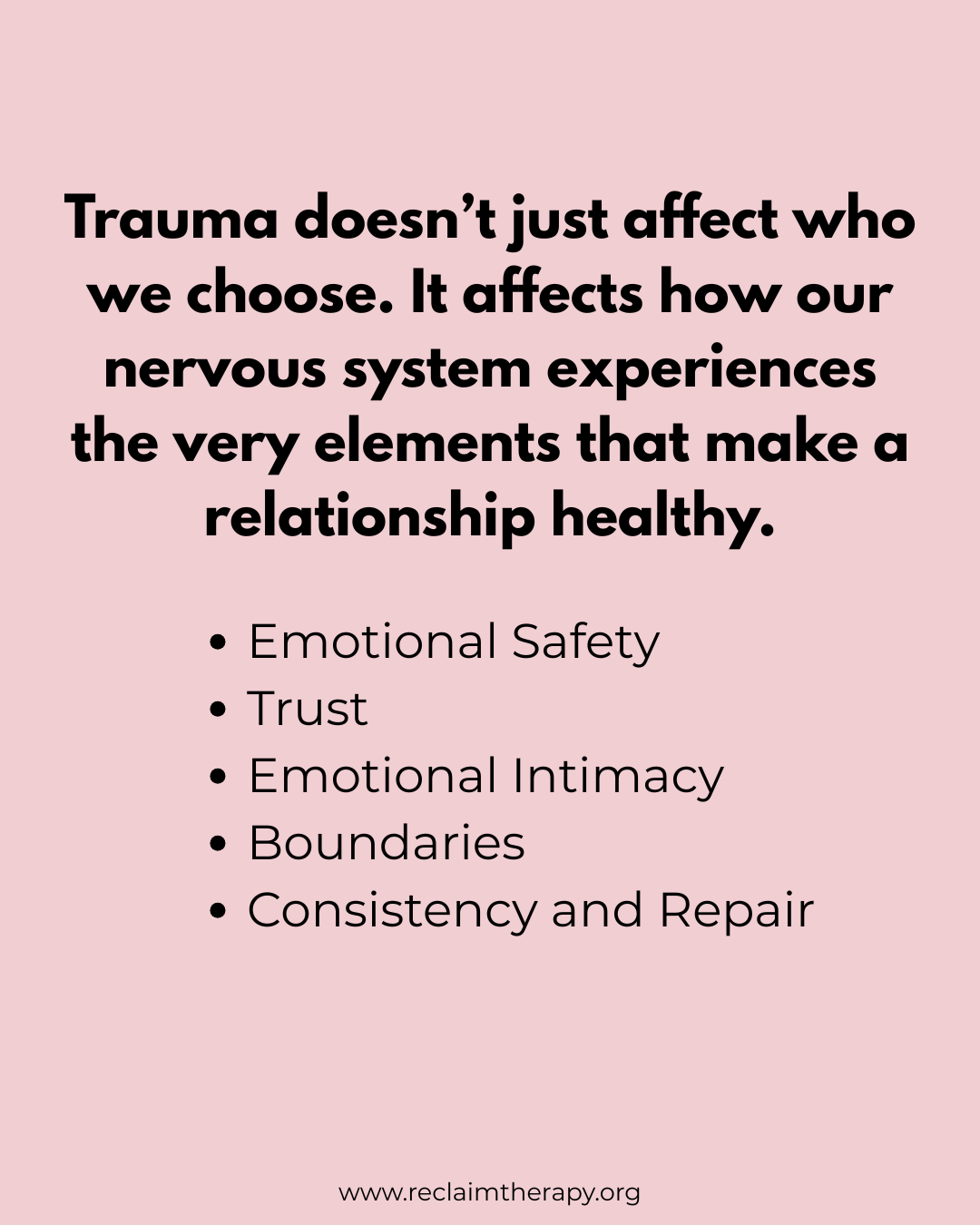
It’s because trauma doesn’t just affect who we choose. It affects how our nervous system experiences the very elements that make a relationship healthy.
Emotional Safety
Emotional safety is the foundation of a healthy relationship. It’s the sense that you can be yourself without being punished, dismissed, or abandoned for it.
For people with trauma histories, especially emotional neglect, emotional safety often wasn’t consistent growing up. You may have learned that feelings were inconvenient, ignored, or something you had to manage alone.
So even when a partner is kind and responsive, your body might stay guarded.
You might notice yourself holding back, staying “fine,” or waiting for the moment when it becomes unsafe to need something.
That doesn’t mean the relationship lacks emotional safety. It means your nervous system might have learned early on that safety was temporary.
Building emotional safety after trauma happens slowly. It comes from repeated experiences of being met without consequences. Of being allowed to have an internal world without having to justify it.
Trust
Trust is often misunderstood as a choice. As something you decide once someone proves themselves.
But trust after trauma is rarely cognitive. It’s physiological.
You can trust your partner and still feel braced. You can believe they’re reliable and still scan for subtle changes in tone, timing, or energy.
This is especially common if closeness once came with unpredictability, broken promises, or emotional reversals.
A healthy relationship after trauma builds trust through consistency, follow-through, and repair. Not through pressure to “just trust more,” but through experiences that slowly teach the body that connection doesn’t disappear when things get real.
Emotional Intimacy
Emotional intimacy is the ability to be known. To share what’s happening inside you and feel met rather than managed.
For trauma survivors, intimacy can be complicated. Being seen may have once led to dismissal, minimization, or being too much for the people you depended on.
So closeness might now bring anxiety, numbness, or an urge to pull away right after connection.
This isn’t fear of intimacy. It’s memory.
A healthy relationship allows intimacy to grow at a pace the nervous system can tolerate. It doesn’t rush vulnerability or confuse disclosure with healing. It respects that intimacy after trauma often unfolds in layers.
Boundaries
In healthy relationships, boundaries create clarity and safety. They make connection sustainable.
But if boundaries once led to guilt, withdrawal, or emotional consequences, they can feel risky. You may have learned that keeping the peace mattered more than being honest, or that saying no threatened connection.
As a result, you might overextend, overfunction, or struggle to name your limits until resentment builds.
A healthy relationship after trauma supports boundaries without turning them into abandonment. It allows space and closeness to coexist. It makes room for differentiation without punishment.
Boundaries aren’t about distance. They’re about staying in relationship without losing yourself.
Consistency and Repair
One of the most important elements of a healthy relationship is not the absence of conflict, but what happens after it.
Trauma often comes from environments where rupture was never repaired. Where tension lingered. Where you had to move on without resolution.
So even small disagreements can feel big in the body. Your system might expect disconnection, shutdown, or emotional withdrawal.
In a healthy relationship, repair is possible. Missteps are acknowledged. Impact matters more than intent. And connection returns.
Over time, these moments teach the nervous system that relationships can bend without breaking.
When Intensity Has Been Mistaken for Connection
Many trauma survivors confuse intensity with intimacy.
Trauma bonds often feel urgent, consuming, and emotionally charged. The nervous system stays activated. There are highs and lows, longing and relief.
Healthy relationships can feel quieter by comparison. And at first, that quiet can feel unsettling.
If this has been your pattern, it may be helpful to explore dynamics like breadcrumbing and love bombing, which often keep people hooked through inconsistency rather than safety.
What healthy connection offers instead is stability. And stability takes time for the nervous system to recognize as safe.
When Narcissistic or Emotionally Immature Dynamics Shaped Early Relationships
If you grew up around narcissistic or emotionally immature caregivers, you may have learned early that relationships required adaptation, self-silencing, or emotional labor.
You might still feel responsible for the emotional tone of the relationship. Or worry about being too much when you have needs.
Understanding narcissistic dynamics in relationships can be an important part of untangling what feels familiar from what is actually healthy.
Healing often involves grieving the roles you had to play to stay connected.

Love After CPTSD
A healthy relationship after trauma isn’t about being perfectly regulated or healed before you let someone in.
Love after CPTSD is about building capacity.
Capacity to stay present. To repair. To feel without collapsing or disappearing.
It’s about learning, slowly, that connection can exist alongside boundaries. That closeness doesn’t require self-abandonment. That safety can be built, not earned.
If this feels tender or slow, that doesn’t mean you’re doing it wrong.
It means you’re building something real.
🧡,

Looking for an EMDR therapist or trauma therapist in Horsham, PA?
Reclaim Therapy is a small therapy practice that specializes in providing therapy for Complex PTSD, therapy for eating disorders and EMDR Therapy. We gave current availability in our Horsham, PA office and virtually across the state of Pennsylvania.