
If you've ever zoned out in the middle of a conversation, forgotten what you were saying mid-sentence, or felt like you're watching your life instead of living it, that's dissociation.
And if you've ever judged yourself for it, like what is wrong with me or why can't I just stay present, this is for you.
This post is about why dissociation happens in complex trauma and CPTSD, what it actually feels like in the body, and how EMDR therapy, when it's paced and adapted for a nervous system that's already had enough, can help you come back to yourself.
Because dissociation is not random. It's not a flaw. And it's definitely not something your system just decided to do for fun.
It's a response. A really intelligent one.
EMDR for Dissociation: Understanding What Dissociation Actually Is
Dissociation is what happens when your nervous system decides that staying fully present is too much.
It’s a trauma response where the body creates distance from overwhelming thoughts, emotions, or physical sensations. Dissociation is also a natural, adaptive response to stressful experiences and trauma, helping individuals manage or separate from painful or stressful experiences.
Dissociation can look like:
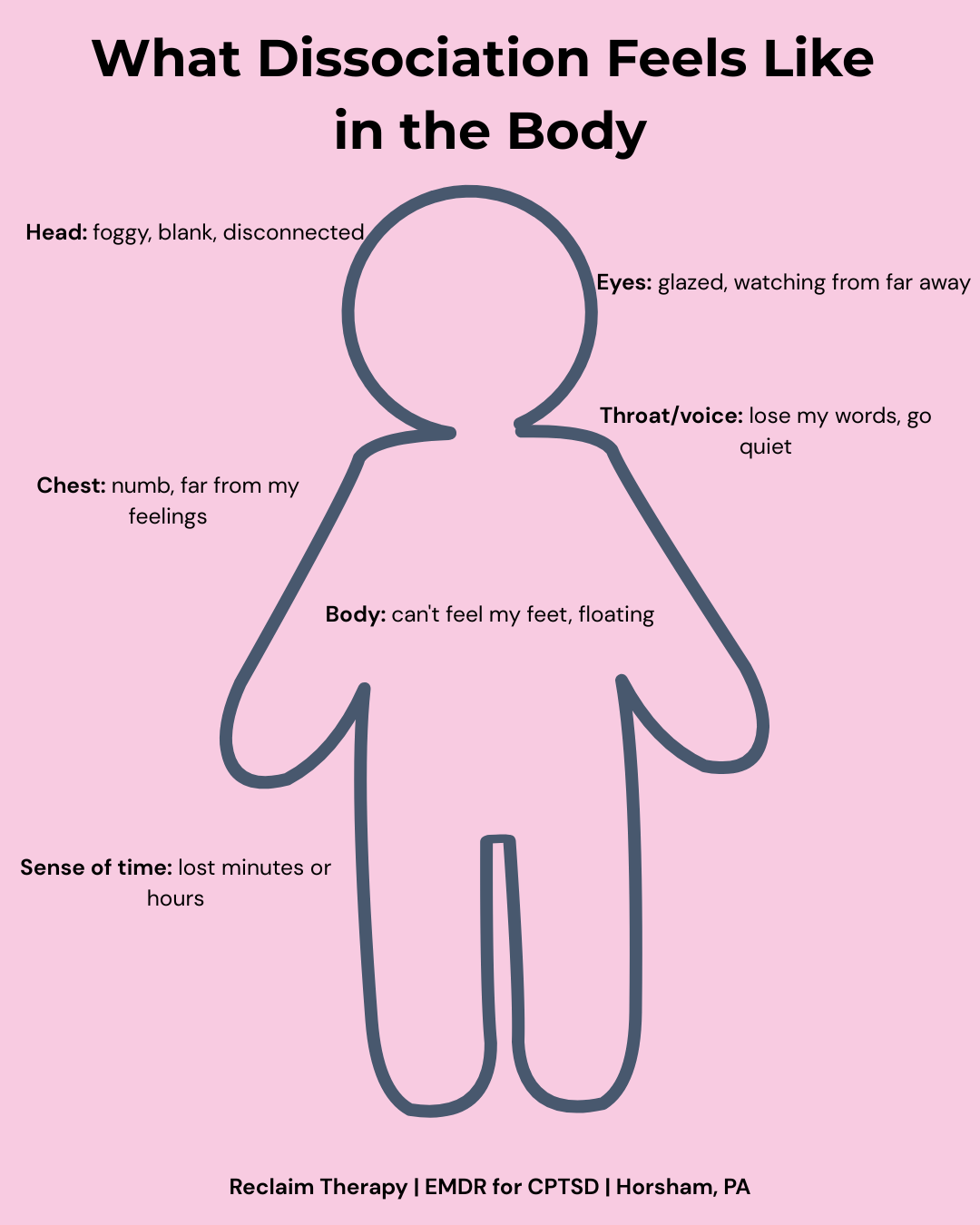
Zoning out or going blank
Feeling numb or disconnected from your emotions
Losing track of time
Feeling detached from your body
Feeling like things around you aren’t real
For some people it’s subtle. You’re still functioning. You’re still getting things done. But something feels off, like you’re not fully in it.
For others, it’s more obvious. Conversations get fuzzy. Memory feels spotty. You check out without meaning to.
Either way, dissociation is your system saying: I can’t stay here safely, so I’m going to take you somewhere else. Understanding dissociation as a protective mechanism is crucial, and the American Psychiatric Association recognizes dissociative disorders in its DSM, providing clinical definitions for conditions like DID, depersonalization, and dissociative amnesia.
Why Dissociation Happens in Complex Trauma
In a single overwhelming moment, the body might fight or run. But, in complex trauma, especially when it starts in childhood, those options often aren’t available.
You can’t fight your caregiver. You can’t leave your environment. You still need connection to survive.
So the system adapts.
Instead of leaving physically, it learns how to leave internally.
This is especially true in emotional neglect. When your feelings weren’t noticed, named, or responded to, your system didn’t learn how to move through emotional experiences. It learned how to move away from them.
Over time, that becomes automatic. Not because you’re avoidant, but because your body never learned that staying present with emotion was safe. This adaptation shapes a dissociative mind—an internal system designed to protect you from overwhelming experiences.
Dissociation in CPTSD
Dissociation is especially common in CPTSD, where trauma is ongoing and often relational. Instead of being tied to one overwhelming event, the nervous system learns over time that certain emotional states are too much to stay present for.
So it builds a pattern.
It disconnects before overwhelm fully hits.
This is why dissociation can show up in everyday moments, not just obvious triggers. A tone shift, a look, a feeling in your body can be enough for your system to step in. These dissociative experiences are common among clients who dissociate as a way to manage ongoing emotional overwhelm.
Again, not because something is wrong with you. Because something overwhelmed you, repeatedly, without enough support.
Understanding Dissociative Disorders
Dissociative disorders are a group of mental health conditions where a person experiences a significant disconnection from their thoughts, feelings, memories, or sense of identity. These disorders can show up in many ways, from feeling detached from your body or emotions to experiencing gaps in memory or even having distinct identities, as seen in dissociative identity disorder (DID). Often, dissociative disorders develop as a protective mechanism in response to traumatic experiences, especially when those experiences are ongoing or overwhelming.
Diagnosing dissociative disorders can be challenging, since symptoms often overlap with other mental health conditions and can be subtle or hidden. However, with the right support, people can learn to manage dissociative symptoms and improve daily functioning. EMDR therapy, especially when guided by a clinical trauma specialist, is one of the most effective approaches for treating dissociative disorders. Through eye movement desensitization and reprocessing, individuals can safely process traumatic memories, reduce the intensity of dissociative symptoms, and begin to reconnect with themselves. Working with a therapist who understands the complexities of dissociation and trauma can make a significant difference in the healing journey.
What Dissociation Looks Like Day to Day
This is where a lot of people start to recognize themselves.
These are some early signs or signs of dissociation that people may notice in their daily lives:
You go blank when someone asks how you feel
You lose your train of thought mid-conversation
You feel disconnected from your body
You have a hard time remembering parts of your childhood
You feel numb, then suddenly overwhelmed
You scroll or distract without realizing how long it’s been
You feel like you’re watching yourself instead of being yourself
You struggle to stay present in conflict or emotional moments
Why Dissociation Shows Up in Therapy
This is one that catches people off guard.
You finally get into therapy. You’re ready. You want to do the work.
And then you can’t stay present.
You feel foggy. You lose your words. You check out.
Then comes the frustration. Or the shame. I’m doing it wrong. I can’t even talk about this.
But what’s actually happening is this:
Therapy starts to bring you closer to experiences your system has spent years protecting you from. Therapists are trained to notice subtle shifts in body language—like changes in facial expressions or posture—as early signs that overwhelming feelings or dissociation may be surfacing during sessions.
So your nervous system does what it knows how to do. It creates distance.
This is also where dissociation and the fawn response often show up together. Both are ways the nervous system tries to manage overwhelm in relationship. One disconnects. One over-attunes. Many people experience both, sometimes in the same conversation.
Dissociation, Parts, Fragmentation, and Dissociative Identity Disorder
In complex trauma, dissociation doesn’t just happen in moments. It shapes how your internal world is organized.
Parts of you hold different experiences. In some cases, these parts may function as dissociative identities, each with their own perspectives and memories. Dissociative amnesia can occur when certain memories are inaccessible to other parts, leading to gaps in recall.
There might be a part that feels overwhelmed. A part that shuts everything down. A part that keeps you functioning no matter what.
Dissociation is what keeps those parts from flooding each other. It creates separation so you can keep going.
That’s why you can feel fine one minute and completely taken over the next. It’s not inconsistency. It’s different parts coming online.
Role of a Clinical Trauma Specialist
A clinical trauma specialist is a therapist with advanced training in helping people recover from trauma and manage dissociative disorders. Their role goes beyond traditional talk therapy—they create a safe, supportive environment where clients can explore and process traumatic experiences at their own pace. Clinical trauma specialists are skilled in techniques like EMDR therapy, which supports effective trauma processing by helping clients process traumatic material without becoming overwhelmed.
Throughout the therapy process, a clinical trauma specialist works collaboratively with clients to develop coping strategies, regulate emotion, and build resilience. They understand the importance of pacing, proper preparation, and attunement to each person’s unique nervous system responses. By providing guidance, empathy, and expertise, clinical trauma specialists help clients move through trauma work in a way that supports lasting mental health and healing. Their support is especially crucial for those navigating complex trauma, dissociative symptoms, or dissociative identity disorder, ensuring that therapy is both safe and effective.
How EMDR Therapy and Trauma Processing Help with Dissociation
A lot of people wonder if EMDR can help with dissociation. The answer is yes, when it’s adapted for a nervous system that uses dissociation as protection. EMDR typically requires less out-of-session homework compared to Cognitive Behavioral Therapy (CBT) and can achieve results faster.
EMDR therapy is one of the most researched approaches for treating complex trauma and CPTSD. But the version that works for dissociation looks different from standard EMDR. While standard EMDR has 8 phases, treating dissociation requires a slower, highly modified approach to prevent overwhelming the client, which can cause increased instability.
Good EMDR doesn’t push through dissociation. It works with it.
The goal isn’t to force you to stay present. The goal is to help your system feel safe enough that it doesn’t need to leave.
That starts with:
Building resources
Strengthening your ability to notice what’s happening in your body
Creating a sense of stability before any trauma processing begins
EMDR preparation, which includes tailored stabilization techniques and assessment tools
Grounding techniques to help manage dissociation and keep you anchored
Mindful breathing, often taught to help clients stay connected to the present moment
For individuals with severe structural dissociation, EMDR requires highly trained specialists who utilize heavily adapted, slow-paced protocols.
Then, when processing does happen, it’s paced.
Slow enough that you can stay connected. Supported enough that you’re not overwhelmed.
There’s something called dual awareness. Part of you stays anchored in the present, while another part touches into the past. Therapists use shorter sets of bilateral stimulation, frequent check-ins, and continuous monitoring of your state to manage dissociation and ensure emotional stability throughout the therapy process.
If that connection starts to slip, you pause. Incorrect use of EMDR can trigger extreme emotional flooding and worsen fragmentation, especially in severe conditions like Dissociative Identity Disorder (DID), making a phased approach essential.
Because you can’t process what you’re not present for. Therapists employ a variety of interventions, including grounding techniques and variations of bilateral stimulation, to help clients manage dissociation and stay present during EMDR sessions.
Why EMDR Needs to Be Modified for Dissociation
This is the difference between EMDR that works and EMDR that feels like too much.
When dissociation is part of the picture, you don’t jump straight into processing. In private practice, EMDR therapists with clinical experience and guidance from EMDR trainers often collaborate within the EMDR community to adapt protocols for dissociative disorder.
You spend time building capacity.
That can look like:
Going slower than you think you “should”
Working with parts of you that are protective
Staying with small pieces instead of the whole story
Learning how to come back when you drift
Using screening tools in the preparation phase to assess dissociative symptoms and inform pacing
It’s not about pushing through.
The preparation phase is crucial for building resilience, learning coping strategies, and establishing safety and trust before trauma processing begins.
It’s about expanding how much you can stay with, little by little.
Can You Heal Dissociation from Trauma
Yes. And also not in the way people usually think.
Healing dissociation isn't about forcing yourself to stay present all the time.
It's about helping your system learn that it doesn't have to leave.
That happens through:
Safe connection
Consistency
Experiences of being with emotion and not getting overwhelmed
Learning how to notice your body without immediately shutting down
It's slow. It's layered. It's not linear.
But it is possible.
EMDR Therapy for Dissociation and CPTSD in Pennsylvania

At Reclaim Therapy in Horsham, PA, our team of seven trauma therapists works with clients across Montgomery County, Philadelphia, and Lower Bucks County who are navigating dissociation, CPTSD, and complex trauma. Every therapist on the team is EMDR trained and understands that EMDR for dissociation has to be paced differently.
If you're looking for EMDR therapy in Pennsylvania for dissociation or complex trauma, working with a therapist who understands how to slow the work down, build stability first, and stay attuned to your nervous system can make the difference between feeling overwhelmed and actually moving through it.
Dissociation isn't something to override. It's something to understand and work with.
When therapy is attuned to that, things can start to shift.
Schedule a free consultation to see if our approach is the right fit for you.
🧡,

Frequently Asked Questions
Is dissociation a sign of CPTSD?
Dissociation is one of the most common features of CPTSD, especially when trauma started in childhood or happened repeatedly over time. Research consistently shows higher rates of dissociation in people with CPTSD compared to single-incident PTSD. Screening tools like the Dissociative Experiences Scale (DES-II) can help differentiate dissociative symptoms from those of post traumatic stress disorder, guiding treatment planning and stabilization. That said, dissociation alone doesn’t mean you have CPTSD. A trauma-trained therapist can help you understand what’s actually happening for you.
Can EMDR therapy treat dissociation?
Yes, when it’s adapted for it. Standard EMDR can feel like too much for a nervous system that already uses dissociation as protection. EMDR for dissociation involves a longer stabilization phase, more time spent building internal resources, and slower, more carefully paced processing. The goal is to keep you present enough to actually integrate what comes up. EMDR therapists are trained to recognize when clients experience dissociation and will adjust the EMDR phases—such as assessment, preparation, and stabilization—to ensure safety and support integration throughout the process.
What does dissociation feel like in the body?
It often feels like distance. You might feel foggy, numb, or like you’re behind glass watching your life. Some people describe floating, feeling unreal, or losing time. Others notice they go quiet, lose their words, or can’t quite feel their feet on the floor. It can be subtle or dramatic, brief or long-lasting.
Grounding techniques such as walking barefoot, touching something with an interesting texture, or listening to ocean waves can help bring awareness back to the body during dissociative episodes.
How long does it take to heal dissociation from trauma?
There’s no set timeline. Healing dissociation is less about a finish line and more about helping your system learn, slowly, that it doesn’t have to leave. Some people notice shifts within a few months of consistent, well-paced therapy. For others with longer or more layered trauma histories, the work unfolds over a longer period. After EMDR sessions, clients may experience emotional responses or encounter new memories related to their past trauma or other distressing life experiences. Having strategies to manage distressing life experiences is important for ongoing healing. What matters more than speed is that the work is paced in a way your nervous system can actually tolerate.
Is dissociation the same as zoning out or daydreaming?
There’s overlap, but they’re not the same. Everyone zones out sometimes. Trauma-related dissociation is deeper. It’s a protective response your system reaches for when something feels like too much, and it often shows up around emotional content, relational stress, or reminders of past experiences. Dissociation often arises as a way to handle distress or difficult emotions that feel overwhelming or unmanageable.
Do I need to be in person for EMDR if I dissociate?
Not always. Many people do EMDR for dissociation effectively online, especially when the therapist is skilled at tracking the nervous system through the screen. Online education operations make it possible for therapists to deliver trauma-focused therapy virtually, adapting techniques and maintaining safety protocols to support clients with dissociative disorders. Some clients may also benefit from working with trauma-informed practitioners such as a yoga teacher or reiki master, who can support grounding, somatic safety, and integrate holistic or spiritual healing approaches alongside EMDR. For some, in-person feels more grounding. This is something worth discussing with your therapist during a consultation so you can choose what fits your system best.