
How OCD and Eating Disorders Often Go Hand in Hand
If you’ve been struggling with both obsessive thoughts and disordered eating, you’re not imagining that there’s a connection.
Obsessive-compulsive disorder (OCD) is a common mental health condition and a mental illness that often overlaps with eating disorders, making the experience even more complex for those affected.
You might notice intrusive thoughts about food that won’t quiet down, rituals around eating that feel impossible to break, or a sense that your brain has hijacked both your relationship with food and your peace of mind.
The exhaustion is real.
The way anxiety shows up in your body, the mental loops that keep you trapped, the feeling that you’re failing at recovery because nothing seems to stick. The OCD struggle is compounded by obsessive compulsive symptoms that can impact every aspect of daily life.
What often gets missed is that OCD and eating disorders aren’t just happening at the same time by coincidence. Psychiatric comorbidity is common, and these conditions often co-occur, sharing neural pathways and feeding off the same underlying dysregulation in your nervous system. Body dysmorphic disorder is another related condition that shares obsessive and compulsive features with both OCD and eating disorders, further complicating diagnosis and treatment.
Recognizing co occurring OCD and eating disorders is crucial for effective treatment, as addressing both conditions together leads to better outcomes.
The Clinical Overlap Between OCD and Eating Disorders
Research shows that obsessive compulsive disorder and eating disorders co-occur at surprisingly high rates. Studies indicate that anywhere from 11% to 69% of people with eating disorders also meet criteria for OCD, depending on the population studied. That’s not a small overlap. Accurate OCD diagnosis is crucial to distinguish between comorbid OCD and eating disorder-related symptoms, as the two disorders can often be mistaken for one another.
Both conditions live in similar neighborhoods of the brain. They both involve:
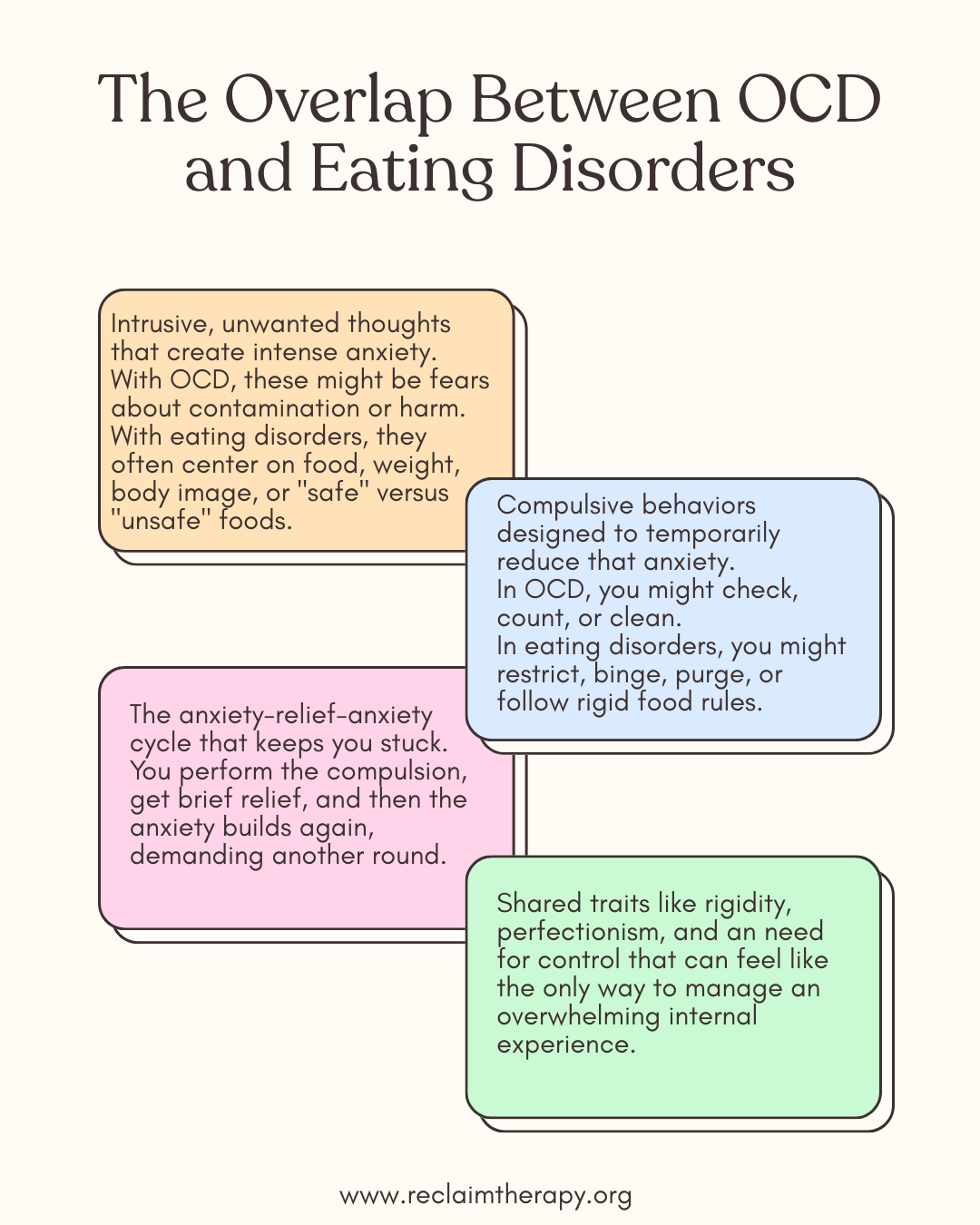
Intrusive, unwanted thoughts that create intense anxiety. With OCD, these might be fears about contamination or harm. With eating disorders, they often center on food, weight, body image, or “safe” versus “unsafe” foods.
Obsessive compulsive behaviors designed to temporarily reduce that anxiety. In OCD, you might check, count, or clean. In eating disorders, you might restrict, binge, purge, or follow rigid food rules. These behaviors can manifest in both OCD and eating disorders, making it important to differentiate whether they are part of one disorder or both.
The anxiety-relief-anxiety cycle that keeps you stuck. You perform the compulsion, get brief relief, and then the anxiety builds again, demanding another round.
The overlap is especially prominent in anorexia nervosa. OCD and anorexia share traits like rigidity, perfectionism, and a need for control that can feel like the only way to manage an overwhelming internal experience. OCD tend, such as perfectionism and order, often overlap with eating disorder symptoms, further complicating diagnosis.
OCD patients who also have eating disorders may experience these symptoms differently than those with only one disorder, highlighting the importance of addressing both disorders simultaneously for effective treatment. Clinical psychology plays a key role in accurately diagnosing and managing these complex cases, ensuring that both conditions are treated appropriately.
People with OCD and bulimia often describe similar patterns, where bingeing and purging become compulsive responses to intrusive thoughts and anxiety. The complexity of diagnosis arises because one disorder can sometimes be mistaken for the other, so it is essential to carefully differentiate between the two disorders.
Some eating disorders look almost indistinguishable from OCD. Orthorexia, the obsession with “clean” or “healthy” eating, often involves obsessive thoughts about food purity and compulsive behaviors around meal planning and ingredient checking. It sits right at the intersection of both diagnoses. Additionally, other mental health conditions and affective disorders, such as depression or anxiety, may also be present, further complicating the clinical picture and requiring comprehensive assessment and treatment.
How to Recognize When Both Are Present
If you’re wondering whether this is your story, here are some signs that OCD and eating disorders might be showing up together:
You have ritualistic eating patterns that go beyond preference. Maybe you can only eat foods in a certain order, need to chew a specific number of times, or can’t let certain foods touch on your plate. These aren’t quirks. They’re compulsions that reduce anxiety temporarily.
You experience intrusive thoughts about food that feel impossible to ignore. Thoughts about calories, contamination, or what will happen if you eat certain foods loop in your mind, and obsessive thoughts about food intake can drive compulsive behaviors aimed at controlling or restricting what you eat.
Fear of contamination extends to food. You might avoid restaurants, won’t eat food prepared by others, or have elaborate rules about food safety that go far beyond standard precautions.
You notice perfectionism driving both. There’s a “right” way to eat, a “right” weight to be, a “right” way to exercise. Anything less than perfect feels dangerous, and your compulsive behaviors—including excessive exercise—are attempts to hit that impossible standard.
Rumination is constant. You replay meals, analyze food choices, or obsess over your body in ways that feel outside your control. The thoughts aren’t just negative. They’re sticky, repetitive, and exhausting.
Concerns about body image are central. Worries about body shape and physical appearance can drive eating disorder behaviors, with a focus on how you look or how your body is perceived.
Fear of gaining weight is persistent. Anxiety about weight gain or weight loss can lead to restrictive eating, purging, or other maladaptive behaviors to control your body.
Obsessive compulsive symptoms may appear in both eating and non-eating contexts, such as repetitive checking, counting, or ordering, not limited to food or body concerns.
Obsessive compulsive behaviors can be present in eating disorders even without a full OCD diagnosis, including rituals or compulsions related to eating, exercise, or body checking.
The emotional impact of these overlapping symptoms can cause significant distress, making daily life and relationships feel overwhelming.
Why Trauma Matters in OCD and Eating Disorder Treatment
Here's where (in our opinion!) traditional treatment often misses the mark. Exposure and response prevention (ERP) for OCD and standard eating disorder protocols like meal plans can be helpful, but if there's unresolved trauma underneath, you're essentially asking your nervous system to calm down while it's still in survival mode.
Both OCD and eating disorders are often adaptive responses to overwhelming experiences. Maybe your environment growing up felt chaotic or unsafe, and controlling food or following compulsive rituals became a way to create predictability. Maybe you experienced trauma that left your nervous system stuck in hypervigilance, and obsessive thoughts and disordered eating became strategies to manage the constant sense of threat.
This is especially true for complex trauma.
When your nervous system has learned that the world is dangerous and you can't trust your own body's signals, of course you might develop rigid rules and compulsions. They're not character flaws, they're survival strategies that made sense at the time.
The problem is, those strategies are keeping you stuck now. And, until you address the dysregulation beneath them, you might just keep cycling through the same patterns.
How Reclaim Therapy Treats OCD and Eating Disorders
at the root of both. That means we’re not just managing symptoms, we’re helping your nervous system heal so the compulsive behaviors and obsessive thoughts lose their grip. Our treatment providers coordinate care to ensure that each client receives a personalized and integrated approach.
Somatic therapy helps you reconnect with your body’s signals. When you’ve been living in fight-or-flight, your body’s cues around hunger, fullness, safety, and danger get scrambled. Somatic Experiencing and other body-based approaches teach you to track sensations, notice when you’re dysregulated, and find your way back to regulation without needing the compulsions.
EMDR therapy targets the traumatic memories and beliefs driving both the OCD and the eating disorder. Maybe there’s a memory of being criticized about your body, or a moment when food became unsafe, or an experience of losing control that your brain has been trying to prevent ever since. EMDR helps reprocess those memories so they stop triggering the same compulsive responses.
Parts work (Internal Family Systems) recognizes that different parts of you are trying to help in the only ways they know how. One part might be terrified of gaining weight. Another might use food restriction to feel in control. Another might be exhausted and just want relief. Instead of fighting these parts, we help them trust that there are other ways to feel safe. We work with the parts carrying the obsessive thoughts and compulsive eating behaviors, helping them relax their extreme roles.
This approach doesn’t just treat the OCD or just treat the eating disorder. It is essential to address both disorders simultaneously for effective recovery, as these disorders tend to worsen if not treated promptly and comprehensively. It treats the nervous system dysregulation and unresolved trauma that both are stemming from.
When we do that, people often find that both conditions start to soften without the white-knuckle effort that hasn’t worked before.
Reducing Stigma and Promoting Awareness
Reducing stigma and promoting awareness around obsessive compulsive disorder (OCD) and eating disorders is essential for improving outcomes and supporting those affected by these common mental health conditions. Despite increased understanding, many people with eating disorders—such as anorexia nervosa, bulimia nervosa, and binge eating disorder—still face significant misunderstanding and judgment, especially when these conditions occur alongside OCD. Research published in the European Eating Disorders Review and other psychiatric research journals consistently shows that comorbid obsessive compulsive disorder is common among individuals with eating disorders, making it even more important to foster open conversations and accurate information.
Mental health professionals play a crucial role in breaking down barriers to care. By educating the public about the realities of eating disorders and OCD, they help dispel myths and encourage early intervention. Tools like the eating disorder examination questionnaire and the standardized criteria found in the Diagnostic and Statistical Manual of Mental Disorders (DSM-5-TR) allow for more accurate diagnosis and tailored treatment plans, ensuring that both eating disorder symptoms and OCD symptoms are addressed together.
Comprehensive treatment approaches, such as cognitive behavioral therapy (CBT), have been shown to be effective in treating eating disorders and obsessive compulsive disorder simultaneously. These evidence-based therapies help individuals manage intrusive thoughts, compulsive behaviors, and the distressing thoughts that often drive disordered eating behaviors. By using self-report questionnaires and thorough assessments, treatment providers can better understand the unique challenges faced by those with both an eating disorder and OCD, leading to more effective and compassionate care.
Promoting awareness also means recognizing the underlying factors that contribute to both OCD and eating disorders. Anxiety disorders, certain personality traits, and body image concerns are frequently present in individuals struggling with these conditions. Addressing these root causes is a key part of any successful treatment program, as it allows for a more holistic approach to recovery.
Organizations like the American Psychiatric Association and other mental health advocacy groups offer valuable resources for individuals and families navigating these complex mental health conditions. By sharing information, supporting research, and encouraging open dialogue, we can reduce stigma, promote understanding, and empower more people to seek the help they deserve.
Ultimately, reducing stigma and increasing awareness about eating disorders and obsessive compulsive disorder is not just about education—it’s about creating a culture of empathy, support, and hope. When we work together to challenge misconceptions and provide accurate information, we make it easier for those struggling with comorbid eating disorder and OCD symptoms to reach out, get diagnosed, and be treated effectively. If you or someone you know is experiencing distressing thoughts, compulsive behaviors, or disordered eating, know that help is available and recovery is possible.
Trauma focused therapy can help with both OCD and Eating Disorder Symptoms
Living with both OCD and eating disorders can feel like you're trapped in a corn-maze with no exit. The obsessive thoughts, the compulsive behaviors, the anxiety that lives in your body. It's exhausting, and it makes sense that you're tired.
What ww know is that these patterns are treatable. When you work with the body, reprocess the trauma, and help the parts of you that are stuck in survival mode, recovery becomes possible. Not the kind of recovery that's about willpower or just pushing through. The kind that actually feels like freedom.
If this resonates, you don't have to figure it out alone. Trauma-focused treatment for OCD and eating disorders can help you get to the root of what's been keeping you stuck.
We’d be happy to support you in your recovery.

🧡,

Getting Help for OCD and Eating Disorders in Montgomery County
If you're in the Philadelphia area and recognize yourself in these patterns, Reclaim Therapy offers specialized treatment for OCD and eating disorders in Horsham, Pennsylvania. Our team of trauma-informed therapists serves clients throughout Montgomery County, Bucks County, the state of Pennsylvania via telehealth and the greater Philadelphia region.
We understand that living with both obsessive compulsive disorder and an eating disorder requires more than surface-level interventions. Our approach using EMDR therapy, Somatic Experiencing, and Internal Family Systems is designed to address the trauma and nervous system dysregulation at the root of both conditions.
Whether you're dealing with OCD and anorexia, OCD and bulimia, or orthorexia with obsessive thought patterns, our therapists in Montgomery County can help you find a path forward that actually addresses what's underneath.
Ready to explore trauma-focused eating disorder treatment?
Contact Reclaim Therapy today to schedule a consultation. We offer both in-person therapy in Horsham, PA and online therapy throughout Pennsylvania.