
The Hidden Cost of High-Functioning Trauma
You Look Fine on the Outside
High-functioning trauma is what happens when the coping strategies you developed to survive a painful or unpredictable childhood, overfunctioning, hypervigilance, emotional caretaking, hyperindependence, become so effective that your life looks successful from the outside while your nervous system is still running on survival mode underneath. It's trauma that doesn't necessarily look like trauma. And it's more common than most people realize.
You're the one who gets things done. The one people call when something needs to actually happen. You show up, you follow through, and you do it with a smile on your face, or at least a very convincing approximation of one, often feeling like you're acting as if everything is okay. High-functioning trauma means you can still function effectively in everyday life while internally struggling with trauma symptoms tied to post traumatic stress disorder or earlier relational trauma.
From the outside, your life probably looks pretty put-together. You handle your responsibilities. You're reliable. You might even be the person that other people hold up as an example of having it together. This is for high functioning individuals who look successful on the outside but feel worn down, anxious, or unable to truly rest underneath it.
And inside?
Inside, you're exhausted in a way that sleep doesn't fix. You can't fully relax even when everything is technically fine. You feel a low hum of anxiety that never fully goes away, a constant scan for what you might be missing, what might go wrong, what you should already be doing.
This is what high-functioning trauma looks like. Not visible suffering. Not obvious struggle. Just a person who has become so good at surviving that it looks, from a distance, like thriving.
It also looks like: coping strategies built in a painful childhood, like overfunctioning, hyperindependence, perfectionism, and chronic hypervigilance, that helped you survive but keep your nervous system stuck in survival mode. Not visible suffering. Not obvious struggle. Just a person who has become so good at surviving that it looks, from a distance, like thriving. What follows breaks down the signs, where these patterns come from, why they leave you depleted, why rest can feel unsafe, and which therapeutic approaches can help you heal.
Being the Responsible One Probably Didn't Happen by Accident
No one is born a high-functioning anxious overachiever. That identity gets built, usually in childhood, usually in environments where being capable was a form of protection.
Maybe you grew up in a home where things were unpredictable. Where you never quite knew what mood you'd walk into, or whether your emotional needs would be met, or whether the adults around you were going to be okay. These kinds of traumatic experiences teach you to read rooms. You learned to stay ahead of problems. You learned that if you just did enough, just stayed small enough, or helpful enough, or impressive enough, things would be okay.
Maybe you were parentified. You took care of siblings, managed a parent's emotional world, or became the family's emotional regulator before you had any real framework for what that meant. Your childhood job was being responsible, and you got very good at it.
Maybe the neglect wasn't dramatic, not violent, but emotionally absent. Parents who were physically present but not really there. A home where accomplishments were noticed but feelings were not. Where love felt conditional on performance, and the message was clear: your worth comes from what you do, not who you are.
Hypervigilance develops in these environments because it has to.
Staying alert, staying productive, staying one step ahead, these were adaptive strategies your nervous system developed to help you survive an environment that felt unpredictable, whether after a single traumatic event or repeated trauma, or where emotional safety wasn't reliably available.
The problem is that strategies built for survival in childhood don't quietly retire when you grow up, they come with you. They run the show. And they're very good at disguising themselves as strengths. Constant busyness can become a way to avoid painful memories or difficult emotions.
A Few Signs This Might Be You
You Struggle to Relax
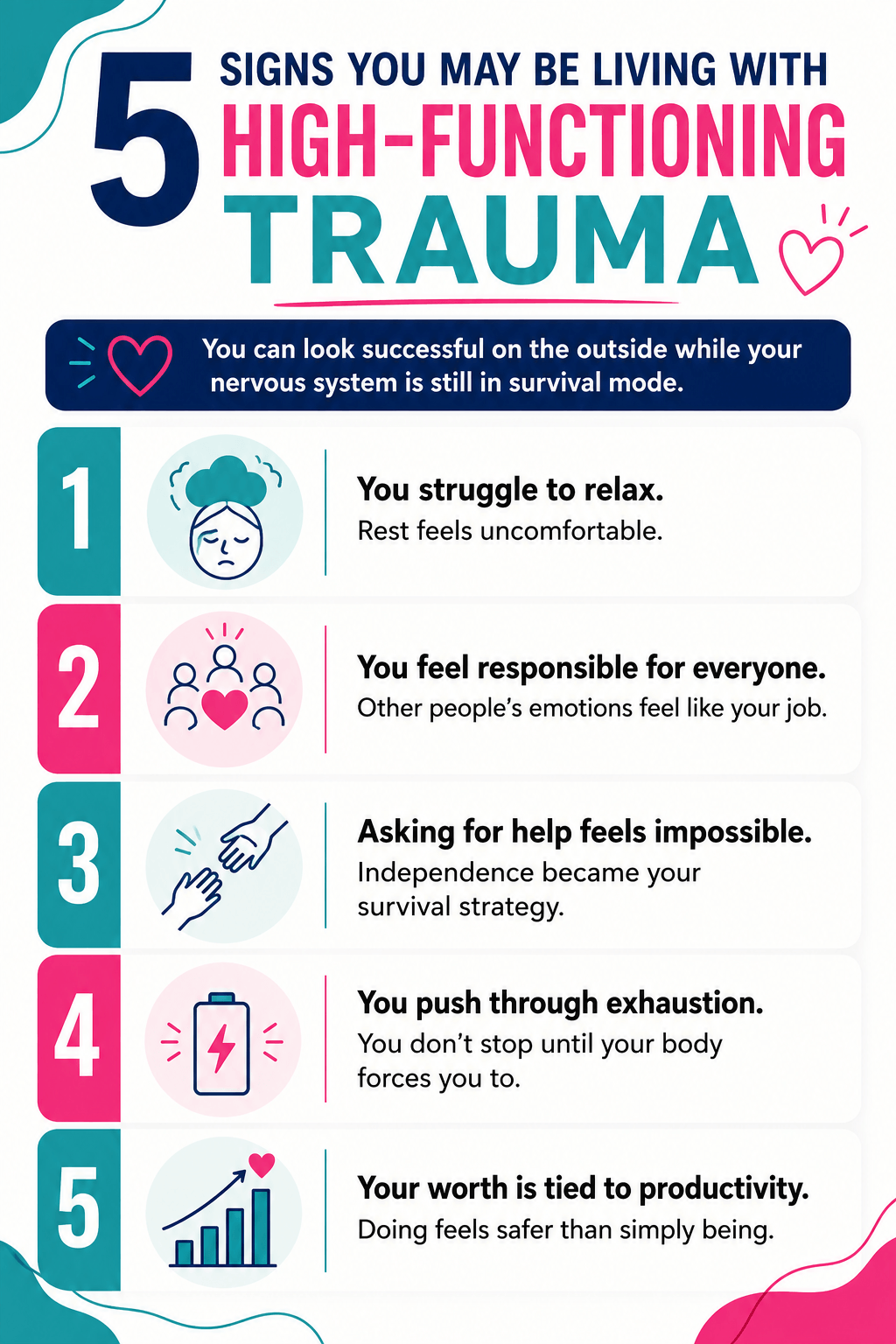
Not just that you're busy, you actually can't downshift. When things slow down, something in you gets uncomfortable, and some high-functioning PTSD patterns also include sleep disturbances, with rest interrupted by racing thoughts or hypervigilance. Rest feels unearned, or wasteful, or vaguely dangerous. You might notice that vacations are more anxious than relaxing, or that you're scrolling your phone the second you sit still, because being still just doesn't feel okay and busyness or distraction can act like avoidance behaviors.
You Feel Responsible for Everyone
Other people's emotions feel like your job. You notice when someone is upset and feel an immediate pull to fix it, often in ways tied to external validation. You over-explain, over-apologize, and find yourself managing how other people feel about you, constantly. The idea that someone might be disappointed in you is genuinely distressing, even when their disappointment isn't your fault and isn't your responsibility, and over time this pattern can make it harder to maintain relationships.
You Have a Hard Time Asking for Help
You will exhaust every possible option before asking someone else to carry something with you. Maybe asking feels like burdening people. Maybe it feels vulnerable in a way that makes your skin crawl. Maybe some part of you just genuinely doesn't trust that help will actually come through, so why bother. Whatever the specific shape it takes, dependence on others doesn't feel safe, and difficulty relying on people can shape relational patterns, especially after complex trauma.
You Keep Going Even When You're Exhausted
Your threshold for pushing through is very high, and that exhaustion can look like chronic fatigue. You've been pushing through your whole life. Sick? You can power through. Burned out? You'll rest after this one thing. You might not even realize how depleted you are until your body makes the decision for you, usually through illness, injury, or a breakdown that comes out of nowhere, and sleep problems may be there even while you keep functioning on the outside. Except it didn't come from nowhere. It came from a long time of not stopping, and those coping strategies can become exhausting over time.
Your Worth Feels Tied to Productivity
Good days are days when you accomplished something. On slow days, or rest days, or sick days, something in you registers as less-than, and that productivity-based self-worth can dull access to positive emotions. You might not be able to receive compliments without deflecting. You might struggle to enjoy an experience that isn't also productive in some way. The idea of just existing without doing, without contributing, without being useful, feels quite uncomfortable.
Survival Mode Can Get Mistaken for Success
Here's the part that makes high-functioning trauma so hard to recognize and so hard to treat: the symptoms look like assets. The same masking often shows up in high-functioning PTSD, where outward competence hides what the nervous system is carrying.
Hypervigilance looks like attention to detail. Overfunctioning looks like work ethic. Emotional caretaking looks like empathy. The inability to rest looks like dedication. And hyperindependence looks like strength.
The people around you probably reinforce this. You get praised for being reliable, you get promoted for your output, people tell you they don't know what they'd do without you. Underneath that, emotional detachment or emotional numbness can still be there. And some part of you knows you should feel good about that, but instead you feel... tired. And a little hollow.

High-functioning trauma often looks like success on the outside while the nervous system is running on survival mode underneath.
And like if you ever stopped producing, you would become invisible.
Sometimes the behaviors people praise are the same behaviors your nervous system developed to survive.
That's not a coincidence.
High-functioning trauma responses are so effective at mimicking success that they can go unrecognized for decades. You might not identify as a trauma survivor because your life looks too functional. Because you're too accomplished. Because nothing that bad happened, or at least nothing you can point to.
But trauma isn't only about what happened. It's about what your nervous system learned in order to cope with what happened. And a nervous system that learned to survive through over-performance and hypervigilance is still a nervous system in survival mode, regardless of how polished the exterior looks.
Doing Everything Yourself Isn't the Same as Feeling Safe
Hyperindependence is one of the most misunderstood trauma responses out there, partly because it gets so much cultural applause.
We live in a world that celebrates self-sufficiency. We call it independence, resilience, grit. We put it on vision boards. We tell people who don't need anyone else that they're strong.
What we don't talk about enough is that the need to do everything yourself. The deep discomfort with receiving help, the compulsive self-reliance, the inability to let people in, is often rooted in early experiences where depending on someone wasn't safe. Where help didn't come when you needed it. Where the people who were supposed to take care of you couldn't, or didn't, or made it cost too much.
Your nervous system drew a very logical conclusion from that: the only person you can actually count on is you.
That conclusion may have protected you then. It probably helped you survive in environments where it was genuinely true. But it's costing you something significant now — because real safety, real connection, real rest all require letting other people matter to you. They require the vulnerability of actually needing someone. And if needing someone still feels like a threat, that's not something you can think your way out of. It lives in the body. It lives in the nervous system. And it needs to be worked with there.
The Exhaustion No One Sees
There's a specific kind of tired that comes with high-functioning trauma. It's not just physical, though it's that too. It's the exhaustion of performing okayness for so long that you've lost track of what okay actually feels like, including the fatigue and other physical symptoms that can come with staying in survival mode.
Burnout in this context is layered. It's not just work burnout, it's relational burnout, emotional burnout, the burnout of being the capable one in every room you walk into. Of being the person who holds things together. Of managing everyone else's feelings while yours go quietly unattended.
Underneath the busy-ness, there's often loneliness. A particular kind of loneliness that comes from being surrounded by people who depend on you but not feeling truly known by any of them. You can't be known when you're performing. And when performing has been the price of admission to relationships for most of your life, intimacy starts to feel impossible.
There's numbness, too. When you've been overriding your own needs and emotions for long enough, the signal starts to go quiet. You stop knowing what you actually want. You stop knowing how you actually feel. Unresolved trauma can also surface through chronic pain or gastrointestinal issues, even when someone still appears fully functional. You function, but something is missing from the inside.
And then there's resentment. The slow, inner kind that builds when you give and give and give and nobody notices that you're running on empty. Sometimes that resentment gets directed outward, at the people who seem to take your reliability for granted. Sometimes it turns inward, into self-criticism and shame. Often both.
Some people call this functional freeze. You're moving. You're doing. You're checking the boxes. But there's a flatness underneath it, a going-through-the-motions quality that doesn't match the life that looks so full from the outside.
Why Rest Feels So Uncomfortable
This is worth sitting with for a minute, because it's one of the things that confuses people most about their own experience.
If you're exhausted, and you probably are, why can't you rest? Why does rest feel like a problem to be solved rather than a relief?
For a lot of people with trauma histories, rest wasn't safe growing up. Stillness meant something bad was about to happen, or that you weren't paying close enough attention, or that you were falling behind in whatever invisible performance was required of you. Your nervous system learned to associate rest with threat. And your nervous system doesn't update that association just because your circumstances changed.
There's also an identity piece. If your worth has always been tied to what you produce, then rest is a direct threat to your sense of self. Not resting doesn't just feel more productive, it feels like being a better person. A more deserving person. Rest feels like something you haven't quite earned yet.
And then there's the guilt. Rest means someone else might have to pick up what you're putting down. Rest means admitting you have limits. Rest means something might not get done the way it would if you'd done it yourself. All of that is intolerable when your nervous system still believes, in some deep cellular way, that everything is your responsibility and everything depends on you.
So you stay busy. And the busy-ness keeps the anxiety managed, keeps the underlying feelings at a distance, keeps you feeling like you're doing something to prevent the thing you're afraid of, even if you can't quite name what that thing is. That can also mean symptoms
You Were Meant for More Than Survival
Let's be clear about something: healing from high-functioning trauma is not about becoming less capable. It's not about dismantling your ambition or learning to care less about doing things well.
It's about getting to choose.
Right now, for a lot of people in this pattern, the high-functioning isn't really a choice, it's a compulsion. It's what the nervous system defaults to. It's what the old survival strategy requires. The doing and striving and managing isn't coming from a place of genuine desire; it's coming from a place of fear.
Healing is what happens when you can still be capable, still care, still achieve, but do it from a regulated nervous system rather than a frightened one. When productivity is something you engage with rather than something that runs you. When you can ask for help without it feeling catastrophic. When you can rest without the guilt spiral. When you can let someone else take care of something and not spend the whole time white-knuckling the outcome.
Your value is not your output. It never was. That belief was handed to you in an environment that didn't know how to love you for just existing, and it's been running the show ever since.
The work is to find out what's underneath it. To meet the parts of you that are still waiting to be told that they're enough. To build, slowly and with real support, a different felt sense of safety in your own body.
You were not built to carry everything alone. You've just been doing it so long it feels like the only option.
Can Therapy Help With High-Functioning Trauma?
Yes, but the kind of therapy matters.
High-functioning trauma is stored in the body and in the nervous system, which means talk therapy alone often isn't enough. Understanding your patterns intellectually is a good starting point, but insight rarely changes the behavior on its own. The compulsion to overfunction, the difficulty resting, the hypervigilance, those live below the level of conscious thought, and they need approaches that work at that level.
EMDR (Eye Movement Desensitization and Reprocessing)is one of the most well-researched treatments for trauma. It works by helping the brain reprocess distressing memories and experiences so they lose their emotional charge. For people with high-functioning trauma, EMDR can help address the root experiences that taught you that your worth was conditional, that rest wasn't safe, or that you couldn't depend on others and it can do it in ways that talking about those experiences often can't.
Somatic therapy works directly with the body and the nervous system. Because so much of the high-functioning trauma pattern is held somatically, in the physical bracing, the chronic tension, the inability to downregulate, somatic approaches help you build the capacity for regulation that may never have developed in childhood. You start to learn, at a body level, what safety actually feels like.
Parts work(including IFS, Internal Family Systems, and approaches drawing on Janina Fisher's structural dissociation model) helps you get curious about the different parts of yourself, the part that overfunctions, the part that fears rest, the part that still believes your worth is conditional. Rather than fighting these parts or trying to override them, parts work helps you understand them, build a relationship with them, and eventually help them update.
Attachment-focused work addresses the relational piece directly. The patterns that show up in your relationships, the hyperindependence, the difficulty receiving care, the fear of being truly known. Because so much of this pattern is rooted in early attachment experiences, the therapeutic relationship itself becomes part of the healing.
At Reclaim Therapy, we specialize in exactly this kind of work. Our therapists are trained in trauma-focused approaches, EMDR, somatic therapy, and parts work, and we understand the particular texture of high-functioning trauma. The high achievers. The reliable ones. The people whose lives look fine on the outside and who are quietly exhausted on the inside.

Many trauma survivors spend years believing their success means they're healed.
That if they were really that affected by their childhood, they wouldn't have built the life they've built. That people with real trauma don't function this well.
But functioning and feeling safe are not the same thing.
Achievement and peace are not the same thing.
Looking okay and actually being okay are not the same thing.
Sometimes healing isn't about learning how to do more. Sometimes it's about finally learning that you don't have to carry everything alone. That rest is allowed. That your worth was never something you needed to earn. That the part of you still performing for safety can, slowly, learn that the performance is no longer required.
That's real work. It's not fast. But it's the work that changes things, not just how you function, but how you actually feel. If you're ready for that, we're here.
🧡,

Frequently Asked Questions About High-Functioning Trauma
What is high-functioning trauma?
High-functioning trauma refers to the way some trauma survivors develop coping strategies like overachieving, overfunctioning, and hyperindependence that allow them to appear successful and capable on the outside while struggling significantly on the inside. It is not the same as a formal PTSD diagnosis, though it can overlap with traumatic stress disorder PTSD presentations. It is also not, by itself, a formal diagnosis. The trauma responses are real and present; they're just hidden behind productivity and reliability.
Can trauma make you overachieve?
Yes. For many people who experienced childhood emotional neglect, parentification, or unpredictable home environments, achievement became a survival strategy. Doing more, being more, and never dropping the ball was a way to stay safe, earn love, or avoid consequences. That drive doesn't disappear in adulthood, it just often gets called ambition.
Why am I successful but still exhausted?
Because functioning and feeling safe are not the same thing. A nervous system running on chronic stress and hypervigilance is working overtime, even when someone seems to function effectively in daily life while still dealing with panic attacks, increased anxiety, or re experiencing symptoms. The exhaustion you feel isn't weakness. It's the cost of carrying a survival strategy for decades.
Can CPTSD cause hyperindependence?
Absolutely. When early caregiving relationships were unreliable, painful, or emotionally unavailable, many people learned that depending on others wasn't safe. Complex PTSD can develop from repeated trauma or prolonged childhood trauma and often includes added struggles with emotional regulation. Hyperindependence is a deeply logical adaptation, it protected you. In adulthood, it often shows up as an inability to ask for help, a strong need to control, and discomfort with vulnerability.
Why can't I relax when everything is done?
Because rest was never actually safe. For many trauma survivors, stillness growing up meant something bad was coming, or it meant you weren't doing enough to prevent it. Your nervous system learned to stay activated. Relaxing doesn't feel like relief, it feels like a threat. This is one of the clearest signs that the body, not the mind, is where the healing needs to happen.
Can trauma cause perfectionism?
Yes. Perfectionism is often a trauma response rooted in the belief that if you just do everything right, you'll be safe, loved, or enough. It's a way of trying to control outcomes in environments that felt chaotic or conditional. PTSD is a common mental health condition, and a proper diagnosis depends on clinical diagnostic criteria. While perfectionism can look like high standards, it is also common in high-functioning people and may coexist with comorbid PTSD, substance use, substance abuse, or other mental illness concerns when symptoms go unaddressed; underneath it is usually a fear of what happens if you fall short.