
When You Can’t Stop Thinking About Your Birth Experience
If you can't stop replaying your birth, even though everything is "technically fine," you might be experiencing unresolved birth trauma.
Your nervous system is trying to process an experience it didn’t get to finish in the moment. Birth trauma therapy, especially EMDR and somatic approaches, can help your body and mind move through what’s still stored.
Maybe it’s at 3am when you’re up with the baby. Maybe it’s in the shower. Maybe it’s when someone casually asks how the birth went and you say “it was a lot” and then change the subject.
You keep coming back to it. The moments. The decisions that weren’t really decisions. What was said. What wasn’t said. The thing that happened that you can’t quite explain to anyone, including yourself.
And on paper, everything’s fine. The baby is here. You’re here. Maybe the discharge papers even said “uncomplicated” or “healthy” or some other word that doesn’t match what your body remembers. Acknowledging that your experience was traumatic is an important first step in healing, as trauma is a subjective experience—your feelings and perceptions are valid, regardless of how others see it.
So why does this traumatic birth experience still feel like it’s playing out in the background of your life?
What is birth trauma?
Birth trauma, also known as childbirth trauma, is the imprint your nervous system carries when something about your labor, delivery, or postpartum experience overwhelmed your ability to feel safe, heard, or in control. The medical chart and your body don’t always agree on what counts as traumatic, and traumatic childbirth experiences can take many forms.
There’s a version of birth trauma you’d recognize—physical birth trauma. Emergency. Hemorrhage. NICU. The kind that has a clear before and after. Physical birth trauma can include significant injuries such as third or fourth degree perineal lacerations, emergency C-sections, or complications like hemorrhage and fetal distress.
And there’s another version that’s harder to name—emotional birth trauma. The cervical check that no one explained. The moment your epidural didn’t work and the room kept moving without you. The provider who walked in without making eye contact. The hours of being told to just relax. The decision that wasn’t really yours, but you signed for anyway. Emotional birth trauma is characterized by feelings of powerlessness, fear, and lack of control during the childbirth experience, which can occur even in medically uncomplicated deliveries.
What is birth trauma, really? It’s not only about what happened on the medical chart. It’s about what your nervous system did with what happened. Whether you felt safe. Whether you were heard. Whether you had any sense of agency in the room. Care-related interpersonal trauma can occur when the care team is disrespectful, ignores, or coerces the birthing person, leading to distress and trauma.
A traumatic birth experience can include physical danger, but it doesn’t require it. Your body can register threat, helplessness, or terror even in a birth that everyone else called “smooth.”
The prevalence and risk factors for birth trauma are significant: up to 45% of new mothers report having experienced birth trauma, and research indicates that 1 in 3 birthing people perceive their childbirth as traumatic, with 4-6% developing Post-Traumatic Stress Disorder (PTSD) as a result. Approximately 1 in 5 U.S. mothers report experiencing some form of mistreatment during pregnancy and delivery care, which can contribute to feelings of trauma. Risk factors include medical complications, lack of support, prior trauma, and mental health history, making some individuals more vulnerable to birth trauma.
When your birth ended in loss
If your baby didn't survive the birth or died shortly after, your experience is both birth trauma and grief, and the two are often woven together. Stillbirth, neonatal loss, and traumatic birth can live in the same body at the same time. You don't have to address them in any particular order, and a perinatal loss therapist trained in trauma can hold both at once.
The labor that brought your baby into a world they didn't get to stay in. The hours and days that followed. The way the medical environment shaped what you were able to hold, see, or know.
There's no right way through this and no timeline you're supposed to meet. Some people need grief work and trauma work in different orders. Others need both held at once by someone trained for this specific kind of work. Plenty of people aren't ready for any of it for a long time, and that doesn't mean you're behind.
If this is your experience, perinatal loss therapy exists, and the right therapist won't ask you to perform anything you aren't actually feeling.
Why can't I stop thinking about my birth?
If you keep replaying your birth, your nervous system is trying to process an experience it didn’t get to fully respond to in the moment. These looping thoughts are not just overthinking—they are trauma related symptoms, reflecting the range of psychological and emotional responses your body and mind have to unresolved birth trauma.
When your system goes through something it didn’t have time to process, it tries to come back to it. Over and over. The mind replays. The body re-enacts. You find yourself telling parts of the story to a friend, then stopping, then trying again with someone else, hoping this time it’ll feel more finished.
Sometimes the memories show up uninvited as intrusive symptoms. A smell. A word. A position your body lands in. The lighting in a room. Suddenly you’re back there, even though your eyes are open and the kettle is boiling.
Other times you avoid. You can’t watch birth scenes in shows. You changed providers and don’t want to drive past the hospital. You skip the postpartum support group because you can tell your story doesn’t fit theirs.
This is what post traumatic stress after childbirth can look like. Not always the version you’ve seen on TV. Childbirth-Related Post-Traumatic Stress Disorder (CB-PTSD) manifests as intrusive thoughts, flashbacks, avoidance of triggers, and hyperarousal. Sometimes it’s the way your day reorganizes itself around what you can and can’t think about. CB-PTSD affects roughly 5% to 20% of postpartum parents. Research indicates that 4-6% of birthing people develop PTSD after a traumatic birth experience, and up to 1 in 10 may develop symptoms of post-traumatic stress disorder.
What are the symptoms of birth trauma?
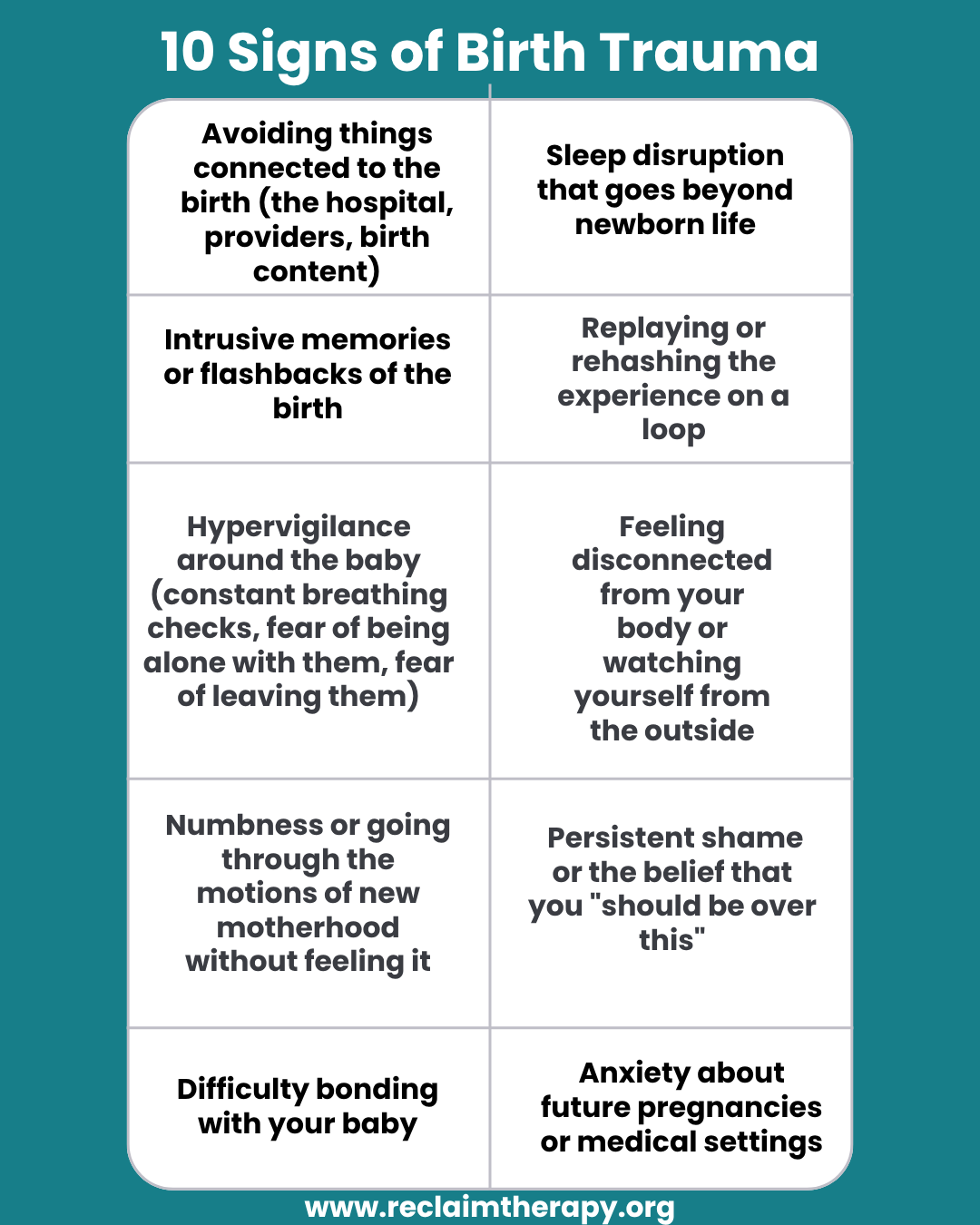
Birth trauma symptoms include intrusive memories, hypervigilance, body disconnection, persistent shame, numbness, difficulty bonding, and avoidance of anything that reminds you of the birth. These symptoms are not only emotional but can also be classified as mental health conditions, such as postpartum depression, anxiety, or PTSD. Symptoms can appear right away or surface months and years later.
Common signs of birth trauma:
Intrusive memories or flashbacks of the birth
Replaying or rehashing the experience on a loop
Hypervigilance around the baby (constant breathing checks, fear of being alone with them, fear of leaving them)
Feeling disconnected from your body or watching yourself from the outside
Numbness or going through the motions of new motherhood without feeling it
Persistent shame or the belief that you “should be over this”
Avoiding things connected to the birth (the hospital, providers, birth content)
Difficulty bonding with your baby
Anxiety about future pregnancies or medical settings
Sleep disruption that goes beyond newborn life
Birth trauma can significantly impact maternal mental health and overall well-being, affecting emotional and psychological recovery after childbirth. It can also disrupt relationships, including parent-child attachment, emotional intimacy with partners, and interactions with other children in the family. Unresolved birth trauma may lead to chronic anxiety, challenges with emotional regulation, and attachment difficulties. Impaired attachment formation can disrupt the vital maternal-infant bond, making it difficult for the parent to respond to the child's emotional cues.
You might feel cut off from your body. Like you’re operating it from somewhere slightly behind your eyes.
You might check the baby’s breathing more times than you can count. You might not be able to leave them with anyone, or you might want to leave them with everyone because being alone with them brings the panic back.
You might be carrying a low, persistent shame. Other people had hard births and seem fine. You should be over this by now. You should be grateful. You are grateful, and also.
You might struggle to bond. Not because you don’t love your baby, but because part of your system is still in the room where it happened.
Postpartum trauma can look like all of this, none of this, or some combination of things that doesn’t quite fit the lists you’ve read.Why does birth trauma get dismissed?
Birth trauma is often minimized because the outcome of a healthy baby gets used to close the door on everything else that happened during the experience. When providers, family, or even you focus only on "at least the baby is okay," the harder parts of the experience can go unnamed and unprocessed.
There's a script you've probably heard. Maybe out loud, maybe in your own head.
"At least the baby's healthy."
"At least you're both okay."
"That's just how birth goes sometimes."
These sentences aren't wrong, exactly. They're just incomplete. They take the most concrete outcome (a living baby, a body that survived) and use it to close the door on everything else that happened in that room.
If your provider didn't acknowledge what was hard, you might have walked out of the hospital questioning whether it was actually hard. If your friends and family kept reflecting back gratitude, you might have started performing it. If the discharge paperwork said everything went well, you might have decided your body was lying to you when it kept bringing you back.
Postpartum trauma often gets minimized because acknowledging it complicates a story everyone wants to be simple. New baby. Healthy mom. The end.
But your experience doesn't end when the medical chart does.
Why does birth trauma get dismissed?
Birth trauma is often minimized because the outcome of a healthy baby gets used to close the door on everything else that happened during the experience. When providers, family, or even you focus only on "at least the baby is okay," the harder parts of the experience can go unnamed and unprocessed.
There's a script you've probably heard. Maybe out loud, maybe in your own head.
"At least the baby's healthy."
"At least you're both okay."
"That's just how birth goes sometimes."
These sentences aren't wrong, exactly. They're just incomplete. They take the most concrete outcome (a living baby, a body that survived) and use it to close the door on everything else that happened in that room.
If your provider didn't acknowledge what was hard, you might have walked out of the hospital questioning whether it was actually hard. If your friends and family kept reflecting back gratitude, you might have started performing it. If the discharge paperwork said everything went well, you might have decided your body was lying to you when it kept bringing you back.
Postpartum trauma often gets minimized because acknowledging it complicates a story everyone wants to be simple. New baby. Healthy mom. The end.
But your experience doesn't end when the medical chart does.
Why does my birth still feel like it's happening?
Trauma doesn’t get stored as an ordinary memory. It gets held in the body as an unfinished experience, which is why your nervous system can drop back into the state of the birth even when you’re nowhere near the hospital. Talking about it alone often isn’t enough to shift it.
Your nervous system doesn’t run on calendar time.
When something overwhelming happens and your body doesn’t get to fully respond (whether that means moving, fighting, fleeing, being heard, being held, being safe), the experience can stay stored in your system as unfinished. Not as a memory you call up on purpose, but as a state you keep dropping back into. Nervous system dysregulation can alter a child's early stress-response systems, causing severe mood swings and environmental hypersensitivity, which can significantly impact overall well-being.
This is why retelling the story to your partner or your therapist can sometimes help and sometimes not be enough. Insight isn’t the same as resolution. Knowing why you feel this way doesn’t always change how you feel.
The body keeps its own records and sometimes the only way to update them is to work with the body, not just talk about it.
What therapy helps with birth trauma?
EMDR therapy and somatic therapy are two of the most effective approaches for unresolved birth trauma, and both are recognized as trauma-focused therapies within perinatal mental health care. Trauma-focused therapy is a crucial component of perinatal mental health, addressing the psychological well-being of women before, during, and after childbirth.
Good birth trauma therapy doesn’t ask you to relive what happened in graphic detail. It works with what your nervous system is still holding and helps it move, drawing on evidence from nursing research and theoretical frameworks that inform best practices in maternal care.
A few approaches that tend to do this well, as supported by research in reproductive and infant psychology and nursing research, include:
EMDR for birth trauma helps your brain reprocess the stuck pieces of the experience. The images, the body sensations, the beliefs you walked away with (“I wasn’t safe,” “no one was listening,” “something is wrong with me”). With EMDR, you don’t have to retell the whole story start to finish. You work with what’s still alive in your system and let it process through.
Somatic therapy for birth trauma works more directly with the body, and approaches like Somatic Experiencing trauma therapy focus on the sensations, movements, and survival responses your system never got to complete. The held breath. The tension in your pelvis. The shoulders that haven’t fully dropped since the labor started. A somatic practitioner helps you notice these patterns and slowly let your body complete what it didn’t get to complete in the moment.
Parts work (IFS-informed approaches) can help if different parts of you have come forward through this experience. The part that feels furious at your provider. The part that froze. The part that still feels like she failed you. The work isn’t to argue them out of existence. It’s to listen to what they’ve been carrying.
All three approaches share something important. They go at the pace your system can actually tolerate. No flooding. No pushing through. Small pieces, processed safely, with you in the driver’s seat.
What does healing from birth trauma look like?
Healing from birth trauma doesn’t mean forgetting what happened or feeling grateful for the experience. Healing matters—recovery and emotional well-being are crucial parts of the postpartum journey. It means being able to think about the birth without your heart racing, feeling more present in your body, having less reactivity around triggers, and the experience taking up less space in your daily life. Processing and sharing your birth story, with appropriate boundaries and support, can be an important step in healing from unresolved birth trauma.
It tends to look like this:
You can think about the birth without your heart racing. You can talk about it in a way that feels like you’re describing something that happened, instead of something that’s happening. The intrusive moments come less often. When they do come, they don’t take you out for the rest of the day.
You feel more in your body again. Bonding, if it was hard, often gets easier as your system stops bracing. You stop feeling like you’re failing at motherhood because part of you is still recovering from how it began.
You’ll still remember. The remembering just won’t take as much from you.
When should I seek therapy for birth trauma?
You don’t need to be in crisis to benefit from birth trauma therapy. If your symptoms have lasted longer than a few months, if certain triggers still bring the experience back, if you’re avoiding future pregnancies because of how the last birth went, or if it’s affecting your mental health, daily life, or your relationship with your baby, working with a trauma-trained therapist can help support your maternal mental health.
If you’re months or years out from the birth and the feelings haven’t softened, that’s information. If certain dates, smells, or appointments still bring it back, that’s information. If you’re avoiding another pregnancy for reasons that go past lifestyle and into “I cannot put my body through that again,” that’s information too.
During the postpartum period, screening for unresolved birth trauma and providing access to support services are crucial for improving maternal mental health outcomes. Birth trauma therapy can help whether the birth was last month or six years ago. Trauma doesn’t have an expiration date, and neither does the option to work with it.
Where can I find birth trauma therapy in Pennsylvania?

If you're looking for a birth trauma therapist in Pennsylvania, the team at Reclaim Therapy specializes in EMDR, somatic therapy, and trauma-focused care for birth trauma, postpartum trauma, and perinatal loss. We see clients in person at our Horsham, PA office and statewide through telehealth, including Montgomery County, Bucks County, and the greater Philadelphia area.
You don't have to come in with the language for what you're carrying. If you're not sure whether what's been showing up is birth trauma, postpartum anxiety, grief, or some combination of all of it, that's something we can sort through together.
If you'd like to talk about whether this kind of work is a fit, you can set up a free consultation.
🧡,

Frequently Asked Questions About Birth Trauma
Can you have PTSD from giving birth?
Yes. PTSD after childbirth is recognized in clinical research and can develop after a birth that involved fear, loss of control, medical emergencies, perceived threat to you or your baby, or feeling unheard during the experience. It can develop after a birth that looked uncomplicated on paper.
How long does birth trauma last?
There's no fixed timeline. Some people find their symptoms ease within weeks. For others, symptoms stay or intensify for months and years. Birth trauma doesn't have an expiration date, and neither does the option to work with it through therapy.
Are flashbacks after childbirth normal?
Intrusive memories and flashbacks are a common feature of unresolved birth trauma, not a sign you're broken. They're your nervous system's way of trying to process something it didn't get to finish. They can be triggered by smells, sounds, body positions, or unrelated medical settings.
Can birth trauma affect bonding with my baby?
Yes, and not because you don't love your baby. When part of your system is still in the room where the birth happened, it can be hard to feel fully present with your baby. This often softens with the right kind of trauma-focused therapy.
Will birth trauma go away on its own?
Sometimes. For some people, time, support, and rest are enough. For others, the trauma stays stored in the body and needs more direct work to process. If your symptoms have been around for more than a few months and aren't easing, working with a trauma-trained therapist can help.
Is birth trauma the same as postpartum depression?
No. They can overlap, and you can have both at the same time. Postpartum depression centers on mood, motivation, and connection. Birth trauma centers on a specific overwhelming experience that the nervous system hasn't processed. They respond to different kinds of treatment.
Is EMDR safe for birth trauma?
Yes. EMDR is widely used for birth-related trauma and PTSD after childbirth. A trained EMDR therapist will pace the work to your nervous system, build in resources before reprocessing, and work with you on what's tolerable. You stay in the driver's seat the whole time.
Sarah Herstich* is a Licensed Clinical Social Worker, Certified EMDR Therapist, and Somatic Experiencing Practitioner, and the founder of Reclaim Therapy, a trauma-focused group practice based in Horsham, Pennsylvania, serving clients across PA via telehealth. Her work focuses on complex trauma, EMDR, and somatic approaches to healing.*