
If you've been managing anxiety for a while, you've probably tried a few things.
Therapy. Medication. Breathing exercises. Maybe a meditation app you opened twice and then abandoned somewhere in your phone's graveyard.
Some of it helped. Some of it didn't. And if you're still here, reading this, there's a decent chance something hasn't shifted the way you hoped it would.
EMDR Therapy might just be what you're missing.
Not because it's magic, but because it works differently than most anxiety treatments. And for a lot of people, that difference, well, it makes all the difference.
Wait, Isn't EMDR Just for PTSD?
This is the most common thing we hear at Reclaim Therapy, and it makes sense. EMDR, which stands for Eye Movement Desensitization and Reprocessing, was originally developed to treat PTSD. It’s one of the most researched trauma therapies in the world, recognized by both the World Health Organization and the American Psychological Association.
But the research has expanded considerably since then. EMDR treatment is now used effectively for anxiety, panic attacks, phobias, depression, mood disorders, eating disorders, severe stress, and a range of other concerns that don’t fit neatly into a PTSD diagnosis. Anxiety EMDR therapy is also applied to address symptoms related to trauma and other psychological issues.
The reason it works for all of these is the same reason it works for trauma. It addresses what’s happening in the nervous system, not just what’s happening in your thoughts.
Tune in to the Complex Trauma Podcast for more about trauma recovery!
Why Anxiety Is Often a Nervous System Problem, Not a Thinking Problem
Here's something that doesn't get said enough in anxiety treatment: most anxiety isn't irrational. It's a nervous system that learned, usually a long time ago, that certain situations, certain feelings, certain kinds of attention or conflict or uncertainty aren't safe.
That learning happened for a reason. Maybe you grew up in an unpredictable environment. Maybe something happened that your brain never fully processed. Maybe you spent years in a situation where staying hypervigilant actually protected you.
The nervous system doesn't unlearn those patterns just because the circumstances have changed. It keeps doing its job, even when the original threat is long gone.
This is why telling an anxious person to just think more rationally has limited returns. The anxiety isn't primarily a thinking problem. It's a body problem. A nervous system problem. And that requires a different kind of intervention.
The EMDR Process and Adaptive Information Processing
At the heart of EMDR therapy is the concept of Adaptive Information Processing (AIP), which suggests that our brains are naturally equipped to process and heal from traumatic memories—unless something gets in the way. When overwhelming or distressing events occur, the brain’s natural ability to process information can become blocked, leaving traumatic memories “stuck” and continuing to trigger anxiety symptoms long after the event has passed.
EMDR therapy is designed to help the brain resume this natural healing process. During an EMDR session, a licensed therapist will guide you through a structured process that begins with identifying a target memory or experience that’s fueling your anxiety. This could be a specific event, a recurring negative thought, or even a persistent body sensation. The therapist will assess your current emotional state and then use bilateral stimulation—often in the form of eye movements, tapping, or auditory tones—to help your brain reprocess the memory.
This process involves revisiting the target memory in a safe, controlled way, allowing your brain to integrate it more adaptively. Over time, the emotional charge and anxiety symptoms associated with the memory decrease, and you may find yourself responding to similar situations with greater calm and resilience. EMDR has been shown to be effective for a range of anxiety disorders, including generalized anxiety disorder, panic disorder, and post traumatic stress disorder, and can significantly reduce the intensity and frequency of emotional flashbacks and PTSD flashback symptoms, making it a versatile tool for those seeking relief from persistent anxiety.
How EMDR Actually Works for Anxiety
EMDR works by helping your brain finish processing the experiences that are keeping your nervous system stuck in threat-detection mode.
When something overwhelming happens, your brain sometimes can’t fully process it in the moment. Those unprocessed memories get stored in a way that keeps them feeling raw and present, even years later. This is consistent with the Adaptive Information Processing (AIP) model, which suggests unprocessed memories can lead to emotional instability. Triggers, physical anxiety responses, that sense that danger is always just around the corner—these are often signs of an unfinished process in the nervous system.
EMDR uses bilateral stimulation, typically eye movements, tapping, or audio tones, to help your brain complete that processing. Through reprocessing therapy, EMDR supports the brain's natural ability to heal by targeting traumatic experiences, disturbing events, and disturbing memories, allowing for the desensitization of negative memory. The suggested mechanisms of EMDR include bilateral stimulation facilitating the brain’s natural healing process. The memory doesn’t disappear, but the charge attached to it changes. It starts to feel like something that happened in the past rather than something that’s still happening now.
For anxiety specifically, this often means working with the early experiences that taught your nervous system it wasn’t safe to relax, to trust, to take up space. EMDR helps replace negative beliefs with adaptive beliefs and positive beliefs, fostering new positive thought processes and positive thought processes. As these negative beliefs and intense emotions are reprocessed, the anxiety that developed to protect you from them often shifts too. This process is part of a healing journey that involves reprocessing therapy work to restore emotional resilience.
What EMDR for Anxiety Actually Looks Like in Sessions
One of the things people find most surprising about an EMDR therapy session is that you don’t have to retell everything in detail. You don’t have to narrate the whole story of what happened. We can work with body sensations, emotions, and the beliefs connected to a memory without requiring a full verbal account.
At Reclaim Therapy in Horsham, we don’t jump straight into processing. The early phases of EMDR are dedicated to history taking, understanding your nervous system, and building resources. An EMDR therapy session follows an 8-phase EMDR therapy process: history taking, preparation, assessment, desensitization, installation, body scan, closure, and reevaluation. For people with anxiety, especially those with complex trauma or a history of high-functioning survival mode, this preparation phase is everything. We won’t move into processing until your nervous system has somewhere safe to land.
During the assessment phase, your therapist will assess your current symptoms and help you identify painful memories, painful events, and emotional triggers. A typical EMDR session might involve identifying a specific memory, image, or body sensation connected to the anxiety, noticing the beliefs and feelings attached to it, and then using bilateral stimulation—often rapid eye movement—to help the brain process it. Desensitization and reprocessing EMDR are core components of this process. During the desensitization phase, clients focus on negative beliefs and disturbing emotions while following the therapist's finger with their eyes, which allows them to process the trauma. You may feel physical sensations and body tension when focusing on these memories. In the installation phase, you focus on a positive belief to replace the negative belief associated with the trauma, strengthening the new belief until it is fully accepted. We check in with your body throughout, and vivid dreams or negative emotions may occur as part of the emotional processing. We close every session with grounding. You leave regulated, not raw.
Treatment sessions vary in number depending on individual needs and the complexity of symptoms, but even a moderate number of sessions can lead to significant improvement. EMDR therapy has been shown to be as effective as cognitive-behavioral therapy (CBT) in reducing anxiety symptoms and treating conditions like PTSD and panic disorders. It is important to work with a qualified EMDR therapist to ensure safe and effective treatment.
Body Scan and Closure in EMDR
A unique and powerful part of the EMDR process is the body scan. After working through a target memory with bilateral stimulation, your therapist will guide you to gently scan your body from head to toe, noticing any physical sensations that remain. This step is crucial because anxiety and traumatic memories often live not just in our minds, but in our bodies—showing up as tension, discomfort, or even pain.
By bringing mindful attention to these sensations, you and your therapist can identify any lingering distress that might need further reprocessing. If tension or discomfort is detected, additional rounds of bilateral stimulation may be used to help release these sensations, supporting your nervous system’s return to a more regulated state, much like Somatic Experiencing trauma therapy focuses on helping the body complete unresolved survival responses.
Closure is the final step in each EMDR session, ensuring you leave feeling grounded and safe. Your therapist may guide you through relaxation techniques such as deep breathing, visualization, or progressive muscle relaxation to help your body and mind settle. This focus on closure helps you integrate the work done in session, so you can move forward with a sense of calm and stability, even after exploring difficult memories.
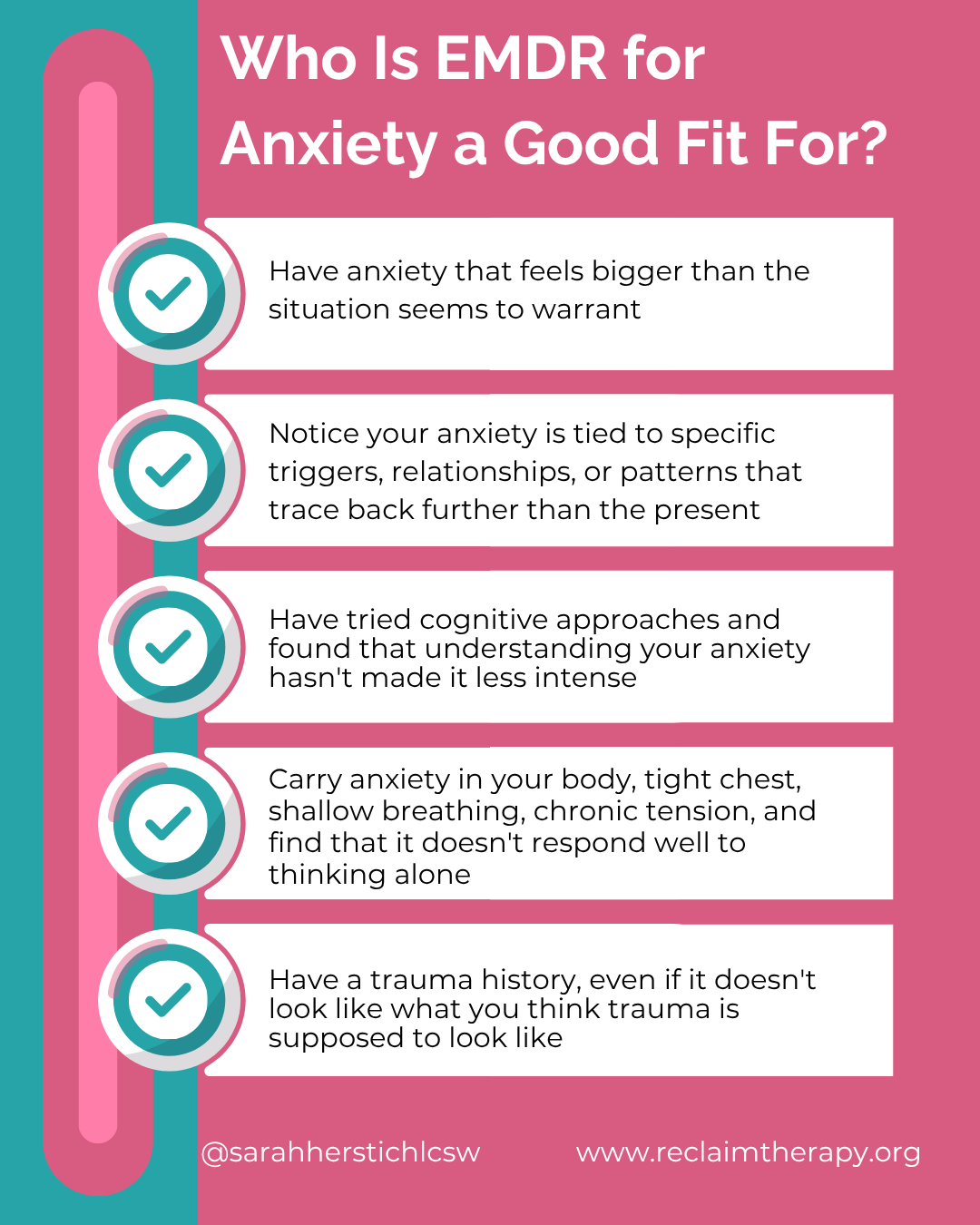
Who Is EMDR for Anxiety a Good Fit For?
EMDR tends to be a strong fit if you:
Have anxiety that feels bigger than the situation seems to warrant
Notice your anxiety is tied to specific triggers, relationships, or patterns that trace back further than the present
Have tried cognitive approaches and found that understanding your anxiety hasn't made it less intense
Carry anxiety in your body, tight chest, shallow breathing, chronic tension, and find that it doesn't respond well to thinking alone
Have a trauma history, even if it doesn't look like what you think trauma is supposed to look like
It's worth noting that EMDR for complex trauma and anxiety requires a therapist who knows how to pace the work carefully. Moving too fast with a nervous system that has been in survival mode for years can be overwhelming rather than helpful. This is something the therapists at our Horsham practice take seriously.
EMDR vs Other Therapies
EMDR therapy stands apart from other approaches like cognitive-behavioral therapy (CBT) or exposure therapy in several important ways. Unlike CBT, which focuses on changing thoughts and behaviors through discussion and homework, or exposure therapy, which involves gradually confronting feared situations, EMDR does not require you to relive traumatic events in detail or spend countless sessions talking about your symptoms.
Instead, EMDR uses bilateral stimulation to help your brain reprocess traumatic memories and reduce anxiety symptoms, often leading to significant reduction in distress in just a few sessions. This therapy technique has proven extremely beneficial for a wide range of anxiety disorders, including obsessive compulsive disorder and panic disorder, as well as for patients suffering from posttraumatic stress disorder and other forms of mental illness, including trauma-related experiences like maladaptive daydreaming and dissociation.
EMDR can also be integrated with other treatments, such as CBT or medication, to create a comprehensive treatment plan tailored to your needs. It’s important to work with a qualified, licensed mental health professional who has specialized training in EMDR to ensure the process is safe and effective. The American Psychiatric Association recognizes EMDR as a valid and evidence-based treatment for PTSD and other anxiety disorders, and research consistently shows that EMDR can lead to significant improvements in symptoms and overall quality of life for those struggling with anxiety.
If you’re seeking a therapy that addresses both the mind and body, and offers the possibility of relief in just a few sessions, EMDR may be the extremely beneficial approach you’ve been searching for.
EMDR Therapy for Anxiety in Horsham, PA and Throughout Pennsylvania

If you've been searching for an EMDR therapist near you in Montgomery County, the Philadelphia area, or anywhere in Pennsylvania, Reclaim Therapy offers EMDR for anxiety, complex trauma, and CPTSD both in person at our Horsham office and via telehealth throughout the state.
Our therapists are trauma specialists first. Every one of them has advanced EMDR training, and several are EMDRIA certified or working toward certification. We integrate EMDR with somatic work and parts work because anxiety rarely lives in just one place, and healing shouldn't either.
We work with high-functioning adults who look like they have it together on the outside and are exhausted by how hard they're working to keep it that way. If that's you, you're in the right place.
The first step is a free 15-minute consultation. We'll talk about what you're carrying, answer your questions, and figure out together whether EMDR Therapy at Reclaim Therapy is the right fit.
🧡,

Frequently Asked Questions About EMDR Therapy for Anxiety
Does EMDR work for anxiety? Yes. While EMDR was originally developed for PTSD, research has expanded to support its use for anxiety, panic attacks, phobias, and other concerns rooted in nervous system dysregulation. It works by targeting the underlying experiences that taught the nervous system to stay on high alert.
How is EMDR different from CBT for anxiety? CBT works primarily with thoughts and behaviors. EMDR works directly with the nervous system and the memories or experiences driving the anxiety response. For people whose anxiety hasn't fully responded to cognitive approaches, EMDR often reaches a layer that talk therapy alone can't access.
How many EMDR sessions does it take to see results for anxiety? It depends on the person and what's driving the anxiety. Some people notice shifts relatively quickly. For those with complex trauma or longstanding anxiety patterns, the work typically takes longer, and a significant portion of that time is spent in preparation before any processing begins. We never rush this.
Is EMDR available online in Pennsylvania? Yes. Reclaim Therapy offers telehealth EMDR throughout Pennsylvania using tapping or audio tones for bilateral stimulation. Many clients find online EMDR just as effective as in-person sessions.
How do I find an EMDR therapist near me in Montgomery County or the Philadelphia area? Reclaim Therapy is located at 400 Horsham Rd, Suite 100 in Horsham, PA and serves clients throughout Montgomery County, Bucks County, Philadelphia, and surrounding areas. We also offer telehealth throughout Pennsylvania. You can book a free consultation directly on our website.
Can EMDR help with anxiety if I don't have a trauma history? EMDR can still be helpful, but at Reclaim Therapy we find that most anxiety, when you trace it back far enough, does have roots in earlier experiences even if those experiences don't look like what most people think of as trauma. Part of the work is understanding what's actually driving the anxiety before we decide together what the best approach is.