
You know the voice…
The one that shows up the second you try something new, speak up in a meeting, or just look in the mirror on a not so great day.
You’re too much. Not enough. Who in the world do you think you are? Ugh, seriously? You are such an idiot. These are the kinds of harsh words and negative self talk your inner critic uses, filling your mind with negative thoughts that can impact your confidence and well-being.
If you’ve spent any time in therapy or self-help spaces, you’ve probably been told to challenge that voice, reframe it, or replace it with something more positive.
And, if you’re like most of the people we work with at Reclaim Therapy in Horsham, Pennsylvania, that advice has landed with all the effectiveness of telling an anxious person to “just calm down.”
So let’s try something different.
What Is the Inner Critic, Really?
The inner critic isn’t a character flaw and it’s definitely not evidence that something is fundamentally wrong with you.
In most cases, it is a learned survival strategy rooted in psychology and shaped by early experiences as a child. Childhood experiences, including parental influences, societal expectations, and core beliefs, play a significant role in the development of self criticism and the inner critic. When growing up in environments where being “too much” had consequences, where mistakes weren’t safe, or where love felt conditional, your nervous system learned to get ahead of the threat by doing the criticizing first. If you tear yourself down before someone else does, it hurts less.
Psychology offers various frameworks for understanding these patterns, and system books—such as pattern system books—provide structured approaches to recognizing and working with self-criticism, inner dialogue, and emotional processes.
In Internal Family Systems therapy, often called IFS or parts work, the inner critic is understood as a protector part. Not the enemy. A younger, frightened piece of you doing a very exhausting job it was never supposed to do forever.
The emotional impact of the inner critic is significant, often triggering difficult emotions and feelings such as shame, self-doubt, and frustration. Recognizing and becoming aware of these patterns is a key step toward self awareness and healing.
That reframe is important because you can’t shame a part of yourself into silence. By shifting your perspective and forming a clearer idea of your inner critic, you can begin to work with it rather than against it.
Why Positive Thinking Doesn't Quiet Negative Self Talk from the Inner Critic
When people try to quiet the inner critic through affirmations or reframing alone, the voice often gets louder. There’s a neurological reason for that.
Your nervous system is wired to prioritize threat. When a critical thought carries real emotional charge, the body responds as if the threat is real—even though the inner critic often distorts your perception of reality. That’s simply how the brain is designed.
Trying to think your way out of a somatic experience is like trying to logic your way out of a panic attack. When the nervous system is activated, regaining control and focus becomes especially challenging. The body has to be part of the equation. This is something the therapists at our Horsham practice come back to again and again, whether we’re doing parts work, EMDR, or Somatic Experiencing with clients across Montgomery County and throughout Pennsylvania.
How to Actually Silence Your Inner Critic
The honest answer: the goal isn’t necessarily to silence it permanently. The goal is to stop letting it run your life unchecked and to acknowledge its presence with empathy and self-compassion, like you would for a friend. This is a wonderful step toward personal growth.
These are the approaches we use with clients at Reclaim Therapy, drawing on IFS, EMDR, and Somatic Experiencing:
Notice it in your body first
Before you engage with the content of the critical thought, pause and notice where you feel it. Tight chest. Shallow breath. Jaw clenching. That physical sensation is data. It tells you your nervous system has activated, and that no amount of rational reframing is going to land right now. Acknowledge that the inner critic is present—this is the first step in changing your relationship with it.
A simple orienting practice, like slowly looking around the room and naming five things you can see, can help your nervous system shift out of threat-detection mode before you try to do any cognitive work. This is foundational in somatic therapy, and it’s something we teach clients doing EMDR in our Horsham office before we ever approach a traumatic memory.
Get curious instead of combative
This is the parts work piece. Instead of arguing with the inner critic or trying to shut it down, try talking to it and hearing what it has to say. “What are you worried will happen if you stop saying this?” Engaging in this kind of self talk allows you to recognize the power and influence of your inner critic, but also your ability to master and overcome it.
That sounds strange, we know. But the protector parts underneath most inner critics are terrified of something. Abandonment. Failure. Humiliation. When you get curious about that fear rather than fighting the voice, something shifts. IFS therapists in Pennsylvania and across the country have seen this consistently, and it’s one of the reasons parts work has become a cornerstone of trauma treatment. Remember, the words and thoughts of your inner critic—those critical thoughts—are not facts. With empathy, you can eventually transform your self talk and reclaim your sense of self-worth.
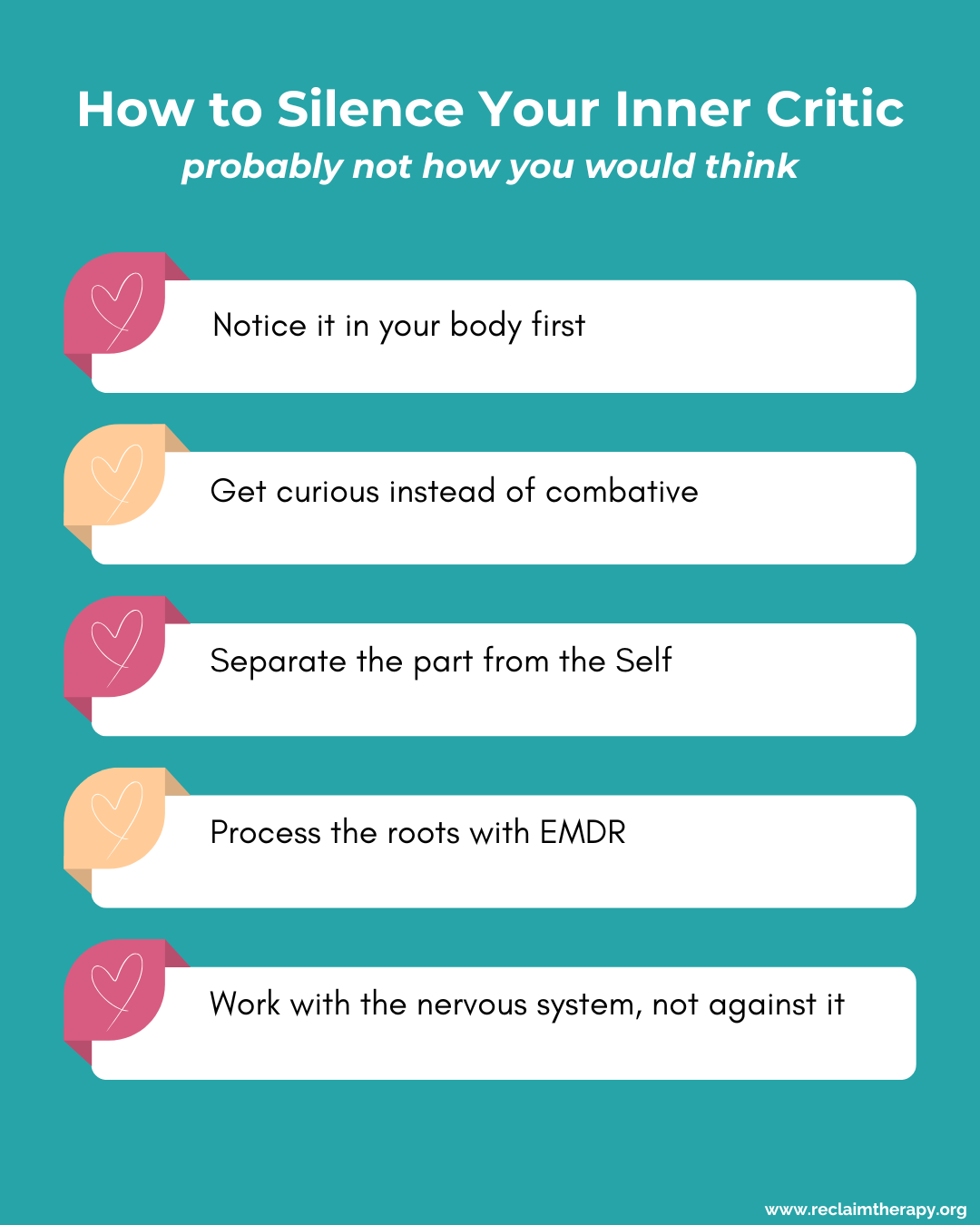
Separate the part from the Self
In IFS language, you are not your inner critic. You have a part that criticizes, but there is a Self underneath all of that, one that is capable of witnessing the critic without becoming it. The desire to stand out or be perfect is often influenced by the inner critic, which can make you question if you are good enough or if something is the matter with you.
This is harder than it sounds, especially for people with significant trauma histories. But even a small moment of “I notice I’m having a critical thought about myself” instead of “I am terrible” is the beginning of that separation. Making a mistake does not mean you are not good enough or that you lack success; mistakes are a natural part of personal growth.
Process the roots with EMDR
Parts work and somatic therapy are powerful for working with the inner critic in real time. EMDR goes a layer deeper. Eye Movement Desensitization and Reprocessing helps the brain reprocess the original experiences that taught you it wasn’t safe to take up space, make mistakes, or exist without performing. The inner critic can especially show up around creative projects like writing a book or launching a course, where self doubt and perfectionism can be overwhelming.
When those early memories shift, the protective parts that became your inner critic often don’t have to work as hard. EMDR therapists in Horsham and across Pennsylvania see this regularly: when the underlying wound changes, the voice that developed to protect it starts to quiet, which is especially important if you’re trying to heal from narcissistic abuse after feeling like you’ve lost yourself.
Work with the nervous system, not against it
Somatic approaches like slow exhale breathing, gentle movement, or body-based grounding help regulate the nervous system enough that protective parts don’t have to work as hard. When the body feels safer, the inner critic tends to quiet on its own. The inner critic impacts personal growth, self doubt, self esteem, and stress—addressing it can lead to wonderful changes in your emotional well-being.
This is why nervous system work is not optional in trauma recovery. You can have every insight in the world and still be hijacked by old patterns if the body hasn’t caught up.
When the Inner Critic Is Actually a Trauma Response
For many people, especially those with histories of complex trauma, emotional neglect, or high-criticism environments growing up, the inner critic is deeply entrenched. It can masquerade as high standards, perfectionism, or just “being realistic”—or use harsh labels like “lazy” to shame and diminish your sense of self-worth, and it can also show up as emotional flashbacks and PTSD flashback symptoms.
If your inner critic is constant, feels like a different voice than your own, or leaves you feeling genuinely worthless rather than just momentarily self-doubting, that’s worth exploring with a trauma-informed therapist. What looks like an inner critic problem is often an attachment wound that needs more than a mindfulness app can offer, especially for trauma survivors who are actively learning how to accept love after CPTSD.
This is some of the most common work we do at Reclaim Therapy with clients in Horsham, Ambler, Blue Bell, Lansdale, and surrounding Montgomery County communities. We also work with clients throughout Pennsylvania via telehealth, so geography doesn’t have to be a barrier.
What Healing Actually Looks Like
It doesn’t look like a permanently quiet mind. It looks like catching the critic faster. Responding to it with more compassion and less panic. Recognizing it as a scared part rather than the truth.
It looks like a relationship with yourself that has more room in it than it used to. Managing your inner critic is a path toward greater self-compassion and personal growth, helping you move forward on your journey to a healthier mindset.
That’s the work. It’s slower than the internet (looking at you tiktok!) would like it to be. But it’s real.
Work With a Trauma-Informed Therapist in Horsham, PA
If you're in Montgomery County or the surrounding Philadelphia area and you're ready to do this work with real clinical support, Reclaim Therapy offers trauma-informed therapy that draws on IFS parts work, EMDR, and Somatic Experiencing.
Our therapists specialize in complex trauma and CPTSD, and we work with high-functioning adults who are tired of holding it all together on the outside while the inner critic runs the show underneath. We offer in-person therapy in Horsham, Pennsylvania and telehealth sessions throughout the state.
If this post resonated with you, reaching out is a good next step. You really don't have to keep managing this alone.
🧡,

Frequently Asked Questions About the Inner Critic and Trauma Therapy
What causes a harsh inner critic? A harsh inner critic often develops as a response to early experiences where criticism, emotional unpredictability, or conditional love were present. The nervous system learns to self-criticize as a way to anticipate threat and stay safe.
Is the inner critic related to trauma? Yes, frequently. In trauma-informed therapy, the inner critic is often understood as a protective response rooted in nervous system survival rather than a character flaw or thinking error.
What is IFS or parts work therapy for the inner critic? Internal Family Systems therapy, also called parts work, views the inner critic as a protector part trying to prevent pain or rejection. IFS therapists in Pennsylvania help clients get curious about this part rather than fighting it, and support it in trusting that it doesn't have to work so hard anymore.
How does EMDR help with the inner critic? EMDR helps the brain reprocess the original memories and experiences that created the conditions for a harsh inner critic to develop. Many people find that after EMDR, the critical voice becomes less intense because the wounds underneath it have started to heal.
Where can I find a trauma-informed therapist for parts work or EMDR in Pennsylvania? Reclaim Therapy in Horsham, PA offers IFS, EMDR, and Somatic Experiencing for adults dealing with complex trauma, CPTSD, and related concerns. We serve clients in Montgomery County, Bucks County, Philadelphia, and throughout Pennsylvania via telehealth.