
Shame Acronym: A Simple Way to Understand What Shame Really Feels Like
If you’ve ever felt that sinking, collapsing feeling in your chest that signals: you are the problem (not what you did, but who you are) you’ve met shame. Shame is a self conscious emotion, often so intense it can make you want to crawl out of your own skin. And if that feeling is less like a passing experience and more like an ever present fog? That’s not just an emotion passing through, it could be shame that’s been living in your nervous system, maybe for a very long time.
Shame is one of the most painful human experiences, and also one of the most misunderstood. It hides inside perfectionism, people-pleasing, explosive anger, and the relentless inner voice that tells you you’re too much or not enough. Shame can contribute to depression and have a significant impact on mental health, often intensifying emotional distress and leading to cycles of anxiety or withdrawal.
A lot of people spend years in therapy before they realize shame has been the thing rumbling underneath their symptoms, running the show.
So let’s slow down and actually look at it. What does shame really mean? And is there a way to understand shame that makes it feel less like a life sentence?
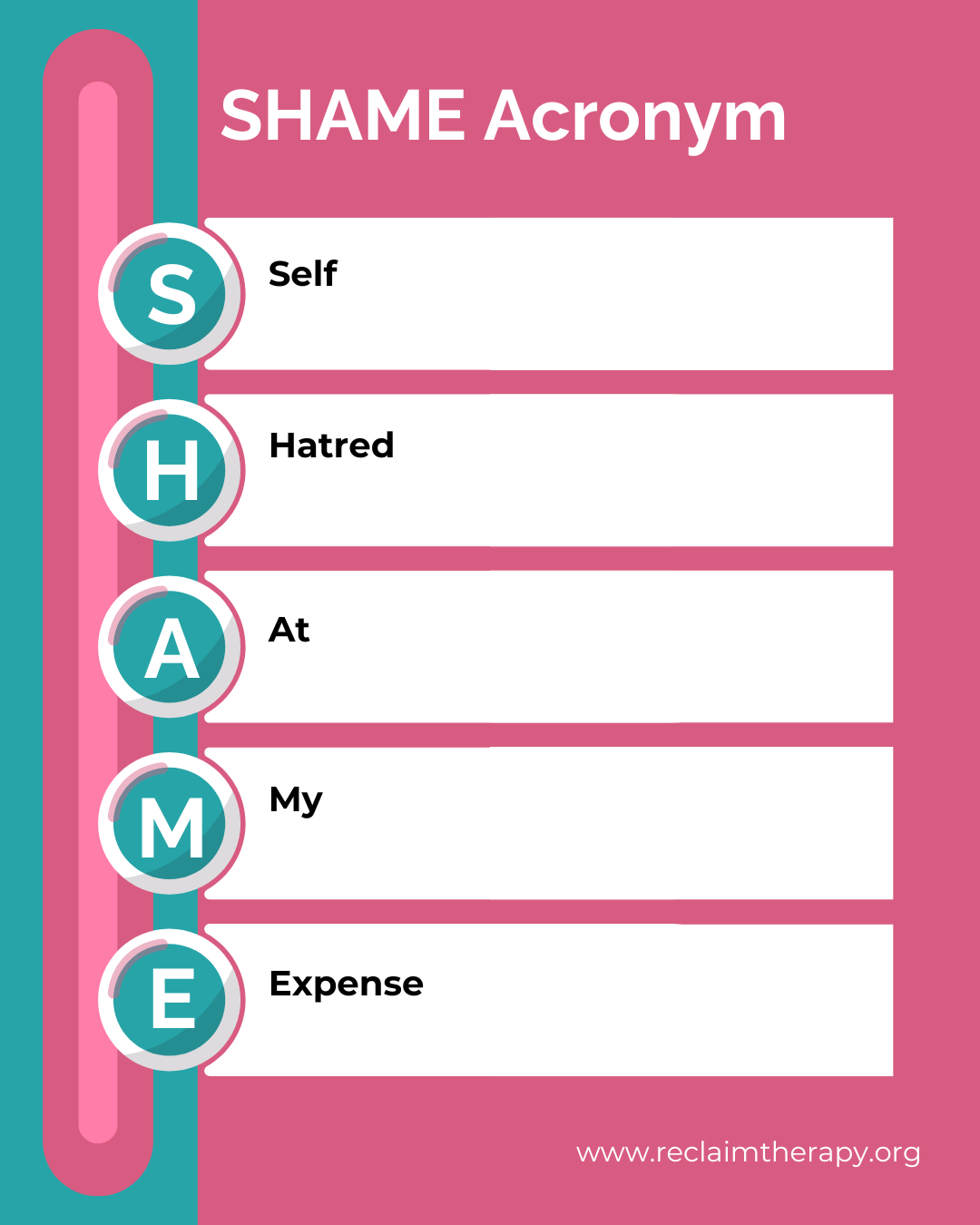
That’s where the shame acronym can comes in. In therapeutic and recovery contexts, the acronym SHAME is often used to describe toxic shame, interpreted as Self-Hatred At My Expense.
What Is the Shame Acronym?
The acronym for shame that resonates most deeply in trauma-informed and therapeutic spaces is this:
S.H.A.M.E. = Self-Hatred at My Expense.
Sit with that for a second. Self-Hatred at My Expense.
Shame isn’t just a bad feeling. It’s an internalized attack on your own identity, and it costs you. It costs you connection. It costs you your sense of self. It costs you the ability to trust yourself, let people in, or believe that you are actually worthy of care.
There’s a second acronym that floats around in some recovery and counseling spaces, “Should Have Already Mastered Everything.”
That one captures the “should” spiral that shame loves so much, the relentless inner critic reminding you that you should be further along, should know better by now, should have figured this out already. Both acronyms point at the same wound.
But, Self-Hatred at My Expense gets to the core of what shame actually is. A fundamental belief that something is wrong with you as a person—a key difference when comparing shame and guilt. With guilt, the feeling is “I did a bad thing,” focusing on a specific action, while shame says, “I am bad.” Guilt is associated with making amends and facing consequences, encouraging accountability and growth. Shame, on the other hand, is about avoiding negative consequences and leads to withdrawal and isolation. While guilt can be a healthy emotion that encourages personal growth and accountability, shame is often considered toxic and can lead to feelings of worthlessness and isolation.
What Does Shame Mean, Really?
The shame definition that matters most in trauma work isn’t found in a dictionary. It’s felt in the body before it’s ever named in the mind.
Shame is a painful, full-body experience rooted in the belief that you are fundamentally flawed, unlovable, or not enough, not because of something you did, but because of who you are.
This is what separates shame from guilt. Guilt says “I did something bad.” Shame says “I am bad.” Guilt is connected to behavior. Shame is an attack on identity.
And if you’ve experienced trauma, particularly early relational trauma, shame rarely starts from within. It gets handed to you.
Through chronic criticism, neglect, emotional unavailability, abuse, or growing up in a home where certain parts of you were treated as too much, too needy, too sensitive, or just wrong.
When children are hurt by the people who are supposed to love them, they almost never conclude that the adult is failing them. They conclude that they are the problem. Children may become afraid and internalize the belief that their worth is tied to the negative treatment they receive, believing that being themselves is unsafe. That’s not a logic error on this child’s part, that’s the way they learned survive and stay connected in their relationship with caregivers.
Chronic shame can develop from early relational trauma, where individuals learn to associate their worth with the negative treatment they received from caregivers, leading to a belief that they are fundamentally flawed or unlovable.
Shame says, “I am the problem.”
Shame vs. Guilt Guilt says "I did something bad." Shame says "I am bad." Guilt is tied to a specific behavior and can actually motivate repair and accountability. Shame attacks your sense of self and tends to lead to hiding, shutting down, or self-destruction. If you find yourself living in a constant state of "I am the problem," that's shame, and it's worth exploring with support.What Does Shame Actually Feel Like in the Body?
This is where it gets important, because shame is not just a thought. It is a somatic experience. It lives in your body, often below the level of conscious awareness, shaping the way you hold yourself, respond to others, and move through the world.
You might recognize shame as heat rising in your chest or face. Shame is often manifested in body language—flushing of the face, downcast eyes, slack posture, and a lowered head are observable signs of this emotion. A sudden urge to collapse inward, shoulders dropping, gaze going down, throat tightening. The impulse to disappear, to get small, to get out of the room. Some people feel it as a kind of freezing, a held breath, a stillness that comes over them when they feel exposed. The experience of shame is often somatic, manifesting physically in the body as tension, a pit in the stomach, or a desire to collapse inward, especially when something is happening that triggers feelings of exposure or threat to belonging.
Your sympathetic nervous system responds to shame the way it responds to a threat, because it is one. We are wired for belonging. Shame signals that belonging might be at risk. And so the body braces. Grounding yourself in your body when shame is happening can soothe your sympathetic nervous system, helping to deactivate the fight-flight-freeze response that shame initiates and allowing for a better understanding of the shame.
Over time, when shame is chronic, the body stops waiting for the threat. It just stays braced. Ready for the exposure that feels inevitable.
The Parts That Carry Shame
If you’re familiar with Internal Family Systems, this will land quickly. If not, here’s the short version: IFS understands the psyche as made up of different parts, each with its own perspective, its own role, and its own history.
Shame doesn’t live in all of you. It lives in specific parts. Usually parts that learned very early that something about them was unacceptable. These are what IFS calls exiles, the parts that got pushed away because showing them felt too risky or too painful. They carry the original wound. The message that they were too much, not enough, bad, broken, or unlovable. These exiled parts may also carry anxiety, especially in the moment when shame is triggered and emotional distress surfaces.
And then there are the protectors. The parts that work overtime to make sure those exiled, shame-carrying parts never get seen. Your inner critic who tears you down before anyone else can. Your people-pleaser who stays agreeable at all costs. Your perfectionist who believes that if you do everything flawlessly, no one will discover what’s actually underneath. Your anger that fires before vulnerability can surface. These protector parts can also hold anxiety, particularly in moments when they are activated by shame or fear of exposure.
All of those parts are doing something. They are protecting you from the shame that feels unsurvivable.
The goal isn’t to get rid of these parts. It’s to understand them, to approach them with curiosity instead of contempt, and eventually to help the parts carrying shame learn that they don’t have to keep hiding.
How Shame Shows Up (That People Don't Always Recognize)
Because shame is so good at disguising itself, it often goes undetected for years. Sometimes it shows up in these ways:
Chronic over-apologizing. Preemptive apologies are often a shame-based nervous system trying to manage the fear of being too much before anyone else has a chance to say so.
Perfectionism and over-functioning. This is shame wearing a productivity costume. “If I do it perfectly, no one will see what’s actually wrong with me.”
Anger and defensiveness. Shame frequently hides behind rage. When the nervous system already believes it’s fundamentally not okay, criticism doesn’t just sting. It confirms the worst thing you believe about yourself.
Isolation and disconnection. Because if people really knew you, really saw all of it, they would leave. So a part of you pulls back first. Shame can also contribute to social anxiety and hyper-independence as a trauma response, making it difficult to connect with others and increasing the fear of rejection or exclusion in social situations.
Numbing and avoidance. Food, alcohol, scrolling, staying busy to the point of exhaustion. Anything that keeps you from feeling the thing that feels too big to survive. Imagine what it would feel like to face the underlying shame instead of avoiding it—visualizing this can help you gain insight and a sense of control.
Shameful events are situations or experiences that trigger feelings of shame, which are then physically and emotionally manifested in the body, leading to these kinds of responses.
Healthy Shame: Why Not All Shame Is Bad
When we talk about shame, it’s easy to assume it’s always toxic or destructive. But not all shame is created equal. There’s a form known as healthy shame, and it actually plays a vital role in our emotional well-being and growth as human beings.
Healthy shame is the quiet sense that reminds us we’re not perfect—and that’s okay. It’s the feeling that nudges us toward humility, helping us recognize when we’ve crossed a line or made a mistake. Unlike toxic shame, which attacks our self-esteem and convinces us we’re fundamentally flawed, healthy shame simply signals that we’re human, with limits and imperfections like everyone else.
Brené Brown, a leading voice in shame research, points out that healthy shame can lead us to take responsibility for our actions, make amends, and grow from our experiences. It’s the difference between thinking “I did something wrong” and “I am wrong.” Healthy shame helps us recognize our mistakes without letting them define our sense of self.
By acknowledging healthy shame, we can develop a more compassionate and realistic self-image. It encourages us to be honest with ourselves, to learn, and to connect with others from a place of authenticity. In this way, healthy shame can actually lead to greater self-esteem and emotional well-being, guiding us toward a more balanced and connected life.
The Inner Critic: Shame’s Persistent Voice
If you’ve ever heard a harsh, relentless voice in your head telling you you’re not good enough, you’ve met the inner critic. This inner critic is shame’s persistent echo, often rooted in past experiences of trauma, abuse, or neglect. It’s the part of you that keeps score, points out every flaw, and insists you’ll never measure up.
The inner critic thrives on self-criticism and judgment, replaying old shame stories and reinforcing the belief that you’re fundamentally lacking. It can lead to a cycle of self-blame and negative self-talk, making it hard to see your true self with any kindness or clarity.
But there’s a way out. According to Dr. Kristin Neff, self-compassion is a powerful antidote to the inner critic. By practicing self-kindness, mindfulness, and acceptance, you can begin to challenge the harsh words of your inner critic and replace them with understanding and care. This doesn’t mean ignoring your mistakes—it means recognizing them without letting shame take over your relationship with yourself.
Overcoming the inner critic is about building a new kind of relationship with yourself—one rooted in compassion rather than criticism. With time and conscious effort, you can quiet the voice of shame and create space for healing, growth, and genuine self-acceptance.
Shame Held in Relationships: How Shame Shapes Connection
Shame doesn’t just live inside us—it shows up in our relationships, shaping the way we connect, communicate, and trust. When you experience shame in a relationship, it can feel like you have to hide your true feelings or parts of yourself, leading to fear, disconnection, and loneliness.
Sometimes, shame is used as a tool for control or criticism, with one person making the other feel small or unworthy. Other times, it’s more subtle: you might pull back, avoid vulnerability, or struggle to believe you’re worthy of love and acceptance. This can make it hard to build real intimacy or feel safe being your true self.
Healing from shame in relationships starts with finding a sense of safety and trust. Sharing your shame story with a trusted person—someone who listens without judgment—can be a powerful step toward breaking shame’s hold. Open communication, honesty, and vulnerability are key to building stronger, more authentic connections.
Dr. Sue Johnson, a pioneer in attachment theory, reminds us that shame can be a major barrier to intimacy, but it’s not insurmountable. By working through shame together, couples and friends can develop more secure, resilient bonds. When you allow yourself to be seen and accepted, shame loses its power, and real connection becomes possible.
Why the Connection Between Shame and Trauma Matters
If you’ve experienced complex trauma, childhood trauma, or grew up with caregivers who were emotionally immature, inconsistent, or harmful, shame is likely not just something you feel sometimes. It became a lens. A filter through which every experience of yourself gets processed. Shame often arises as a survival response, particularly in the context of trauma, where individuals may internalize the belief that their trauma was their fault, leading to chronic feelings of shame.
Pete Walker writes about shame as a core wound in complex PTSD.
Janina Fisher describes the exile parts that carry early shame, the young parts of us who internalized the message that they were defective or unlovable, and still believe it.
Bessel van der Kolk’s work reminds us that the body keeps the score, including the somatic imprint of shame that lives in posture, in the held breath, in the bracing that happens before a conscious thought even forms.
This is why understanding the shame acronym isn’t just an intellectual exercise.
Naming it is the beginning.
Recognizing “oh, this is self-hatred at my expense” creates just enough distance between you and the experience to ask, is this actually true? Or is this what a part of me learned to believe a long time ago? If you are struggling to overcome shame, consider seeking support from a mental health professional, who can help you process these feelings and develop practical strategies for healing. Healing from shame can positively impact not only you, but also that person's life and relationships, fostering growth and change beyond the individual.
What Shame Needs (and What It Doesn't)
Shame thrives in secrecy. Brené Brown has spent decades making this point, and the research backs it. Shame cannot survive being spoken. It needs silence and isolation to stay powerful. When it gets brought into connection, when it gets witnessed without judgment, its grip begins to loosen. Recognizing and labeling the feeling of shame is a crucial first step—naming the shame by literally telling yourself 'I am feeling shame' allows you to ground yourself in your experience and validate your emotions, helping to separate you from the shame itself.
What shame does not need is more self-criticism. More trying harder. More attempts to fix or manage the part of you that feels defective.
What shame does need is compassion. Witness. A nervous system that feels safe enough to finally unclench. Sharing your emotional experience of shame with a trusted person can help regulate emotions and facilitate reconnection, preventing shame from taking its power.
Somatically, healing from shame often looks like the body slowly learning it is safe to take up space again. Shoulders dropping. Breath deepening. Eye contact that doesn’t feel like exposure. The capacity to be seen without immediately wanting to disappear.
This is why trauma-informed approaches like EMDR Therapy, Internal Family Systems, and Somatic Experiencing can be so meaningful for people working with chronic shame. They don’t just talk about shame. They help the body have a different experience. They create the conditions for those exiled parts to finally be met with something other than rejection.
Healing from Shame Is Possible

The shame acronym gives us a place to start. Self-Hatred at My Expense. When you can name it, you can begin to see it as something that happened to you and got wired in, rather than the truth of who you are.
Those parts carrying shame? They have been working so hard for so long. They don't need to be pushed away. They need to be met.
If you're ready to start that work, our trauma therapists at Reclaim Therapy in Horsham, Pennsylvania specialize in exactly this.
We work with complex trauma, CPTSD, and the deep patterns shame leaves behind, using EMDR, Somatic Experiencing, and Internal Family Systems (Parts Work).
🧡,
