
Sexual Abuse Signs in Adults: What Survivors of Childhood Abuse Often Carry Into Adulthood
If You're Just Starting to Question Your Past…
Maybe something surfaced in therapy. Maybe a conversation with a friend left you unsettled. Maybe you've been sitting with a persistent feeling that something happened to you, even if you can't name it or prove it or fully remember it.
First, I want you to know that you don't have to have a clear, concrete memory for something to have affected you. Trauma doesn't always show up as a film reel of what happened. Sometimes it shows up as the patterns you've been living out for years without understanding why.
This post isn't here to tell you what your story is. It's here to help you understand how childhood sexual abuse in adults can show up, often in silence, often in ways that look like anxiety or relationship struggles or body stuff, long after childhood is over.
A Note Before We Go Further: This post covers signs of childhood sexual abuse in adults. It is psychoeducational, not diagnostic. If anything here resonates, please work with a trauma-informed therapist who can help you explore it safely.
Why Childhood Sexual Abuse Often Goes Unrecognized
One of the most common things we hear from survivors is: “but I’m not sure it was really abuse.” And we truly understand why. Because child sexual abuse rarely looks the way we’ve been taught to expect it to, and experienced childhood sexual abuse often goes unrecognized due to these factors. Abuse can occur multiple times, often within the family or home environment, and sexual abusers may be known to the child, with abuse frequently happening in familiar settings.
Childhood sexual abuse doesn’t always involve a stranger. In many cases, sexual abuse is perpetrated by a family member or someone trusted. It doesn’t always involve violence or force. Sometimes it happens slowly, through grooming, where a trusted adult builds trust and emotional closeness before crossing lines. Sexual abusers often use grooming tactics and may be family members or trusted adults.
Sometimes it involves coercion disguised as love, or confusion that a child had no language to name. Sometimes it happened so young that memory is fragmented or entirely absent.
There are a few things that make childhood sexual abuse especially hard to identify later in life:
Grooming often feels like attention and affection. When someone we trusted violated that trust, it gets complicated to process as abuse.
Children don’t have adult frameworks for understanding what’s happening to them. Without language or context, there’s no clean memory to hold onto. Children cannot legally or developmentally provide informed consent, which is why any sexual contact with a child is considered abuse.
Dissociation is the nervous system’s way of protecting us from what’s too much to bear. It can create gaps in memory, or a felt sense that it happened to “someone else.” The absence of physical evidence can make it difficult to detect child sexual abuse, so behavioral and emotional indicators are often relied upon.
Emotional neglect alongside abuse makes it even harder to trust your own perception. When your feelings weren’t validated growing up, questioning your reality becomes second nature.
Minimization is a survival strategy. “It wasn’t that bad” or “others had it worse” can keep uncomfortable truths at a distance until we’re ready.
Legal definitions of child sexual abuse vary by state, but generally include any sexual activity involving a minor, as children cannot provide informed consent. Abuse often occurs with alarming frequency, especially incest, underscoring the seriousness and widespread nature of the issue.
None of this means your experience didn’t happen. It means your mind did exactly what it needed to do to protect you.
Adult Manifestations and Signs of Childhood Sexual Abuse
These patterns aren’t a checklist to diagnose yourself with. They’re a way of understanding how trauma shapes us, often in ways that don’t look like “trauma” from the outside. Adult manifestations of childhood sexual abuse can include a wide range of psychological, physical, and behavioral symptoms. Behavioral sequelae and behavioral symptoms may impact adult functioning and should be considered when seeking mental health support. Individuals who have experienced sexual abuse may display these signs in adulthood. You might recognize several of these. You might only recognize one. Regardless, working with a trauma therapist can be supportive.
Emotional, Internal, and Mental Health Symptoms
Childhood sexual abuse leaves imprints on how we feel about ourselves, often in ways that are pervasive:
Chronic shame that lives in your body, not just your thoughts. The sense that you are fundamentally bad, broken, or “too much,” even when you can’t explain why. More extreme symptoms, such as severe depression or dissociation, may be linked to early, repeated, or forceful abuse.
Anxiety that doesn’t quite match your current life circumstances. You’re safe, but you can’t feel safe.
Emotional numbness or disconnection, like you’re watching your own life from the outside. Mental health care is important for addressing the psychological impacts of trauma.
Difficulty identifying what you’re feeling. Feelings weren’t safe at some point, so they went underground.
A persistent sense of unsafety that follows you, regardless of where you are or who you’re with.
Deep difficulty trusting your own perception, your gut, your memory, or your judgment.
Depression is a significant emotional effect of sexual abuse, with symptoms including persistent low mood, hopelessness, and a lack of interest in previously enjoyed activities.
Chronic shame is one of the most consistent findings in adult survivors of childhood sexual abuse. It’s not the same as guilt (which is about what we did). Shame is about who we believe we are. It’s relational in origin, and it heals in relationship, including a therapeutic one.
Body-Based and Nervous System Patterns
When we experience trauma, especially repeated relational trauma in childhood, the nervous system doesn’t just process it and move on. It learns to anticipate threat. It stays alert. It shuts down when things feel like too much. These are signs that show up in the body long after the original experience:
Feeling disconnected from your body, like you live from the neck up, or like your body is something that happens to you rather than something you inhabit.
Dissociation or “zoning out” during stress, intimacy, or even ordinary moments.
A startle response that feels disproportionate. You’re always waiting for something to go wrong.
Chronic tension, pain, pelvic pain, or GI issues without a clear medical cause. The body holds what we can’t consciously access.
Sensory triggers that activate a big response without an obvious reason. A smell, a touch, a specific sound.
Feeling frozen or shut down when you’re overwhelmed, even when nothing dangerous is happening.
Many survivors of sexual abuse report chronic pain, including headaches, back pain, and pelvic pain, which can be a direct result of physical trauma or a manifestation of the body's prolonged stress response. Survivors are also at increased risk for gastrointestinal, cardiovascular, and reproductive health problems due to the stress and anxiety associated with trauma. Adults abused as children are four to five times more likely to abuse alcohol and illicit drugs. Long-term effects of childhood sexual abuse can include chronic pain conditions, such as headaches, back pain, and pelvic pain.
Somatic therapy, EMDR, and other body-based approaches exist precisely because healing from this kind of trauma requires working with the nervous system, not just the thinking mind.
Sexuality and Intimacy Patterns
This is an area that carries a lot of shame. However your sexuality has shown up in the wake of what happened to you is a response, not a character flaw.
Avoidance of sex or physical closeness, sometimes with people you genuinely love and want to be close to.
The opposite: compulsive sexual behavior that feels disconnected from desire or choice. Sex as a way of feeling something, or feeling nothing.
Difficulty feeling present during intimacy. Your body is there but you’re not.
Confusion around desire, boundaries, or consent, including in yourself. What do you actually want? What’s okay? What’s yours to decide? Sexual dysfunction, such as difficulties with arousal or orgasm, can result from childhood sexual abuse. Sexual activity, sexual contact, and sexual touching may also be sources of confusion or distress for survivors.
Feeling like your body belongs to other people rather than to you.
Shame about pleasure, arousal, or sexual response, especially if your body responded to abuse.
Important: Physical arousal during abuse is a physiological response, not consent. It does not mean you wanted it. Sexual acts, including vaginal intercourse, are forms of abuse when they occur without informed consent and involve a minor. This distinction matters enormously for healing, and it’s something worth exploring with a trauma-informed therapist.
Relationship and Attachment Patterns
When the people who were supposed to protect us are the ones who harmed us, or failed to stop the harm, our attachment system gets wired in complicated ways. Trust becomes dangerous. Closeness becomes threatening. And we develop strategies to manage that.
People-pleasing or fawning, doing whatever it takes to keep others happy because conflict or disapproval feels genuinely threatening.
Difficulty setting boundaries, or feeling profound guilt when you try to.
Fear of being "too much" or "not enough" in relationships. Always monitoring yourself.
Being drawn to emotionally unavailable or unpredictable partners. Inconsistency can feel like home when that's what you grew up in.
Difficulty trusting yourself or others, even when there's no current reason for mistrust.
Staying in relationships that don't feel safe because unfamiliarity feels more dangerous than known discomfort.
Behavioral Coping Patterns
The nervous system is incredibly creative when it comes to managing pain. These coping strategies made sense at some point. They helped you survive. The goal isn’t to shame yourself for them. It’s to understand where they came from.
Disordered eating: restriction, bingeing, purging, or using food and/or control over food to manage overwhelm.
Perfectionism and overfunctioning. If you do everything right, nothing bad can happen.
Numbing through work, scrolling, substances, or busyness. Staying occupied enough that nothing gets to surface.
Drug abuse. Using drugs or misusing substances as a way to cope with trauma and emotional pain.
Self harm. Engaging in self-injurious behaviors such as cutting or burning the skin as a response to overwhelming emotions.
Hyper-independence. Needing help is dangerous if help has never been safe.
Avoidance of vulnerability. Walls that were once protection can start to feel like a prison.
Self-harm, including cutting or burning the skin, can be a way for individuals who have experienced sexual abuse to manage overwhelming emotions, including emotional flashbacks and other PTSD flashback symptoms, indicating deep distress and a need for immediate intervention. Adult survivors of childhood sexual abuse are also at increased risk for drug abuse and suicidal ideation, especially during periods of high stress or emotional overwhelm.
If you recognize yourself in these patterns, please hear this: these behaviors developed for a reason. They were adaptations. Your system did what it needed to do to get you here. And they can shift, slowly, with the right support.
The Long-Term Effects of Childhood Sexual Abuse
The long-term effects of childhood sexual abuse can touch almost every area of a person’s life. Not because survivors are broken, but because abuse during childhood happens during critical windows of development, in relationships, nervous system regulation, sense of self, and understanding of the world. The behavioral sequelae of childhood sexual abuse can include a range of psychological and physical symptoms, such as emotional distress, posttraumatic stress, and distorted self-perception. Extreme symptoms may be linked to early age of abuse onset, frequent abuse, or abuse involving force, and certain life events can trigger the reemergence of distressing symptoms. Past abuse, especially when it occurred at an early age or was frequent, can influence adult health and functioning, affecting both emotional and physical well-being.
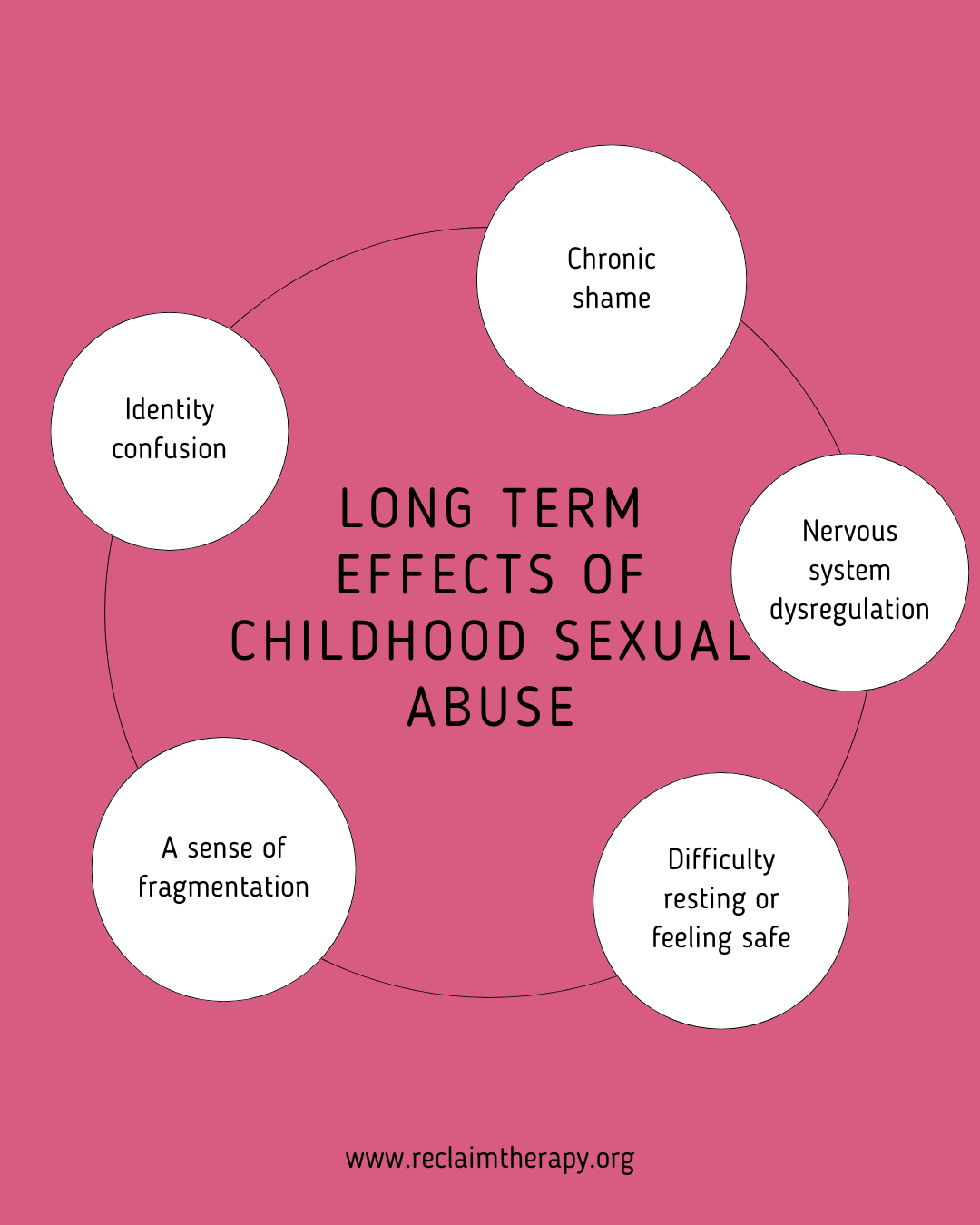
Some of what survivors carry into adulthood:
Identity confusion: Who am I, outside of survival? What do I want? What do I feel?
Chronic shame that has been internalized as truth rather than recognized as a wound.
Nervous system dysregulation: living in chronic fight, flight, freeze, or fawn.
Difficulty resting or feeling safe in your own skin, even in objectively safe situations.
A sense of fragmentation, like different parts of you want different things or hold different beliefs, especially when it comes to letting yourself receive and accept love as a trauma survivor.
Grief. Grief for a childhood that should have been different. For safety that wasn’t there. For versions of yourself that never got to exist.
These aren’t permanent sentences. They are patterns. And patterns can shift.
Why These Patterns Make So Much Sense
Your nervous system learned what to expect from people. It learned that closeness could be dangerous. That your body wasn't fully your own. That love and violation could come from the same source. And so it adapted. It built systems to protect you.
The fawn response that kept you placating people? It kept you safe. The dissociation that took you out of your body? It let you survive something unbearable. The hypervigilance, especially after experiences like narcissistic abuse that made you feel lost to yourself? It was your system doing its job.
Healing from Childhood Sexual Abuse Is Possible, Even If It Feels Slow
I want to say this plainly: healing is real. It’s also not linear, and it’s rarely fast. But it happens. I’ve watched it happen in my practice over and over again. For sexual abuse survivors, mental health care and support are crucial components of the recovery process.
A few things worth knowing about healing from childhood sexual abuse:
You don’t have to remember everything to heal. The nervous system can shift without a complete narrative. Many body-based modalities work precisely because they don’t require full memory access.
Healing often happens in the body first. Cognitive understanding is helpful, but if your nervous system still believes you’re in danger, insight alone won’t move the needle.
Safety is built slowly, in small repeated experiences. In therapy, in relationships, in how you respond to your own needs.
Learning to set boundaries, understand consent, and develop self-trust are all part of the healing process. Not because you didn’t know these things, but because they got complicated.
Promoting healing involves recognizing sexual abuse signs in adults, seeking timely intervention, and accessing resources and support. These steps are essential for emotional and physical recovery.
Modalities like EMDR, Somatic Experiencing, and Internal Family Systems are specifically designed to work with the kind of trauma that childhood sexual abuse creates. In addition to therapy, creating safe environments and teaching children about personal boundaries are important steps to keep children safe and help prevent future abuse.
Not all therapy is the same, and not all therapists are trained to work with trauma. If you’re looking for support, seek out a therapist who is specifically trained in trauma-informed approaches. EMDR, somatic therapies, and parts-based work like IFS have strong evidence bases for complex trauma.

If You're Seeing Yourself in This, Therapy for Childhood Sexual Abuse in Horsham, PA Could Help
It takes something to read a post like this.
To sit with the question of whether this is your story. To let yourself consider that something that happened a long time ago might still be shaping your life.
You don't have to have all the answers right now. You don't have to label anything or name anything before you're ready. There's no timeline on this.
What we do know is that you deserve support. You deserve to work with someone who understands how trauma lives in the body, not just the mind. Someone who won't push you to recover on a schedule or tell you to "just process it" and move on.
Healing from childhood sexual abuse is one of the most courageous things a person can do. And you don't have to figure out where to start all by yourself.
If you're in Pennsylvania and you're looking for trauma-informed care, we'd love to connect. Reclaim Therapy, located in Horsham, PA, specializes in treating complex trauma, and the long-term effects of childhood sexual abuse, using EMDR, Somatic Experiencing, and Parts Work.
Looking to get started with a trauma therapist?
🧡,

Frequently Asked Questions
What are signs of childhood sexual abuse in adults? Signs of childhood sexual abuse in adults can show up emotionally (chronic shame, anxiety, difficulty trusting yourself), physically (body disconnection, hypervigilance, chronic tension), relationally (people-pleasing, attachment difficulties, struggles with intimacy), and behaviorally (disordered eating, perfectionism, numbing). Child sexual abuse can affect individuals from all economic groups and backgrounds. It's important to note that older children and other children may display different behavioral symptoms, such as withdrawal from peers or acting out, compared to younger children. These patterns don’t confirm abuse, but they can be important signals worth exploring with a trauma-informed therapist.
Can you have been sexually abused and not remember it? Yes. Dissociation is one of the nervous system’s primary ways of protecting us from overwhelming experiences. It’s common for survivors to have fragmented memories, gaps, or no explicit memory at all. This doesn’t mean the abuse didn’t happen. The body often holds what the mind couldn’t consciously store.
How does childhood sexual abuse affect adults? Childhood sexual abuse affects adults across multiple domains: emotional regulation, nervous system functioning, relationships and attachment, sexuality and intimacy, sense of self, and physical health. The effects can look like anxiety, depression, chronic shame, CPTSD, relational patterns, dissociation, and body-based symptoms. These effects make sense as responses to early relational trauma. Family violence, including sexual violence, can have long-term effects on survivors' mental and physical health. Child abuse, including sexual abuse, can have behavioral and emotional sequelae that persist into adulthood.
What are the long-term effects of sexual abuse? Long-term effects of childhood sexual abuse include chronic shame, difficulty with trust and intimacy, nervous system dysregulation, identity confusion, grief, and behavioral patterns like perfectionism or numbing. Sexual exploitation is a form of child sexual abuse that can have significant psychological and emotional consequences. These can persist into adulthood without survivors always understanding the connection to their history.
Can you heal from childhood sexual abuse? Yes. Healing from childhood sexual abuse is absolutely possible. It’s often nonlinear and requires working with the body, not just the mind. Modalities like EMDR, Somatic Experiencing, and Internal Family Systems have strong track records with complex trauma. Sexual abuse survivors can promote healing by seeking support and accessing resources. You don’t have to have full memories to heal, and you don’t have to do it alone.