
Polyvagal Theory Made Simple: What It Is and Why It Matters in Therapy
If you've spent any time in the therapy world, or honestly just on Instagram, you've probably seen the words "polyvagal theory" floating around.
Maybe you've nodded along like you knew what it meant. Maybe you actually do.
Either way, this post is going to break it down in a way that actually makes some sense, because this isn't just academic stuff. It's one of the most clinically useful frameworks I work with as a somatic and EMDR therapist, and once you understand it, you'll start seeing your own nervous system in a completely different light.
So What Is Polyvagal Theory, Exactly?
Polyvagal theory was developed by Dr. Stephen Porges in 1994.
The short version: it’s a scientific framework that explains how your autonomic nervous system is hierarchically organized, with different neural circuits activated based on perceived safety or threat, and why those responses live in your body, not just your brain.
Here’s where it gets interesting. Most of us grew up learning that the nervous system has two gears: the sympathetic system (fight or flight) and the parasympathetic system (rest and digest). Polyvagal theory adds a critical layer to that. It introduces the concept of neural circuits, positing that the autonomic nervous system is organized hierarchically, with different neural circuits activated depending on whether you perceive safety or threat, influencing physiological states such as heart rate and muscle tone. Polyvagal theory says the parasympathetic system actually has two distinct branches, and they do very different things.
The Vagus Nerve Is Kind of a Big Deal
The vagus nerve is the longest cranial nerve in your body. It connects your brain to your heart, lungs, gut, and basically everything in between. The word “vagus” comes from the Latin word for wandering, which tracks, because this nerve travels everywhere. The nucleus ambiguus, an important brainstem nucleus, is a key source of myelinated vagal fibers and plays a significant role in parasympathetic control, highlighting its evolutionary and anatomical importance within the vagal system.
In polyvagal theory, the vagus nerve is the star of the show. It’s the channel through which your nervous system is constantly sending and receiving information about whether the world is safe or not. The vagus plays a crucial role in regulating heart rate, stress response, and overall parasympathetic activity, supporting physiological and behavioral adaptability. And something most people don’t realize is that approximately 80% of those nerve signals travel from the body up to the brain, not the other way around. Your body is talking to your brain way more than your brain is talking to your body. That’s why you can’t just think your way out of a trauma response, and why body-based therapy matters.
The Three States of the Nervous System
Polyvagal theory describes three autonomic states, organized in a hierarchy. Your nervous system moves through them based on what it perceives in the environment.
Ventral Vagal: Safe and Social
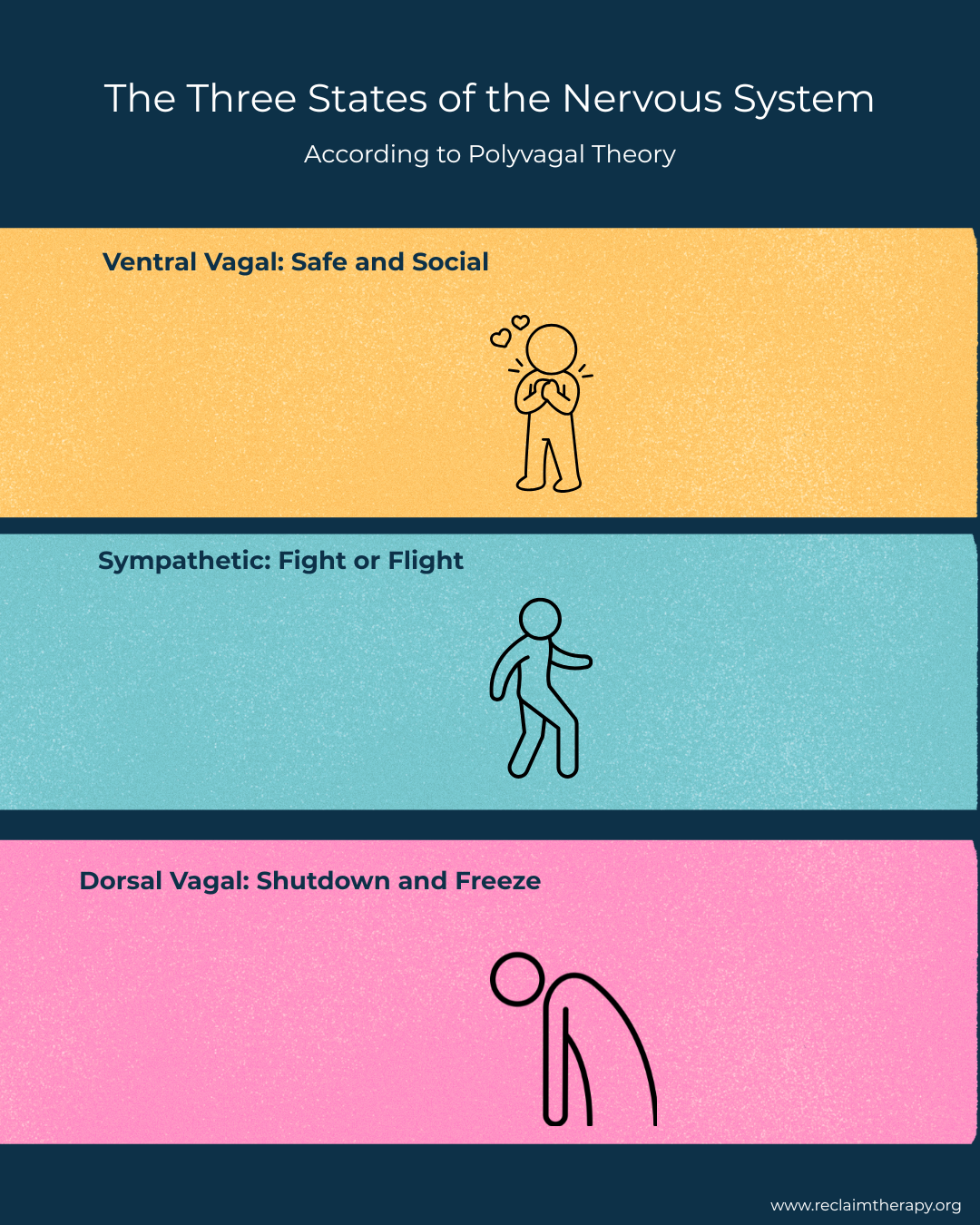
This is the state you’re in when you feel genuinely okay. Not just “fine,” but actually regulated. You can make eye contact, think clearly, connect with other people, and tolerate hard emotions without completely losing it. Your voice has natural variation in it. You feel present.
This is the ventral vagal state, sometimes called the social engagement system. The ventral vagal influence acts as a regulatory 'vagal brake,' supporting calm states and social engagement during safe conditions by maintaining physiological calm and constraining defensive responses. The Ventral Vagal Complex coordinates the heart and lungs with facial and vocal muscles, supporting calmness, clear thinking, and bonding. It’s where healing actually happens, where connection and social communication are possible. And for a lot of people who’ve been through trauma, it can feel really far away.
Sympathetic: Fight or Flight
When your nervous system detects a threat, it mobilizes through sympathetic activation. Your heart rate goes up, muscles tense, breathing gets shallow, and your body is ready to do something. This is the sympathetic state, and it’s not bad. It kept humans alive for millennia as an adaptive response to perceived danger.
However, sympathetic activation can impact emotion regulation, making it harder to manage emotional responses. After trauma, your nervous system can start calling in this response when there’s no actual danger. A tone of voice, a certain smell, being ignored in an email thread. The body responds like the threat is real, because as far as the nervous system is concerned, it might be.
Dorsal Vagal: Shutdown and Freeze
This is the oldest part of the system evolutionarily. When the threat is too big, too overwhelming, when fight or flight isn’t an option, the nervous system goes into shutdown. You go numb. You dissociate. You freeze. You might feel completely flat, disconnected from your body, or like you’re watching your life from the outside. These physical sensations—such as numbness, heaviness, or a profound sense of disconnection—are common in the dorsal vagal state.
This is the dorsal vagal state. It’s an ancient survival response. It’s the nervous system doing the most it can when it has no other options. Vagal influences during this state lead to reduced heart rate and energy conservation, as the body shifts into a mode focused on basic survival.
Neural Pathways and Autonomic Circuits
Polyvagal theory invites us to look under the hood of our bodies and see the intricate wiring that shapes how we respond to the world. At the heart of this is the autonomic nervous system—a network that quietly manages everything from your heart rate to your digestion, often without you ever noticing. The vagus nerve, a key player in this system, acts as a superhighway, carrying signals between your brain and body.
When the sympathetic nervous system activates, it’s like your internal alarm system going off—preparing you to fight or flee from perceived threats. This is the classic “fight or flight” response, and it’s essential for survival. But polyvagal theory adds nuance by highlighting the ventral vagal complex, sometimes called the “smart vagus.” This branch supports your ability to feel calm, connect with others, and engage socially. It’s what allows you to make eye contact, listen, and feel safe in the presence of others.
On the flip side, the dorsal motor nucleus is linked to the “freeze” response—a more primitive, shutdown state that can leave you feeling numb or disconnected when stress becomes overwhelming. These neural pathways form a hierarchy: the ventral vagal system is the most adaptive, supporting social engagement and flexible responses, while the dorsal vagal system is the fallback when all else fails.
Understanding these autonomic circuits isn’t just academic—it’s foundational knowledge for anyone looking to manage their mental health. By recognizing which neural pathways are active in moments of stress or calm, you can start to work with your nervous system, rather than against it, and develop more effective coping strategies for daily life.
What Is Neuroception?
Here’s a concept from Porges that I come back to constantly in my work; neuroception. It’s your nervous system’s ability to scan for safety or danger below the level of conscious awareness. You don’t decide to do it. It just happens.
Your nervous system is reading facial expressions, tone of voice, body language, social cues, and environmental cues all the time. And for trauma survivors, neuroception often gets dysregulated. Neutral cues start getting read as threatening. The system gets stuck in a pattern of detecting danger even when there isn’t any. Trauma compromises the ventral vagal complex, making it harder to interpret social cues and maintain feelings of safety. That’s not a character flaw. That’s an injury to the nervous system, and it’s one that can heal.
Daily Life Applications of Polyvagal Theory
Polyvagal theory isn’t just for therapists or neuroscientists—it’s a practical guide for anyone who wants to feel more grounded, connected, and resilient in daily life. By understanding how your autonomic nervous system shapes your emotional responses, you can start to notice patterns in your own behavior and learn new ways to self-regulate.
Simple practices like rhythmic breathing, gentle movement, or even humming can help increase your vagal tone, making it easier to shift into a state of relaxation and social engagement. These techniques support your nervous system’s natural ability to recover from stress and return to balance. Meditation and yoga are also powerful tools for tuning into your body’s signals and fostering a sense of calm.
For those navigating trauma or anxiety, polyvagal informed therapy offers a roadmap for healing. Therapists trained through organizations like the polyvagal institute use these principles to help clients build adaptive responses to stress, expand their capacity for self regulation, and improve overall mental health. Even outside of therapy, applying polyvagal theory can enhance your relationships, support healing your capacity to accept love after trauma, boost your emotional resilience, and help you feel more at home in your own skin.
By weaving polyvagal principles into your daily routine, you’re not just managing stress—you’re building a foundation for greater well-being, stronger social connections, and a more vibrant life.
A Note on the Science
Polyvagal theory has become kind of a celebrity in the therapy world, and like most celebrities, it has its critics. Debates around Polyvagal Theory often focus on the empirical evidence supporting its claims, with some studies and meta-analyses offering inconclusive or conflicting data.
Some neurobiologists have pushed back on specific claims in the theory, particularly around whether the dorsal vagal complex actually drives the freeze and shutdown responses the way Porges describes, and whether the anatomical distinctions hold up under scrutiny. These are legitimate scientific debates, and they’re ongoing. If you go looking, you’ll find them.
Polyvagal Theory is grounded in neurophysiological foundations, including the study of neural circuits and autonomic regulation, which underpin its application across various disciplines. It has notably influenced fields such as clinical neuropsychiatry, especially in understanding emotion modulation and autonomic regulation.
Here’s where I land on it… polyvagal theory is a theory. It’s a scientific framework, a way of organizing observations about how the nervous system behaves under stress and threat. It is not a law of physics. And like most good frameworks in psychology and neuroscience, it will keep getting refined as research catches up.
Measurement controversies also exist. For example, respiratory sinus arrhythmia is sometimes used as an indicator of vagal tone and autonomic nervous system activity, but it is not considered a direct measure due to confounding factors and measurement inaccuracies.
What it is not, despite what some corners of the internet would have you believe, is useless.
Clinically, the map it gives us is genuinely helpful. When a client can look at their own responses and say “oh, that’s not me being broken, that’s my nervous system doing the only thing it knew how to do,” something shifts. When we can name the state they’re in and work with the body from there, things move. Whether the underlying neuroscience gets revised over time doesn’t change the fact that body-based, nervous-system-informed therapy works.
We use polyvagal theory the way good clinicians use any framework: as a tool, not a religion.
What Happens to the Nervous System in Trauma?
With that context in mind, here’s why this framework matters so much in trauma work specifically.
Trauma doesn’t just leave a memory. It leaves a pattern in the body. When someone experiences trauma and doesn’t get to complete the full cycle of response and recovery, the nervous system can get stuck in defensive states. Some people get stuck in the sympathetic state, which looks like chronic anxiety, hypervigilance, anger, or an inability to ever fully relax. Others get stuck in the dorsal vagal state, which looks like depression, numbness, fatigue, dissociation, or overwhelming emotional flashbacks that feel terrifyingly real.
Often it’s both, shifting unpredictably between defensive states without ever landing in ventral vagal for long. That’s what chronic dysregulation looks like.
Polyvagal-informed therapy is applied to treat trauma, anxiety, and depression, focusing on bottom-up approaches that influence the mind through bodily sensations. Polyvagal Theory has transformed trauma therapy by showing that behaviors like freezing or shutting down are adaptive biological responses to extreme stress, which is especially relevant for survivors healing from narcissistic abuse after losing their sense of self.
What matters most is that none of this is a choice. Your nervous system is doing exactly what it learned to do to keep you safe. The goal of trauma therapy isn’t to judge those responses. It’s to slowly expand your capacity to come back to ventral vagal, to build what Deb Dana calls “flexibility” in the system.
Polyvagal Theory and Personal Growth
Looking at yourself through the polyvagal lens can be a game-changer for personal growth. This theory highlights that your autonomic nervous system is always working behind the scenes, shaping your reactions to stress, safety, and connection. By becoming more aware of these physiological responses, you can develop a deeper sense of self-acceptance and compassion.
Polyvagal informed therapy encourages you to honor your body’s adaptive responses, rather than judge them. It’s about recognizing that your nervous system is doing its best to protect you, even when its strategies no longer serve you. Through co regulation—connecting with others in safe, supportive ways—you can experience new patterns of physiological regulation and emotional resilience.
The theory also emphasizes the importance of individual differences. There’s no one-size-fits-all approach to healing or growth; your nervous system’s unique wiring is part of what makes you, you. By embracing this, you can move toward personal development with a non judgmental attitude, focusing on what helps you feel safe, connected, and empowered.
Whether you’re working with a polyvagal therapist or simply exploring these ideas on your own, the polyvagal perspective offers a scientific foundation for understanding your behavior, improving your social interactions, and navigating life’s challenges with greater ease. It’s not just about managing stress—it’s about transforming your relationship with yourself and others, and opening the door to lasting growth and satisfaction.
Why This Matters in EMDR and Somatic Therapy
In somatic therapy, we're working directly with the body's sensations and responses. Understanding the three states helps clients start to recognize where they are in any given moment and what their nervous system is trying to do. That awareness alone can interrupt old patterns, especially when you bring in approaches like Somatic Experiencing and the SIBAM framework in trauma therapy.
In EMDR Therapy, the therapeutic relationship itself is a regulating force. Before we ever go near trauma content, we build resources, establish safety, and make sure the nervous system has a felt sense of what ventral vagal actually feels like. You can't process trauma from inside a shutdown or a spiral. The window of tolerance has to be open first, and understanding the eight stages of EMDR therapy can help demystify how that process unfolds.
Co-regulation matters too. Your nervous system is always in conversation with the nervous systems around it. It's biology. The relational container of therapy is actually doing something physiological, which is why who you work with matters just as much as what modality they use.
You Don't Have to Figure This Out Alone

If you read all of this and thought "okay but how do I actually get my nervous system to cooperate," that's exactly the work. And it's not something you can white-knuckle your way through with willpower or a really good book.
At Reclaim Therapy, we work with trauma through EMDR and somatic approaches that are directly informed by polyvagal theory. That means we meet your nervous system where it actually is, not where you think it should be. If you're in Pennsylvania, or near Horsham, PA, and you're ready to start understanding your body's responses instead of fighting them, we'd love to connect.
🧡,

Looking for a trauma therapist or an EMDR therapist near me?
Reclaim Therapy is a team of EMDR therapists who specialize in treating trauma, complex PTSD and eating eating disorders. We believe that all people are deserving of reclaiming their lives from the impact of trauma, shame and disordered eating.
Frequently Asked Questions About Polyvagal Theory
What is polyvagal theory in simple terms? Polyvagal Theory, developed by Dr. Stephen Porges in 1994, is a framework that focuses on how the autonomic nervous system regulates physiological states in response to environmental demands. It explains how your nervous system responds to safety, danger, and threat through three primary states: ventral vagal (safe and connected), sympathetic (fight or flight), and dorsal vagal (shutdown or freeze). The theory emphasizes the importance of neuroception, which is the unconscious evaluation of safety and danger, influencing how the autonomic nervous system responds to environmental cues.
How does polyvagal theory relate to trauma? Trauma can cause the nervous system to get stuck in a dysregulated state, either chronic hyperarousal or shutdown, making it hard to feel safe, connect with others, or be present. Polyvagal theory helps explain why trauma responses happen in the body and how therapy can support nervous system healing. Polyvagal therapy helps clients learn to recognize and shift out of defensive states back into a state of safety and connection.
What is the vagus nerve’s role in trauma? The vagus nerve connects the brain to the body and plays a central role in regulating our response to stress and threat. In trauma, the vagal pathways can become dysregulated, contributing to symptoms like anxiety, dissociation, and emotional numbness. Vagal tone, which reflects the activity of the vagus nerve, is proposed as a measurable index of stress vulnerability and reactivity, with higher vagal tone associated with better emotional regulation and social behavior. Practices such as diaphragmatic breathing, humming, and cold water exposure can stimulate the vagus nerve, promoting calmness.
What does “safe and social” mean in polyvagal theory? The safe and social state, also called the ventral vagal state, is when the nervous system is regulated enough to support connection, clear thinking, and emotional flexibility. It’s the state where healing happens, and a primary goal in trauma therapy is helping clients build access to it. Co-regulation is the ability of individuals to use their nervous systems to help calm others, facilitated by signals of safety like soothing voices or warm facial expressions.
Is polyvagal theory used in EMDR therapy? Yes. Many EMDR therapists use polyvagal-informed approaches to help clients develop nervous system regulation and safety before processing trauma. Understanding where a client’s nervous system is in any given moment helps therapists pace the work and support more effective healing.
Is polyvagal theory scientifically proven? Polyvagal theory is a theoretical framework, not a proven law. Some aspects of the theory are debated among neurobiologists. That said, the clinical application of polyvagal-informed therapy is widely supported by therapists and clients alike, and the broader principle that trauma lives in the body and requires body-based healing has strong research backing. Polyvagal Theory has influenced clinical neuropsychiatry, and clinical applications of heart rate monitoring and vagal activity assessment are used in fields like fetal medicine to aid in diagnosing fetal distress and monitoring fetal health during pregnancy.
What is polyvagal therapy? Polyvagal therapy is an approach based on Polyvagal Theory that incorporates techniques to restore the body's baseline sense of calm and facilitate natural transitions between states of rest and alertness. Practitioners of polyvagal therapy may use neural exercises to implement 'cues of safety' that help clients feel secure and connected, which is essential for effective therapy. Techniques in polyvagal therapy can include controlled breathing, mindfulness practices, and somatic exercises that help individuals regulate their autonomic nervous system responses. Polyvagal therapy can be particularly beneficial for individuals who have experienced trauma, chronic stress, or adverse childhood experiences, as it helps them learn to recognize and shift out of defensive states back into a state of safety and connection. Using polyvagal techniques can enable individuals to manage stress and build emotional resilience.