
If you’ve ever cried in your car after a work email felt like a personal attack, snapped at someone you love over something objectively small, or felt completely taken over by a feeling that had no business being that big… and then spent the next several hours hating yourself for it, this post is for you.
Because what nobody tells you about ADHD?
The hyperactivity and the distraction, those are kind of just the tip of the iceberg.
Underneath?
There’s this whole other layer of emotional experience that can feel like chipping away at your relationships, your self-worth, and your sense of who you are.
And it has a name.
It’s called emotional dysregulation. And in adults with ADHD, it’s incredibly common, deeply misunderstood, and in our opinion, not talked about enough. Emotional dysregulation is increasingly recognized as a core symptom—and sometimes even a primary symptom—of adult ADHD, playing a major role in the challenges faced by those with the disorder.
Here’s what most people don’t tell you about ADHD: the attention stuff? That’s actually the easier part to explain. It’s the emotions, the flooding, the shame spirals, the rejection sensitivity that hits like a freight train, that tend to take people out. And almost nobody’s talking about it.
First, What Is Emotional Dysregulation?
Emotional dysregulation isn’t just “having big feelings.”
It’s when your nervous system doesn’t have the brakes it needs to modulate emotional intensity. Think of it like this: most people feel anger as a 6 out of 10. For an ADHD brain, that same anger might register as a 10 immediately, with very little runway between the trigger and the reaction. This illustrates how emotional dysregulation can make it much harder for individuals with ADHD to manage and control their emotional responses in daily life.
It’s not drama. It’s not immaturity. It’s not a personality problem.
It’s a nervous system difference.
Research suggests that somewhere between 30 and 70% of adults with ADHD experience significant emotion regulation challenges.
And yet emotional dysregulation isn’t even in the official diagnostic criteria for ADHD, according to the diagnostic and statistical manual (DSM). Which means a lot of people are walking around with this massive piece of their experience completely unaddressed and very much unexplained.
That’s not okay.
What It Can Look Like Day to Day
Emotional dysregulation in ADHD adults doesn’t look the same for everyone. Strong emotions, big emotions, and intense emotions are frequent features of emotional dysregulation in ADHD, often leading to sudden, overwhelming emotional responses that can impact daily life. But some of the most common patterns I see are:
Emotional Flooding
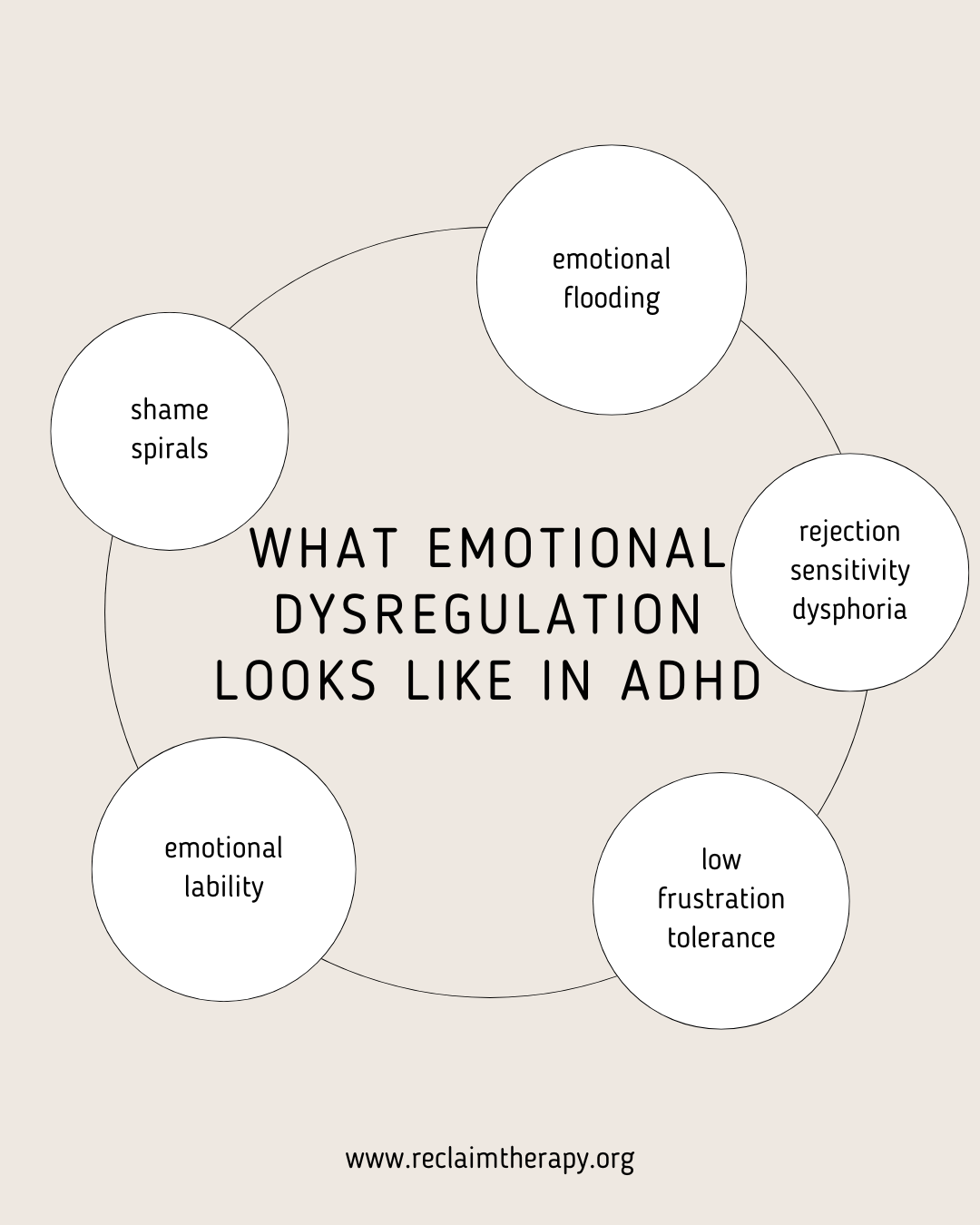
This is when one feeling takes over completely. Your brain gets hijacked by the emotion, and suddenly your logical, reasoning self has left the building. You’re not being dramatic. Your prefrontal cortex, the part of your brain responsible for executive function and emotional regulation, is genuinely struggling to keep up with the intensity of what your nervous system is feeling. In ADHD, this emotional reactivity often leads to intense feelings that can be hard to manage, resulting in difficulty calming down even after the emotional episode has passed.
Emotional flooding can look like: shutting down entirely, rage that comes out of nowhere and dissipates just as fast, sobbing without being fully sure why, or feeling frozen when you know you need to respond.
Rejection Sensitive Dysphoria (RSD)
This one is huge in the ADHD world.
Rejection sensitive dysphoria is an intense emotional response to perceived or actual rejection, criticism, or failure.
The key word is perceived
It doesn’t have to be real rejection. A delayed text back, a slightly flat tone in a meeting, someone not laughing at your joke, any of these can trigger a wave of emotional pain that feels completely disproportionate to what happened. This is often due to perceived rejection, where individuals with ADHD may interpret neutral or benign interactions as rejection or criticism.
And then comes the shame about having that response. Which makes everything worse.
RSD can show up as people-pleasing, social withdrawal, perfectionism, or avoiding anything you might fail at. It’s a big driver of anxiety in ADHD adults, and it’s one of the reasons ADHD and anxiety get so tangled up.
Low Frustration Tolerance
When you have ADHD, small frustrations don’t always feel small. Technology that won’t cooperate, traffic, being interrupted when you’re finally in a flow state, these can trigger an emotional response that feels way too big for what’s happening. This low frustration tolerance is closely linked to challenges with impulse control in ADHD, making it harder to pause before reacting emotionally. And then you feel embarrassed by your own reaction, which adds another layer onto the whole thing.
Emotional Lability
Emotional lability means your mood shifts quickly and often.
You can go from genuinely fine to overwhelmed to okay again within the same hour. People around you might struggle to track it. You might struggle to track it. And because we live in a world that generally pathologizes emotional sensitivity, you’ve probably been told at some point that you’re “too much.”
You’re not too much. Your brain processes emotion differently. That’s actually a pretty important distinction. Managing intense emotions is crucial in this context, as learning to recognize and regulate these rapid mood shifts can help you navigate emotional lability more effectively.
ADHD Shame and the Spiral
What often gets missed in conversations about emotional dysregulation is what comes after. After the flooding, after the outburst, after the RSD spiral, there’s frequently an intense wave of self-criticism and shame.
A lot of adults with ADHD have spent decades being told they’re too sensitive, too reactive, too emotional. That narrative gets internalized, and over time, repeated criticism and shame can contribute to low self esteem. And it’s one of the most painful parts of living with unrecognized or undertreated ADHD.
Why the ADHD Brain Struggles with Emotion Regulation
Here’s the neuroscience piece.
The ADHD brain has differences in how the prefrontal cortex communicates with the rest of the brain. Differences in brain function and executive functions, such as planning, impulse control, and emotional regulation, contribute to emotional dysregulation in ADHD. The prefrontal cortex is responsible for executive functioning, things like planning, organizing, and yes, regulating emotional responses. When that communication is disrupted, emotions can essentially bypass the “reasoning” filter and land at full intensity. Executive dysfunction and cognitive deficits are common in ADHD and further impact emotional regulation, making it difficult to manage impulses and control emotional responses.
Add in differences in dopamine and norepinephrine; the neurotransmitters that help regulate mood, motivation, and attention, and you’ve got a nervous system that is genuinely working harder to do something that feels automatic for other people.
This isn’t about trying harder. You can’t willpower your way out of a nervous system that processes emotion this way. Which is why understanding it matters so much.
When It's ADHD, Trauma, or Both (Because It's Often Both)
Here’s something that comes up constantly, both in therapy rooms and in the comments sections of every ADHD post on the internet: emotional dysregulation that looks exactly like ADHD can also be a trauma response, including experiences like emotional flashbacks in complex PTSD. And a trauma response can look a lot like ADHD. And sometimes, pretty frequently, actually, it’s both at the same time.
So let’s talk about that.
How they overlap
Both ADHD and trauma can cause difficulty regulating emotions, hypervigilance, impulsivity, concentration problems, and a nervous system that feels perpetually on edge. From the outside, and sometimes even from the inside, they can be genuinely hard to tell apart, especially when trauma-related coping mechanisms like maladaptive daydreaming and dissociation are also present. Emotional dysregulation is also a feature seen across various mental disorders, not just ADHD and trauma, highlighting its role as a transdiagnostic factor in mental health.
This is part of why ADHD in adults, especially women, gets missed for so long. What looks like “just anxiety” or “just trauma” or “just being sensitive” is often a much more layered picture. Mental health problems and comorbid diagnoses, such as anxiety, depression, or somatoform disorders, can further complicate the clinical picture and make it harder to identify the root cause.
Both also involve the same brain regions.
The prefrontal cortex, the amygdala, the stress response system, trauma and ADHD are both operating in that same neighborhood, which is part of why their symptoms show up looking so similar.
Where they’re different
With trauma, emotional dysregulation tends to be more context-dependent. There are usually specific triggers, things that remind the nervous system of past experiences and the dysregulation is the nervous system doing its job, trying to protect you from something it learned was dangerous.
With ADHD, the emotional dysregulation is more consistent and less tied to specific triggers. It’s more about the brain’s baseline capacity to regulate intensity, regardless of what’s happening in the room.
That said, trauma can make ADHD symptoms significantly worse. And growing up with undiagnosed ADHD, navigating a world that repeatedly told you that you were too much, not enough, or fundamentally flawed, can itself be traumatic.
So the two don’t just coexist. They compound each other.
Why this matters for healing
If you’ve been doing trauma work and hitting a wall, unaddressed ADHD might be part of what’s making regulation so hard. If you’ve been treating ADHD and still feeling stuck, there may be trauma underneath that needs its own attention.
This is exactly why approaches like EMDR therapy and its eight stages, Somatic Experiencing, and IFS work so well for people sitting at this intersection. They’re not just targeting symptoms, they’re working with the nervous system itself, which is where both ADHD and trauma actually live.
Dysregulated Is Not Who You Are
I want to be really clear about something.
Emotional dysregulation is a neurological difference, not a moral failing.
The way your brain processes emotional intensity is rooted in how your nervous system is wired, not in some deficit of character or self-control. In fact, what many researchers call "deficient emotional self regulation" is now recognized as a core feature in many individuals with ADHD, highlighting the neurological basis of these challenges.
That doesn’t mean it doesn’t cause real harm to you, to your relationships, to your sense of self. It does, and that’s worth taking seriously.
But there’s a massive difference between “I have a nervous system that needs support” and “I am broken.”
A neuro-affirming approach to ADHD means starting from the assumption that your brain isn’t wrong, it just works differently. And that different brains need different tools, not more shame.
ADHD Medication and Treatment
When it comes to managing attention deficit hyperactivity disorder, ADHD medication is often one of the first things people think about. But what many don’t realize is that these medications can do more than just help with focus or impulsivity—they can also make a real difference in emotional dysregulation.
ADHD medication works by supporting the brain’s ability to regulate emotions, not just attention. For some people, this means fewer emotional outbursts, less time spent stuck in a spiral of negative feelings, and an increased ability to pause before reacting. It can help smooth out the mood swings and make it easier to return to baseline after a strong emotional response.
Of course, medication isn’t a magic fix. It’s one tool among many for regulating emotions and managing the ups and downs that come with ADHD. Many people find that combining medication with therapy, lifestyle changes, and practical coping strategies gives them the best chance at feeling more balanced and in control.
If you’re struggling with emotional dysregulation and wondering if ADHD medication could help, it’s worth having a conversation with a mental health professional who understands the full picture of ADHD—not just the attention piece, but the emotional side too. Finding the right support can make a significant difference in how you experience your own emotions, and in your day-to-day life.
What Actually Helps
This isn’t a quick fix list, because those aren’t actually real. But here’s what tends to actually move the needle:
Understanding what’s happening in your body first. Somatic awareness, tuning into physical sensations before the emotional flood hits, can give you a small but meaningful window to respond rather than react. Emotions live in the body before they become thoughts. Learning to notice the tightness in your chest, the heat in your face, the shallow breathing, that awareness is the starting point. Recognizing these physical sensations can help with feeling emotions and managing negative emotions, making it easier to regulate your responses.
Working with your nervous system, not against it. Co-regulation, movement, breathwork, and sensory regulation are tools that work with how your nervous system actually functions. They’re not just “wellness trends.” They’re practical nervous system support. Using coping mechanisms, adaptive strategies, and emotion regulation strategies—such as physical movement, exercise, or grounding techniques—can improve emotional regulation and help manage intense feelings.
Therapy that actually gets ADHD. Not every therapeutic approach is equally helpful for ADHD and emotional dysregulation. Approaches like EMDR Therapy, Somatic Experiencing, and Internal Family Systems can be particularly effective because they work at the level of the nervous system and the underlying emotional patterns, not just the surface behaviors. Evidence-based interventions are supported by clinical psychology review and clinical psychological science, and options like dialectical behavior therapy are also recommended for emotion dysregulation.
Naming it. Seriously. Just having language for what’s happening, “this is emotional flooding,” “this is RSD” can interrupt the shame spiral enough to give you a little breathing room. You’re not losing it. You’re having a nervous system response that makes complete sense given how your brain works. Naming both positive emotions and negative emotions can help regulate emotional responses and reduce their intensity.
Community and connection. Shame grows in isolation. Finding spaces where your experience is recognized and not pathologized matters more than I can overstate.
Developing emotional regulation skills is key to managing emotional dysregulation in ADHD. Practicing a few deep breaths or deep breaths can create a pause, allowing you to choose an appropriate response rather than reacting impulsively. These strategies are especially relevant for adult ADHD, young adults, and in adolescent psychiatry, where emotion dysregulation and emotional dysregulation subgroups are important considerations in attention disorders and affective disorders. Certain situations can trigger strong emotions, so bringing awareness back to the present moment is a valuable coping skill. Community and connection play a crucial role in supporting individuals with attention disorders and emotion dysregulation, helping to foster resilience and adaptive strategies.
If This Is Landing for You
Maybe you've known for a while that you have ADHD and emotional regulation has always been the piece that feels the hardest. Maybe you're newly diagnosed and things are starting to click. Or maybe you've never been diagnosed but you're reading this thinking oh.
All of those are valid places to be.
What I want you to walk away with is this: the emotional intensity you've been living with is real, it's neurological, and it's workable. You don't have to keep white-knuckling your way through your own feelings or apologizing for a nervous system that was never explained to you.
At Reclaim Therapy, we work with adults navigating ADHD, complex trauma, and emotional dysregulation using somatic, EMDR, and IFS approaches. If you're in Pennsylvania and ready to explore what healing can look like for your nervous system, we'd love to connect.
🧡,
