
You likely know what you need to do.
The email needs an answer. You need to make the appointment. There are three things you meant to grab at the grocery store, and somehow you came home with twelve other things instead. You sat down to pay a bill, got distracted halfway through, and remembered it again while lying in bed that night.
Meanwhile, there are other areas of your life where you are incredibly capable.
You can manage a crisis. You can keep track of what everyone else needs. You can meet a deadline when there is absolutely no other option. You might even be the person everyone comes to when something needs to get done.
So why does your brain sometimes completely tap out on seemingly simple things?
Yes, trauma can contribute to executive dysfunction, especially when the trauma is complex or developmental. If you are an adult dealing with childhood emotional neglect, dissociation, perfectionism, people-pleasing, nervous system dysregulation, or complex PTSD, executive dysfunction may be one piece of the puzzle.
Trauma can affect attention, working memory, cognitive flexibility, planning, and other processes involved in executive functioning. That doesn't mean every struggle with executive function is caused by trauma, and it doesn't mean trauma causes ADHD.
But if you've spent years feeling confused by shutdown, disorganization, forgetfulness, or difficulty starting and finishing basic tasks, understanding the trauma connection can replace self-blame with a clearer path forward. Below, we'll look at what executive dysfunction is, how trauma can shape it day to day, how trauma-related executive struggles differ from ADHD, and what healing and therapy can help.
What Is Executive Dysfunction?
Executive functioning is basically the collection of mental processes that helps you get from I need to do this to actually doing it.
It helps you decide what matters first, hold information in your mind, organize a task, shift your attention, manage impulses, estimate time, start something, and keep going long enough to finish it.
Executive dysfunction happens when accessing those abilities becomes difficult.
It can look like procrastinating even when something matters to you, repeatedly forgetting things, struggling to organize your day, getting overwhelmed by multi-step tasks, losing track of time, having difficulty switching from one activity to another, or knowing exactly what you need to do while feeling completely unable to start.
Executive dysfunction isn't simply a lack of motivation.
Sometimes you desperately want to do the thing. You may have spent the last three hours thinking about how much you need to do the thing. Your brain just isn't cooperating with the plan.
How Can Childhood Trauma Affect Executive Functioning?
To understand trauma and executive dysfunction, it helps to zoom out from productivity for a minute.
Your brain isn't designed to make sure you answer emails efficiently. Its first job is keeping you alive.
When your nervous system detects threat, resources shift toward whatever might help you respond to that threat. Attention narrows or becomes more vigilant. Your body prepares for action, and trauma can shift the brain's baseline from learning toward survival, pulling resources away from executive control through a dysregulated stress response. It can become harder to think flexibly, hold multiple pieces of information in mind, or make thoughtful decisions.
That's useful when you're actually in danger.
It becomes more complicated when your nervous system has spent years learning that danger can show up just about anywhere.
With complex trauma, especially trauma that happened in childhood, a person's nervous system may have developed while repeatedly managing stress, unpredictability, emotional neglect, abuse, criticism, or a lack of reliable support. Repeated exposure during brain development can leave the prefrontal cortex affected by chronic stress, which is linked to problems with decision-making and other higher-order cognitive processes.
Instead of occasionally responding to danger and then returning to safety, the system may have spent much more time adapting around survival. Over time, chronic stress signaling and stress hormones can alter neural architecture, and the hippocampus is often smaller in trauma survivors.
Trauma therapist Thomas Zimmerman describes people with complex trauma as having often been so occupied with the tasks of survival that some adaptive capacities had less opportunity to develop or become easily accessible.
That doesn't mean someone with CPTSD lacks executive functioning skills. In fact, many trauma survivors become exceptionally capable in certain environments.
It means those skills may be harder to access when the nervous system is overwhelmed, activated, shut down, dissociated, or anticipating threat.
What Executive Dysfunction and Impulse Control Issues Can Look Like With Complex PTSD
One of the reasons complex PTSD and executive function can be confusing is that the struggle doesn't always look the way people expect, and it can shift depending on the stressors in your daily life.
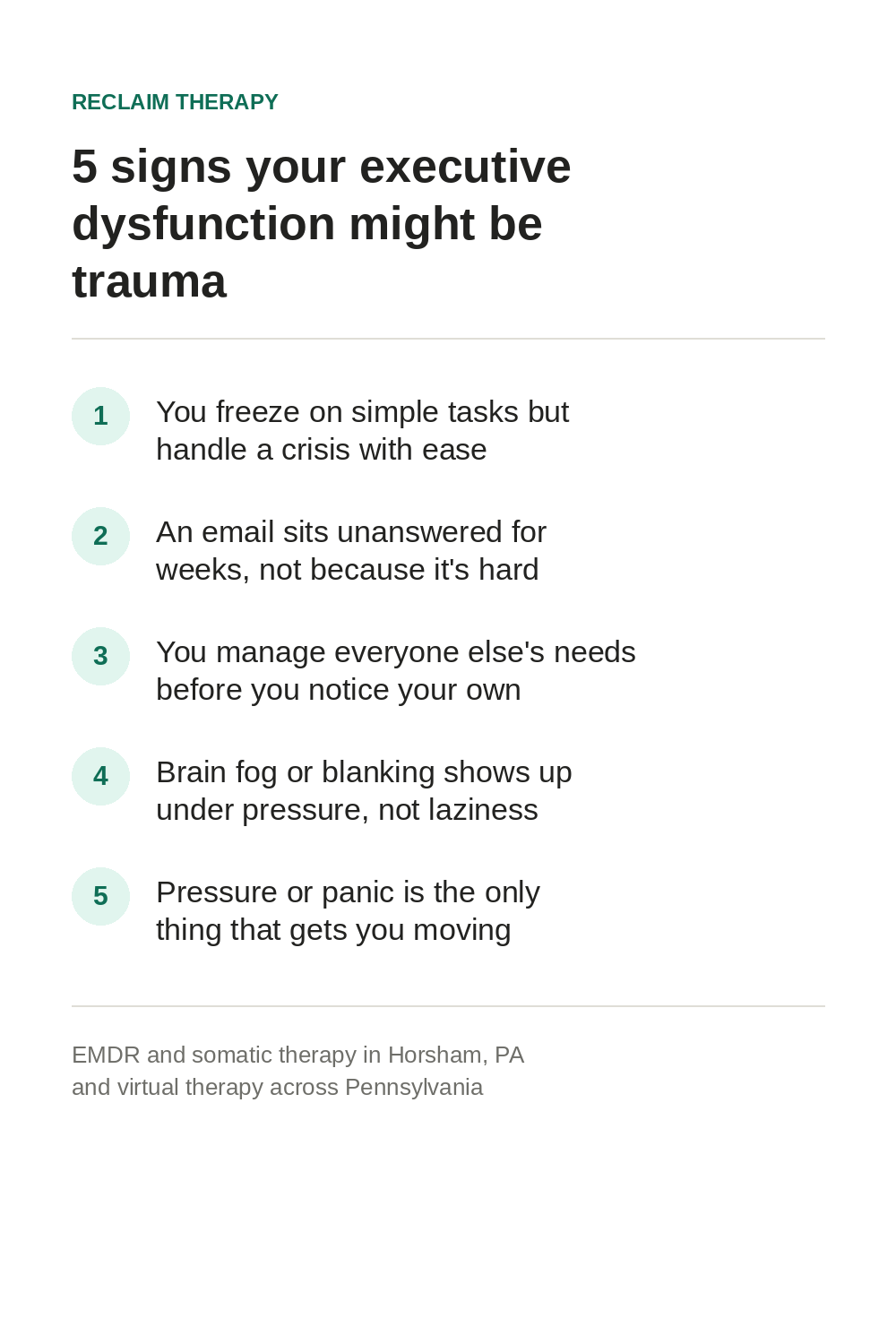
You might run meetings at work and forget to schedule your own dentist appointment for eight months, a pattern that can still hurt performance at work or school despite looking highly capable.
You might be the person everyone calls during a crisis and still feel completely overwhelmed by deciding what to make for dinner.
Maybe you can accomplish an astonishing amount when a deadline is breathing down your neck, but without urgency, getting started feels almost impossible; hypervigilance can sometimes sharpen threat-based performance while disrupting focus and mental clarity on ordinary tasks, leading to missed deadlines.
You might create elaborate lists and systems because you're terrified you'll forget something.
You may procrastinate on emails, paperwork, phone calls, or decisions that involve the possibility of getting something wrong, and these patterns can sit alongside many symptoms.
Or you can keep going, going, going until your body eventually decides the meeting is over and you crash.
This is part of why executive dysfunction after trauma can be missed in people who are outwardly high functioning.
If you've learned to overfunction, people-please, anticipate problems, or push through exhaustion, other people may see someone extraordinarily competent.
You may see someone who can somehow manage everybody else's life but cannot figure out why moving your own laundry from the washer to the dryer requires an act of Congress.
Both things can be true.
Sometimes the Task Isn't Actually the Whole Problem
This is where looking at executive dysfunction through a trauma lens becomes particularly useful.
Take an unanswered email.
On paper, the task is pretty straightforward. Open email. Write response. Hit send.
But maybe the email requires you to disappoint someone.
Maybe you aren't sure what the "right" response is.
Maybe someone could misunderstand you.
Maybe you're setting a boundary.
Maybe you're asking for something you need.
Now the task involves uncertainty, potential conflict, vulnerability, or the possibility of being judged. In survival mode, those cues can trigger feelings of threat, pulling attention away from higher-order thinking.
For someone who grew up in an environment where mistakes, needs, conflict, or other people's disappointment carried consequences, that email may activate much more than a simple organizational task.
Suddenly you're rereading it seventeen times, thinking about it all afternoon, avoiding your inbox, and becoming increasingly angry with yourself—or slipping into irritability or emotional flooding—because of the intense feelings behind WHY CAN'T I JUST ANSWER THE EMAIL?
The problem may not be that you don't know how to send an email. Your nervous system may be responding to what the email represents.
Why More Pressure Can Make Executive Dysfunction Worse
A lot of people respond to executive dysfunction with the strategy they learned early in life:
Pressure.
Come on.
Just do it.
Stop being lazy.
Why are you making this such a big deal?
Everyone else manages this.
And occasionally, pressure works.
Adrenaline can get things moving. Fear of disappointing someone can create urgency. A looming deadline can suddenly make a task that felt impossible yesterday very possible today.
If you grew up using anxiety, perfectionism, or fear of consequences to mobilize yourself, you may have gotten really freaking good at this.
The problem is that it's expensive. You aren't necessarily building greater capacity to initiate and complete tasks. You're repeatedly creating enough internal threat to force your system into action, which can further erode self regulation and make impulse control and behavior harder to manage over time. And eventually, that strategy can run out of road.
Emotional Neglect Can Affect More Than Your Emotions
Childhood emotional neglect is particularly relevant here because what didn't happen during development matters too.
Children don't only need food, shelter, and physical safety. They rely on caregivers for emotional attunement, support, co-regulation, guidance, and help making sense of their internal experiences, and childhood trauma can affect prefrontal cortex development, which supports self-monitoring and regulation.
Psychologist Lindsay Gibson writes about how children of emotionally immature parents may learn to put other people's needs first, become self-sufficient early, and take responsibility for maintaining relationships.
You can become remarkably skilled at noticing what everyone else needs while becoming increasingly disconnected from your own internal signals, and some adults from these backgrounds also have emotional outbursts when overloaded.
What do I need?
What actually matters to me?
Am I tired?
Am I hungry?
Do I have capacity for this?
Which thing needs my attention first?
Do I even want to do this?
Those questions matter because executive functioning doesn't happen in a vacuum. Planning, prioritizing, decision-making, and follow-through all require some ability to notice and organize around your own internal experience, and when self-monitoring is reduced, a person's ability to evaluate behavior and priorities becomes less reliable.
If most of your attention developed around anticipating the needs, moods, or reactions of other people, turning that attention toward yourself can take practice.
Dissociation and Shutdown Can Look Like Executive Dysfunction Too
Trauma doesn't always look like anxiety and hypervigilance.
Sometimes the nervous system responds to overwhelm by moving toward shutdown, disconnection, or dissociation.
That can feel very different cognitively.
Instead of racing thoughts, you may get brain fog.
You stare at your computer without taking anything in.
You walk into a room and can't remember why you're there.
You read the same paragraph four times.
You lose track of time.
Your brain feels strangely blank.
You know you need to start something, but there seems to be an enormous gap between knowing and moving.
Trauma-related disconnection and freeze can involve feeling overwhelmed, numb, disconnected from the body, or unable to mobilize even when part of you wants to.
This is one reason I don't love reducing executive dysfunction to a productivity problem. Sometimes we're asking, how do I make myself do more? when a more useful question is, What happens in my system when I try to do this?
ADHD vs Trauma Executive Dysfunction
This is where things can get confusing because ADHD and trauma-related executive dysfunction can overlap.
Both can involve difficulty with attention, working memory, organization, emotional regulation, impulse control, time management, and task initiation.
But ADHD is a neurodevelopmental disorder. Trauma does not cause ADHD. Trauma can, however, affect some of the same areas of functioning. And someone can absolutely have both ADHD and a trauma history. About 10% of people with ADHD also have PTSD linked to traumatic experiences. This is why trying to figure out ADHD vs trauma executive dysfunction from a list of symptoms can only take you so far.
A thorough assessment may look at when symptoms began, whether difficulties were present during childhood and across different settings, developmental and school history, family history, patterns of hyperactivity or impulsivity, and how symptoms change depending on stress or perceived safety.
A clinician may also consider other things that can affect concentration and executive functioning, including anxiety, depression, dissociation, chronic stress, and sleep.
For some people, the question isn't ADHD or trauma. The clinically accurate answer may be both.
And identifying both matters because you deserve support for what is actually happening, rather than trying to squeeze your experience into whichever explanation happens to be trending online this week. For example, trouble with unexpected changes across many settings points more toward ADHD, while symptoms that flare around reminders of danger point more toward trauma.
Can Executive Function Improve as Trauma Heals?
For some people, yes, and cognitive functioning can improve as recovery progresses.
But I want to be careful about what that means. Trauma therapy isn't a productivity hack. Healing complex trauma will not necessarily turn you into a beautifully organized human who remembers every appointment and has never once searched for her phone while actively holding it.
The goal isn't peak efficiency.
As your nervous system develops more capacity to tolerate emotions, move through activation, remain present during stress, receive support, and recover after difficult experiences, you may find that you have more cognitive capacity and stronger cognitive abilities available too as part of the recovery process.
You may notice that making decisions takes less energy. A mistake doesn't derail your entire day. You can start something without waiting until panic kicks in. You catch yourself becoming overwhelmed earlier. You can ask for help instead of spending three hours trying to figure everything out yourself.
And perhaps most importantly, you begin responding to moments of executive dysfunction with curiosity instead of immediately turning against yourself.
What Helps With Trauma-Related Executive Dysfunction?
If trauma is contributing to executive dysfunction, the answer usually isn't finding the perfect planner.
Although, listen, if buying a beautiful new planner brings you joy, I'm certainly not here to take that away from you.
External supports can genuinely help. Calendars, reminders, visual cues, written lists, routines, timers, and breaking tasks into smaller steps reduce the amount of information your brain has to hold at once, and building consistent routines can improve focus and reduce anxiety.
But it can also help to pay attention to the moments when executive functioning becomes especially difficult.
Do you freeze when a task involves making a decision?
Do you procrastinate when someone could evaluate your work?
Does your mind go blank during conflict?
Do you avoid tasks that require asking for help?
Do you become significantly less organized when you're emotionally overwhelmed?
Does perfectionism turn a relatively small task into something enormous?
Do changes in plans leave you stuck or scrambling, a sign that cognitive flexibility can involve trouble shifting focus when plans change?
Those patterns give us information.
Rather than trying to overpower them, trauma therapy can help you understand what's happening underneath them.
That might include working with traumatic memories, increasing your capacity to stay present with uncomfortable emotions, addressing dissociation, developing more flexible responses to mistakes and uncertainty, building self-trust, and creating external supports that actually work with your brain.
Practical strategies and targeted interventions can also improve executive functioning abilities and ease executive functioning challenges: Cognitive Behavioral Therapy (CBT) effectively addresses trauma-related executive dysfunction, trauma-informed therapy can improve emotional regulation and cognitive control, mindfulness practices can enhance impulse control and emotional regulation, and executive function coaching provides tools for organization, planning, and problem solving.
When Executive Dysfunction Is Affecting Your Life
If difficulty with focus, memory, organization, task initiation, or follow-through is affecting daily life, work, or relationships, outside perspective and the right support matter.
You don't have to figure out on your own whether it's trauma, ADHD, anxiety, dissociation, chronic stress, something else, or some combination of all of the above.
A good assessment looks at the whole picture, including whether trauma is linked to executive functioning difficulties.
And if trauma is part of that picture, working with a therapist who understands complex trauma can help you move beyond How do I force myself to function better?
Because sometimes a much more useful place to begin is understanding why functioning became so hard in the first place.

Therapy for Complex PTSD and Executive Dysfunction in Pennsylvania
At Reclaim Therapy, we work with adults who are dealing with the effects of complex trauma, childhood emotional neglect, dissociation, perfectionism, people-pleasing, and nervous system dysregulation.
Our therapists offer trauma-focused approaches including EMDR therapy and somatic therapy, with in-person therapy available in Horsham, PA and virtual therapy throughout Pennsylvania.
If you've spent years wondering why you can be incredibly capable in some parts of your life and completely stuck in others, there may be more happening than a lack of motivation.
Sometimes the work isn't figuring out how to force yourself to function better. It's understanding what makes functioning so hard in the first place, and giving your brain and body something other than pressure to work with.
If this is resonating, schedule a free consultation and let's figure out what's actually going on.
🧡,

Frequently Asked Questions
Can trauma really cause executive dysfunction?
Trauma doesn't cause executive dysfunction the way a diagnosis does, but it can significantly affect the same systems involved in attention, working memory, planning, and task initiation. When the nervous system develops around survival, those skills may be harder to access, especially under stress.
What's the difference between ADHD and trauma-related executive dysfunction?
ADHD is a neurodevelopmental disorder, and trauma does not cause it. But trauma can affect many of the same areas of functioning, and it's possible to have both. A thorough assessment looks at developmental history, symptom onset, and how difficulties shift depending on stress or safety.
Can executive function improve as trauma heals?
For many people, yes. As the nervous system develops more capacity to tolerate stress and return to safety, cognitive resources that were tied up in survival often become more available for planning, decision-making, and follow-through.
What does trauma-related executive dysfunction look like day to day?
It often looks inconsistent. Working memory deficits are also common in people with a trauma history. Someone might manage a work crisis with ease but feel unable to answer a simple email, or run an entire household while struggling to start a five-minute task, especially when a hyperactive amygdala keeps them in a heightened state and constantly scanning for distractions or perceived danger cues. That inconsistency is a hallmark, not a contradiction.