
Highly Sensitive Person: Symptoms, Anxiety and Trauma
Maybe you've always been told you're sensitive.
Highly sensitive person symptoms often include feeling overwhelmed in loud or chaotic environments, noticing subtle shifts in other people's moods, experiencing emotions deeply, needing more downtime after socializing, and reacting strongly to sensory input like noise or bright lights. You notice when someone's energy shifts. Loud restaurants wear you out. Conflict sticks with you long after everyone else seems to have moved on. You need more time to recover after busy days, and sometimes it feels like your brain and body are taking in everything at once.
Maybe you've even found the term "highly sensitive person" and thought, Oh. This explains a lot.
And maybe it does.
If that sounds like you—especially if you also grew up with emotional neglect, unpredictable caregivers, chronic stress, anxiety, or complex trauma—there may be another layer worth understanding. Being a highly sensitive person and having a nervous system shaped by trauma are not the same thing. High sensitivity is generally understood as a temperament trait, while trauma can change how your nervous system responds to cues of safety, danger, connection, and uncertainty.
The confusing part is that they can look remarkably similar from the outside.
You can also be both.
So rather than trying to figure out which box you belong in, it may be more useful to understand what your sensitivity is actually doing and what your nervous system has learned to do with all the information it takes in.
That's where this article goes: what it means to be a highly sensitive person, the symptoms commonly linked to high sensitivity, how sensitivity overlaps with anxiety and trauma, how hypervigilance differs from temperament, how emotional neglect can shape your responses, and when therapy may help. The distinction matters, because understanding whether you're dealing with natural sensitivity, trauma-related adaptations, or both can make overwhelm feel more workable and help you find support that fits without pathologizing who you are.
What Does It Mean to Be a Highly Sensitive Person?
A highly sensitive person, often shortened to HSP, is someone thought to have greater sensitivity to internal and external stimuli.
HSP is not a mental health diagnosis. You won't find "highly sensitive person" in the DSM, and being sensitive is not something that inherently needs to be treated.
People who identify as highly sensitive often describe noticing subtleties other people seem to miss, processing experiences deeply, feeling affected by other people's emotions, and becoming overwhelmed when there is too much sensory or emotional input at once.
This can include everything from needing some quiet after a packed weekend to noticing a tiny change in someone's facial expression before anyone else has picked up on it.
And sensitivity isn't inherently a weakness.
A nervous system that takes in a lot of information may also pick up on nuance, beauty, connection, creativity, emotion, and subtle interpersonal cues.
The problem is that taking in more information can become exhausting when your nervous system has also learned that some of that information might signal danger.
That's where the conversation gets more complicated.
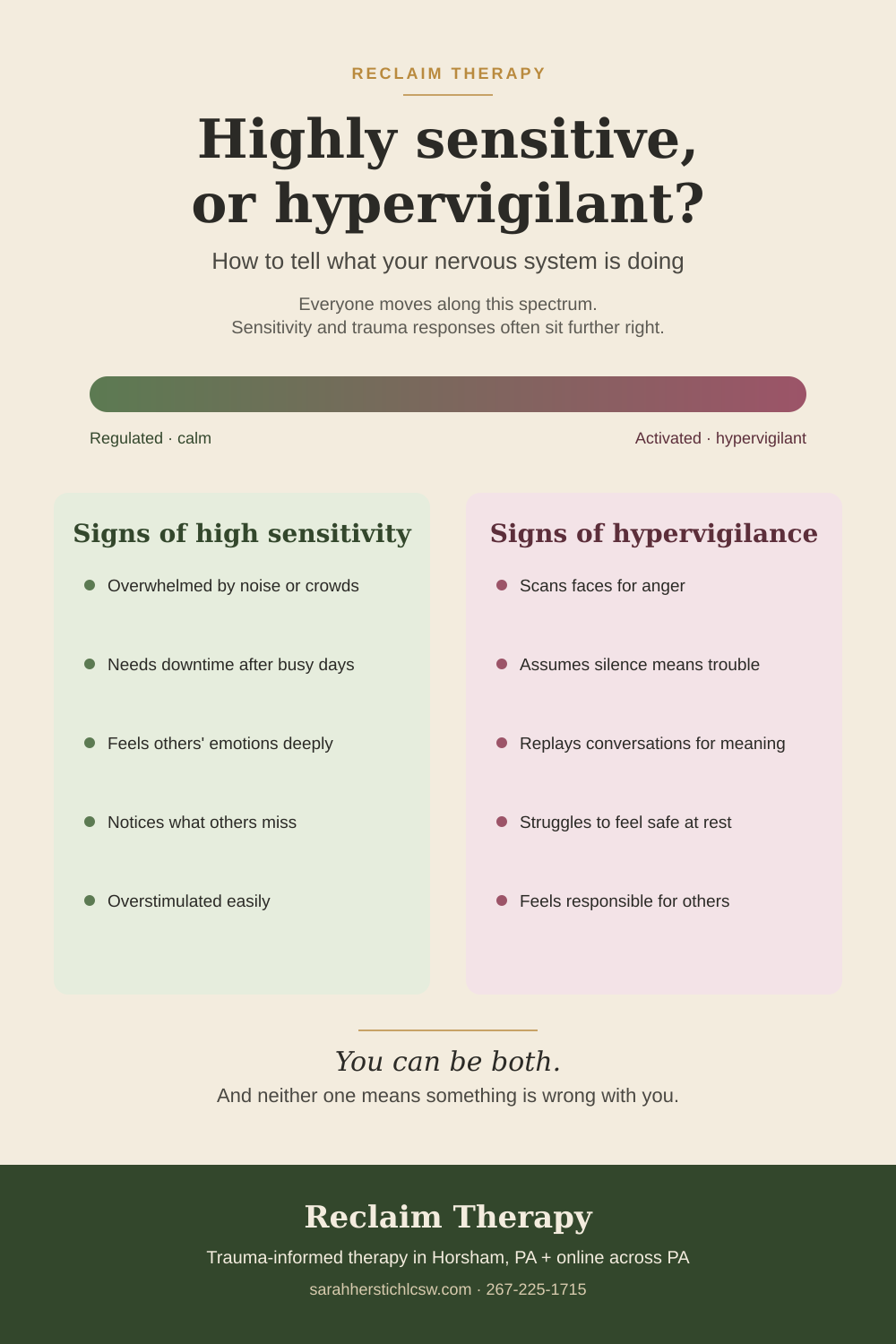
Common Highly Sensitive Person Symptoms
People often search for "highly sensitive person symptoms," but because HSP isn't a disorder, it may be more accurate to think of these as traits associated with high sensitivity.
Some common experiences include:
Feeling easily overwhelmed in loud, crowded, chaotic, or highly stimulating environments
Needing more downtime after socializing or busy days
Noticing subtle changes in other people's moods, tone of voice, or body language
Experiencing emotions deeply
Feeling strongly affected by criticism or conflict
Becoming overstimulated when several things are happening at once
Having strong responses to sensory experiences like noise, bright lights, smells, textures, or physical discomfort
Thinking deeply about experiences and interactions
Needing time to process decisions or changes
Feeling especially affected by other people's distress
None of these automatically mean someone has anxiety or trauma.
But some of them can overlap with symptoms we see in people whose nervous systems have spent a long time adapting to stress.
And that overlap matters.
HSP and Anxiety Can Look Surprisingly Similar
Let's say you walk into a crowded restaurant.
Within a few minutes, you're aware of the music, people talking at the table beside you, silverware hitting plates, the overhead lights, someone walking behind your chair, and your friend asking you a question while you're trying to read the menu.
For a highly sensitive person, that's a lot of sensory input to process. Crowded settings can feel overwhelming before anxiety-related threat scanning even starts.
Now imagine walking into that same restaurant with a nervous system that is already anxious or hypervigilant.
You might still notice the noise, lights, people, and movement. But your system may also be evaluating some of that information for threat.
Who's behind me?
Is my friend irritated?
Why did her tone change?
Am I being weird?
Did I say something wrong?
Where's the exit?
Suddenly, we're talking about more than sensitivity to stimulation.
We're talking about what your nervous system has learned to do with the information it receives.
This is one reason HSP and anxiety can be difficult to separate based on a checklist alone.
Two people can both say, "I notice everything," while having very different experiences internally.
One person's nervous system may simply register more sensory and emotional information. Another person's system may be monitoring that information because it learned that subtle changes sometimes mattered for safety.
And for some people, both things are happening.
When High Sensitivity Meets Childhood Emotional Neglect
This is where I think the HSP conversation often stops too soon.
What happens when a naturally sensitive child grows up in an environment that doesn't know what to do with their sensitivity, and when childhood experiences shape how that sensitivity gets lived?
Maybe your caregivers weren't overtly abusive. Maybe they loved you. Maybe many of your physical needs were met. But emotionally, you were largely on your own.
Perhaps feelings made your parents uncomfortable. You learned that crying was dramatic, anger was disrespectful, or needing reassurance made you needy.
Maybe one parent's mood dominated the house. Maybe you got very good at figuring out what everyone else needed while slowly losing contact with what you needed. If any of this sounds familiar, you might recognize yourself in what it's like growing up emotionally unseen.
Psychologist Lindsay Gibson writes about highly perceptive and sensitive "internalizers" who grow up with emotionally immature parents. These children may become especially focused on connection, learn to think about what others need first, do a disproportionate amount of emotional work in relationships, and feel apologetic about needing help themselves.
If you were already sensitive to your environment, genetic and environmental factors may both have influenced that sensitivity, and environmental factors like early family dynamics may have intensified how strongly it was expressed.
You weren't simply noticing.
Sometimes, noticing was useful.
You could hear Dad's footsteps and know what kind of night it was going to be.
You could tell from Mom's sigh whether you should ask for something now or wait.
You could recognize a shift in someone's face before they said they were upset.
You learned when to talk, when to get small, when to help, when to disappear, and when to make absolutely sure nobody had a reason to be disappointed in you.
Over time, sensitivity and protection can become pretty tangled together.
Is It High Sensitivity or Hypervigilance?
This may be a more useful question than simply asking whether you're "too sensitive."
Hypervigilance is associated with a nervous system that has become highly attentive to possible threat.
And threat doesn't always mean physical danger.
For someone with complex trauma or attachment wounds, signs of disconnection, rejection, criticism, anger, or unpredictability may carry enormous weight.
So consider what happens after you notice something.
You notice that your partner's voice sounds different.
Do you simply register, Hmm, they seem off today?
Or does something inside you immediately start working?
Are they mad at me?
What did I do?
Should I ask? No, that'll annoy them.
Maybe I should give them space.
Actually, maybe I should fix it.
Let me replay the conversation from this morning, and then get pulled into anxious thoughts.
The difference isn't that one person notices and the other doesn't. It's what that information means to the nervous system and what happens next.
Trauma-related hypervigilance often has a protective quality. Your system isn't gathering information just because it enjoys being observant. It may be gathering information so it can predict what is coming and prepare you for it.
That can show up as people pleasing, perfectionism, overthinking, difficulty resting, scanning people's faces, anticipating conflict, or feeling responsible for other people's emotions. If people pleasing is a pattern you recognize in yourself, it's worth understanding it as a survival strategy rather than a personality flaw. Our post on the fawn response goes deeper into how that pattern develops.
These patterns can make even more sense when we understand trauma as something that can shape how the nervous system organizes around protection and responds to present-day experiences. It makes sense for the nervous system to become highly alert in stressful situations when it has learned that relationships could feel unsafe.
Why Noise Sensitivity Can Get Worse With Anxiety and Stress
Noise sensitivity deserves its own conversation because it can be incredibly frustrating.
Sometimes people wonder why they suddenly can't tolerate sounds they used to handle just fine.
The television is too loud, and even sudden loud noises can feel unbearable under stress.
Someone chewing makes you want to crawl out of your skin.
Your kids are talking to you while another conversation is happening, your to-do list is growing, and your brain essentially files for bankruptcy.
Sensitivity to sound can have many possible causes, and it isn't specific to anxiety, depression, trauma, or HSP.
But your overall level of activation can affect how much stimulation feels manageable.
Think about the difference between hearing a dog bark when you're sitting outside on a relaxing Saturday morning versus hearing that same bark after you've slept four hours, rushed through your entire day, had an argument with your partner, skipped lunch, answered 37 emails, and now someone needs to know what's for dinner.
Same bark.
Very different nervous system.
Sometimes the question isn't simply, "Why am I so sensitive to noise?"
It may also be, "How much is my system already carrying before that noise even happens?"
Being Highly Sensitive Doesn't Mean You're Dysregulated
This distinction is important.
I don't want sensitivity to become another human trait we immediately pathologize.
Feeling deeply isn't automatically dysregulation.
Needing time alone isn't automatically avoidance.
Being affected by conflict doesn't automatically mean you have trauma, and strong emotional responses can still be part of normal sensitivity.
Noticing other people's emotions doesn't automatically mean you're hypervigilant.
Sometimes you really are just sensitive, and that can reflect a natural heightened sensitivity rather than a problem. If you're curious about what regulation actually means for your nervous system versus what dysregulation looks like, that's a whole topic on its own, and we've unpacked it in this post on nervous system regulation.
The goal isn't to turn every personality trait into evidence that something terrible happened in childhood.
At the same time, we don't want to swing so far in the other direction that we call every trauma adaptation "just being an HSP."
If you're constantly scanning other people's moods, abandoning your own needs to keep relationships stable, feeling chronically unsafe, struggling to come down after activation, or becoming overwhelmed by relatively small interpersonal shifts, there may be more happening than temperament alone.
Understanding that isn't about finding another label.
It's about getting more curious about your experience.
What If You're Both Highly Sensitive and a Trauma Survivor?
You don't have to pick one. A person can have a sensitive temperament and also have a history of trauma.
In fact, thinking about the interaction between the two may help explain why you've spent so much of your life feeling like everything affects you "more" than it seems to affect other people.
Imagine a child who notices a lot.
Now put that child in an emotionally supportive environment.
Their caregiver helps them understand what they're feeling.
Their sensitivity isn't mocked.
They get help when they're overwhelmed.
Conflict is followed by repair.
They learn that other people's emotions aren't automatically their responsibility.
That child gets repeated experiences of feeling a lot without having to manage everything they feel alone.
Now imagine a similarly sensitive child growing up in a chronically unpredictable environment.
They notice Dad's anger and have to figure out what to do with it.
They notice Mom withdrawing and wonder how to get her back.
They feel overwhelmed and are told they're dramatic.
They get hurt and hear that they're too sensitive.
They need comfort and discover that comfort isn't reliably available.
The sensitivity itself isn't necessarily the wound.
The environment in which that sensitivity develops matters.
Research and clinical models of developmental trauma emphasize the importance of repeated experiences of attunement, emotional support, safety, and connection in shaping how children learn to regulate and relate to their internal experiences.
That is a very different conversation from "You're an empath who absorbs everyone's energy."
And frankly, it's a much more useful one.
Do Highly Sensitive People Need Therapy?
Not simply because they're highly sensitive. High sensitivity itself does not require treatment.
But therapy for sensitive people can be helpful when sensitivity is happening alongside experiences like:
Anxiety or chronic hypervigilance
Complex PTSD or childhood trauma
Emotional neglect
People pleasing
Perfectionism
Difficulty setting boundaries
Disordered eating or body image struggles
Dissociation or feeling disconnected from your body
Chronic overwhelm
Difficulty identifying your own needs
Feeling responsible for other people's emotions
Trouble trusting yourself
Relationships that repeatedly leave you depleted
The goal of HSP therapy shouldn't be to toughen you up until nothing bothers you. You've probably had enough people telling you that you're "too sensitive."
Good therapy can help you become more curious about the sensitivity, and support emotional wellness and overall well-being when it exists alongside anxiety or trauma.
What am I noticing?
What happens in my body when I notice it?
Does this actually require action?
Is something happening now, or is my nervous system preparing for something familiar?
Can I feel someone's disappointment without immediately fixing it?
Can I notice tension without assuming I caused it?
Can I experience sensory overload and make space for self care without judging myself for having needs?
Those are very different questions from, "how do I stop being so sensitive?"
What Therapy for HSPs Can Actually Help With
If trauma is part of your history, therapy may help separate your natural sensitivity—more specifically, sensory processing sensitivity—from the protective responses that developed around it.
That might mean learning to recognize activation before you're completely overwhelmed. It may mean noticing when you're tracking everyone else in the room but have completely lost contact with yourself, especially when others emotions start crowding out your own. It might involve working with the part of you that believes another person's disappointment is an emergency.
For some people, it includes trauma therapies such as EMDR or somatic therapy.
With complex trauma in particular, understanding something intellectually doesn't always change how the nervous system responds. Trauma healing is experiential, meaning new experiences can provide information that differs from what was encoded in earlier painful experiences.
In regular-person language, you can know you're allowed to have needs and still feel panic when you ask for something.
You can know your partner isn't your parent and still brace when their tone changes.
You can know you're safe and still have a body that isn't convinced yet.
Therapy gives you somewhere to work with that gap. If part of what you're recognizing in yourself is disconnecting from your body or feeling like you're watching your own life from a distance, that's worth naming too. We've written about what that experience of dissociation after trauma can look like.
Over time, the hope isn't that you stop noticing.
It's that noticing doesn't always have to turn into managing, fixing, bracing, pleasing, analyzing, or abandoning yourself.
And that can feel like a very different way to live in a sensitive body while supporting your well being over time.

Therapy for Highly Sensitive People in Horsham, Pennsylvania
If you've always identified as a highly sensitive person but you're beginning to wonder whether anxiety, emotional neglect, or complex trauma might also be part of your story, you don't have to figure out the perfect label before reaching out for support.
At Reclaim Therapy, we work with highly sensitive adults who are navigating complex trauma, childhood emotional neglect, anxiety, people pleasing, perfectionism, disordered eating, body image concerns, and nervous system dysregulation.
Our therapists offer trauma-informed therapy in Horsham, PA, as well as online therapy throughout Pennsylvania. Depending on your needs, treatment may include approaches such as EMDR therapy, somatic therapy, parts work, and other trauma-informed approaches.
The goal is never to make you less sensitive.
It's to help you understand what your sensitivity is telling you, what your nervous system may still be protecting you from, and what it might feel like to stay connected to yourself even when you're taking in a whole lot of the world around you.
Because maybe the question was never, How do I stop being so sensitive?
Maybe it's, How do I learn to live well in a nervous system that notices so much, without feeling like I have to protect myself from all of it?
Schedule a free consultation with Reclaim Therapy to talk about what support could look like for you.
🧡,

Frequently Asked Questions
What's the difference between being a highly sensitive person and having anxiety?
High sensitivity is generally considered a temperament trait, meaning your nervous system takes in more sensory and emotional information than average. Anxiety involves your nervous system evaluating that information for threat. The two can look identical from the outside, and many people experience both at once.
Can you be a highly sensitive person and also have complex trauma?
Yes. A sensitive temperament and a trauma history aren't mutually exclusive, and understanding how they interact often explains why everyday experiences can feel more intense than they seem to for other people.
Does being highly sensitive mean something is wrong with me?
No. HSP is not a mental health diagnosis, and sensitivity itself doesn't require treatment. It becomes worth exploring in therapy when it's accompanied by things like chronic overwhelm, people pleasing, or difficulty trusting yourself.
Do highly sensitive people need therapy?
Not simply because they're highly sensitive. Therapy tends to help most when sensitivity shows up alongside anxiety, complex trauma, emotional neglect, dissociation, or chronic patterns like perfectionism and people pleasing.