
Written by Sarah Herstich, LCSW, Certified EMDR Therapist, EMDRIA-Approved Consultant, Somatic Experiencing Practitioner, and owner of Reclaim Therapy in Horsham, PA
Falling into old family roles means slipping back into the part you played as a kid, like the peacekeeper, the responsible one, or the scapegoat, as soon as you're back with your family. It happens most around the holidays, and it's often called holiday regression. It isn't immaturity. It's your nervous system responding to familiar people, places, and patterns.
Key Takeaways
Falling into old family roles is extremely common, especially during the holidays, when families recreate the same setting, people, and rituals from childhood.
Family roles like the peacekeeper, the responsible one, and the scapegoat usually developed as survival strategies that helped a child stay connected and safe.
Holiday regression happens below conscious thought, so knowing your family's patterns doesn't automatically stop your body from responding to them.
Small, body-based tools before, during, and after a visit can help you stay connected to the adult you are now.
Trauma therapy, including EMDR, Somatic Experiencing, and parts work, can help you loosen the grip of an old family role for good.
What does it mean to fall into old family roles?
Falling into old family roles means that, around your family of origin, you start thinking, feeling, and behaving the way you did when you were younger. You might be a confident, capable adult everywhere else in your life, and then within an hour of arriving at your parents' house, you're keeping the peace, managing your mom's mood, or sulking like you're fourteen.
The term people often use for this is holiday regression. In psychology, regression has its roots in psychoanalytic theory, where it describes a defense in which a person copes with stress by returning to an earlier developmental stage. We tend to think about it a little differently. From a nervous system lens, falling into an old family role is your body recognizing an old environment and reaching for the strategy that kept you safe there the first time.
What it feels like to walk back in the door
Maybe you spend the drive over giving yourself a pep talk. This year you're going to stay calm, hold your boundaries, and not take the bait. Then you walk into the kitchen, someone makes a comment about your job, your partner, or your plate, and suddenly you're twelve years old and standing at that same counter.
Maybe you notice your voice changes. You get quieter, or more cheerful, or more defensive. Maybe you find yourself refilling everyone's drinks, cracking jokes to break the tension, or disappearing into your phone in the guest room. Maybe you leave with a headache, a stomachache, or a heaviness that takes three days to shake off.
A lot of people tell us they feel embarrassed by this. They say things like, "I'm a grown adult with kids of my own, and my dad still gets under my skin in five seconds." That makes complete sense, and it's not a sign that your healing isn't working.
Why do I feel like a kid again around my parents?
You feel like a kid again around your parents because your nervous system learned how to survive in your family long before you had words for any of it. Those early lessons are stored as implicit memory, which shows up as body sensations, emotions, and automatic reactions rather than as a story you consciously remember.
The holidays are a perfect storm for this. You're often in the same house, with the same people, eating the same food, and repeating the same rituals. Every one of those details is a cue. Your body picks up on the tone of your mom's voice or the way your brother laughs, and it responds before your thinking brain has a chance to catch up.
Attachment plays a big role here, too. Kids need connection with their caregivers to survive, so they adapt to whatever keeps that connection intact. If you grew up with emotionally immature parents, you may have learned that the way to stay close was to need very little, to manage their feelings, or to be whatever version of you made things easiest. Those adaptations didn't disappear when you moved out. They're still there, waiting for the right cues.
You don’t need to navigate the pain of falling back into familiar roles alone.
Our trauma therapists get it, and work with people who find themselves getting pulled back into family patterns and the roots of why that happens.
In person in Horsham, PA, and virtually across Pennsylvania.
What are the most common family roles?
Family roles are the patterns each person takes on to help the family system keep functioning. Family therapist Sharon Wegscheider-Cruse, building on the work of Virginia Satir, described roles like the hero, the scapegoat, the lost child, and the mascot in families affected by alcoholism. Many people who didn't grow up with addiction recognize themselves in these roles too. Here are the ones we see most often in our practice.
The peacekeeper
The peacekeeper notices tension before anyone else does and works hard to smooth it over. If you were the peacekeeper, you might find yourself changing the subject, defusing arguments, or agreeing with things you don't believe. This role is closely connected to the fawn response, which is a survival strategy built around keeping other people happy to stay safe.
The responsible one
The responsible one is the family's hero, the kid who held it together, got good grades, and took care of things that weren't theirs to take care of. As an adult, you might be the one who hosts, plans, cleans, and makes sure everyone else is okay, while nobody asks how you're doing.
The easy kid
The easy kid learned that having no needs was the safest way to be loved. Around family, you might downplay your own life, avoid sharing anything that could cause a reaction, and leave feeling unseen even though you were in the room the whole time.
The scapegoat
The scapegoat absorbs the family's blame and tension. If this was your role, you might notice that you're the one who gets criticized, that your reactions are seen as the problem, or that you feel angry and defensive within minutes of arriving.
The invisible one
The invisible one, sometimes called the lost child, survived by staying out of the way. Around family, you might go quiet, retreat to another room, or feel like you're watching the holiday from behind glass.
The entertainer
The entertainer, or mascot, used humor to cut the tension and keep things light. You might notice that you're always "on" at family gatherings, cracking jokes and keeping the energy up, and then completely exhausted the second you get in the car.
Most people have played more than one role, and roles can shift depending on who's in the room. There's no need to pick the perfect label. What matters is noticing the pattern so you can get curious about it.
Is it holiday regression or an emotional flashback?
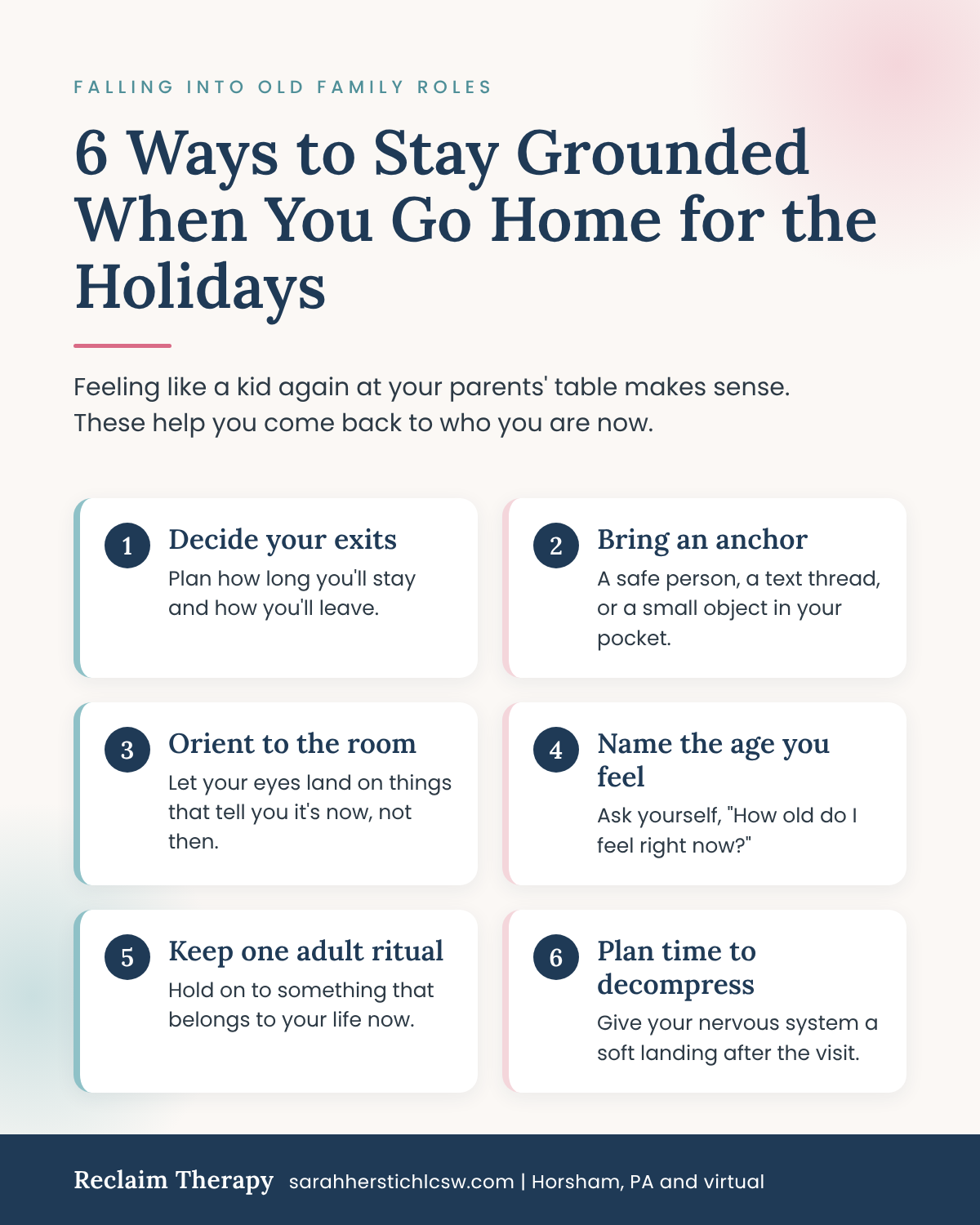
Six ways to stay grounded at the holidays when you notice yourself falling into old family roles.
Holiday regression and emotional flashbacks overlap a lot. Pete Walker describes emotional flashbacks as sudden returns to the overwhelming feelings of childhood, like fear, shame, or helplessness, often without a clear memory attached. When falling into an old family role comes with that kind of intense, young feeling, an emotional flashback may be part of what's happening. You can learn more in our post on how to recognize and heal from emotional flashbacks.
Why falling into old family roles makes sense
Falling into old family roles makes sense because those roles worked. At some point, being the peacekeeper, the responsible one, or the invisible one helped you get through your childhood with as much connection and safety as was available to you. Your nervous system is loyal to what kept you alive.
That's why knowing your family's patterns doesn't always stop them from happening. You can understand exactly what's going on and still feel your shoulders creep up toward your ears when your mom starts in about the turkey. Insight is a beautiful starting place, and the body usually needs more than insight to change.
So if you fell into your old role last Thanksgiving, nothing is wrong with you. The part of you that stepped in was trying to help, the way it always has.
How do I stay myself when I go home for the holidays?
You stay yourself at the holidays by giving your nervous system reminders of the present, before, during, and after the visit. The goal isn't to never fall into an old role again. The goal is to notice it sooner and have a way back to yourself when it happens. Here are six ways to stay grounded that our clients find helpful.
Decide your exits ahead of time
Before you go, decide how long you'll stay and how you'll leave. Driving yourself, booking a hotel instead of staying in your childhood bedroom, or planning a walk after dinner gives your body proof that you have choices now, which is something you may not have had as a kid.
Bring an anchor
An anchor is anything that connects you to your adult life. It could be a partner or friend who knows your history, a quick text thread with someone safe, or a small object in your pocket, like a smooth stone or a ring, that you can touch when you start to feel yourself shrinking. This kind of connection is a form of co-regulation, and it can make a big difference.
Orient to the room
When you feel yourself sliding into an old role, let your eyes slowly move around the space and land on a few things that tell you it's now and not then. Notice the new couch, your own car keys, or the adult hands holding your coffee mug. Orienting helps your nervous system update where and when you are.
Name the age you feel
If you suddenly feel small, ask yourself, "How old do I feel right now?" Just naming it, even silently, creates a little space between you and the younger part of you who's feeling it. From there, you can offer that part some kindness instead of criticism.
Keep one adult ritual
Hold on to at least one thing that belongs to your life now, like your morning coffee routine, a workout, a phone call with your kids, or an episode of your favorite show. A familiar ritual from your current life reminds your body who you've become.
Plan time to decompress
Give yourself a soft landing after the visit. Block off a quiet evening, take a bath, go for a walk, or let yourself cry if that's what comes. Visits with family can stir up a lot, and your nervous system needs time to settle back into your own life.
If politics are a reliable flashpoint at your family's table, we also shared six ways to approach political conversations with family over the holidays. And if this season is hard for other reasons, our post on trauma triggers during the holidays goes deeper into what tends to come up this time of year.
How therapy helps with old family roles
Therapy helps with old family roles by working with the experiences that created them and helping your body learn that the old strategy isn't the only option anymore. At Reclaim Therapy, we often combine a few approaches.
EMDR therapy can help process the memories that taught you your role, so family gatherings feel less charged. Somatic Experiencing helps you notice how a role lives in your body, like the tight throat of the peacekeeper or the bracing of the scapegoat, and gently helps your nervous system find more settled options. Parts work helps you get to know the younger part of you who still shows up at the holiday table, so you can care for that part instead of being taken over by it.
Therapy also gives you a place to think through the bigger questions, like how much contact feels right, what boundaries you want to hold, and how to grieve the family you wished you'd had. Our post on how to deal with a dysfunctional family is a good place to start if you're thinking about those questions now.
We offer trauma therapy in person at our office in Horsham, PA, and virtually across Pennsylvania, including Montgomery County, Bucks County, and Philadelphia.
You learned your role when you didn't have other options. You're allowed to walk into that house as the person you are now, and with practice and support, you can.
If the holidays bring you right back to who you had to be as a kid, we'd love to help you find your way back to who you are. Schedule a free consultation with our team, and we'll help you find the right therapist for you.
🧡
Frequently Asked Questions
Why do I act like a teenager around my parents?
You may act like a teenager around your parents because your nervous system recognizes old cues and reaches for the strategies you used back then. This is often called holiday regression, and it's a very common response to being back in your family's environment, not a sign of immaturity.
Is holiday regression normal?
Yes, holiday regression is very normal. The holidays bring together the same people, places, and rituals from childhood, which makes it easy for anyone to slip into old patterns, whether or not they have a trauma history.
Is falling into old family roles a trauma response?
Falling into old family roles can be a trauma response, especially if your role developed to keep you safe in an unpredictable, critical, or emotionally neglectful home. Even when there wasn't trauma, family roles are survival strategies your nervous system learned early and still remembers.
Why am I so exhausted after visiting my family?
You may feel exhausted after visiting family because playing an old role takes a lot of energy. Keeping the peace, staying on guard, or holding back who you are now all keep your nervous system working hard, so your body needs time to recover.
How do I stop falling into old family roles?
You can start by noticing when it happens and giving your body reminders of the present, like planning your exits, bringing an anchor, and orienting to the room. Lasting change usually comes from working with the experiences that created the role, often with the support of a trauma therapist.
Can therapy help with family roles?
Yes, therapy can help with family roles. Approaches like EMDR, Somatic Experiencing, and parts work help you process the experiences behind your role and build new options, so you can show up to family gatherings as the adult you are now.