
What's Actually Connected Between Neurodivergence and Eating Disorders
The connection between neurodivergence and eating disorders doesn't get talked about nearly enough, and if you're ADHD, AuDHD, or autistic—or you're a clinician trying to understand why standard eating disorder explanations or treatment plans don't quite fit—there's a good chance you've felt the gap.
Maybe you spent years hearing "you're just picky" or "why can't you just eat something" or "you're so disorganized about food," and none of it ever quite landed as an explanation.
ADHD and autism aren't just about attention or social differences. They can affect how you notice what's happening inside your body, process sensory information, plan and initiate tasks, shift attention, respond to rewards, and regulate emotion.
Turns out, eating asks us to do a whole lot of those things.
This is why so many neurodivergent people spend years being treated for "disordered eating" or "picky eating" without anyone asking a more useful question.
What if the eating pattern isn't the whole story?
What if ADHD, autism, sensory differences, executive functioning, interoception, and someone's history with food all need to be part of the conversation?
Neurodivergence doesn't automatically cause an eating disorder. And neurodivergent eating patterns aren't automatically disordered eating.
But ADHD, autism, ARFID, anorexia nervosa, binge eating disorder, bulimia nervosa, and other eating concerns overlap often enough that we need to get much better at understanding what is actually happening underneath someone's relationship with food. That's what this article unpacks: how neurodivergence can shape eating behavior, where assessment and diagnosis often miss the mark, and why treatment may need to be adapted with nervous system, sensory, executive functioning, interoception, and trauma-informed realities in mind so people get more accurate support and better recovery outcomes.
The Nervous System Connection Between Neurodivergence and Eating
Eating is not a simple behavior.
Think about what has to happen just to feed yourself consistently throughout the day.
Your nervous system has to notice internal signals like hunger and fullness. Your brain has to recognize what those sensations mean. You have to interrupt whatever you're doing, decide what to eat, gather or prepare food, tolerate its taste, smell and texture, eat it, and eventually recognize when you've had enough.
And tomorrow, somehow, we're expected to do the whole thing again.
Rude.
For ADHD and autistic people, some of the processes involved in eating can work differently. One of those processes is interoception, the ability to sense and make meaning of what's happening inside your body.
Some neurodivergent people may notice hunger later than other people. Others may feel body sensations intensely but have difficulty identifying what those sensations mean. Hunger might register as irritability, nausea, shakiness, a headache, brain fog, or suddenly feeling like you need food right now.
Fullness can be complicated too.
And this matters because eating disorder recovery often asks people to notice, interpret, and respond to body cues. That's much harder when those cues have never been particularly clear or predictable in the first place. We go deeper into this in our post on interoception and eating disorders.
ADHD and Eating Disorders
The connection between ADHD and eating disorders can show up in several different ways.
Attention-Deficit/Hyperactivity Disorder (ADHD) affects things like attention, reward processing, impulse control, executive functioning, working memory, and the ability to shift attention. All of those things can affect eating.
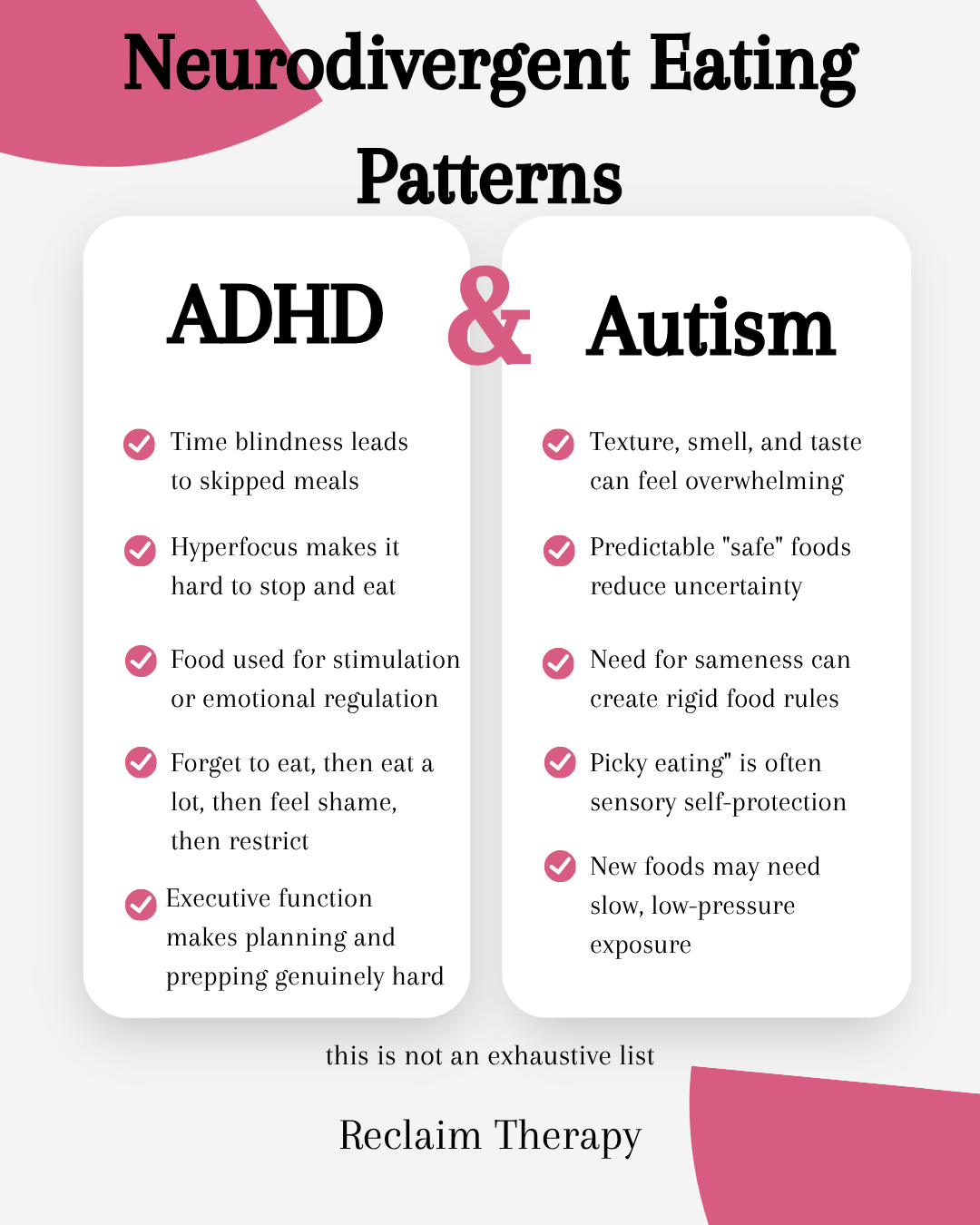
Time blindness can mean entire chunks of the day pass before someone realizes they haven't eaten.
Hyperfocus can make stopping what you're doing to make lunch feel nearly impossible.
Executive functioning differences can make grocery shopping, meal planning, cooking, and remembering what food is in the refrigerator genuinely difficult, including difficulty planning and preparing meals.
Food can also provide stimulation, pleasure, comfort, or a way to regulate emotion, particularly when someone is bored, overwhelmed, depleted, or understimulated.
People with ADHD are significantly more likely to experience disordered eating.
And when someone hasn't eaten enough throughout the day, they may eventually reach a point where their body is understandably asking for a lot of food, quickly.
That pattern can easily become:
—>Forget to eat.
—>Get extremely hungry.
—>Eat a lot. —>Feel ashamed about eating a lot.
—>Decide you need more control tomorrow.
—>Restrict.
—>Repeat.
Over time, binge eating, restriction, chaotic eating, or rigid food rules can become layered on top of the original ADHD-related difficulties with feeding yourself consistently.
This is an important distinction because simply telling someone to "have more willpower" or "plan your meals better" doesn't address the executive functioning challenges underneath the pattern. ADHD also comes with increased risk factors, including being four times more likely to have anorexia.
Binge Eating Disorder and Bulimia Nervosa are often associated with ADHD.
Autism Spectrum Disorder and Eating Disorders
The connection between autism and eating disorders can look somewhat different, including in people with autism spectrum disorder.
Autistic nervous systems can process sensory processing information differently, and food is basically one giant sensory experience.
Texture. Temperature. Smell. Taste. Appearance. The sound of someone chewing next to you. Whether two foods are touching each other on the plate. Whether the yogurt company had the audacity to slightly change the recipe.
What gets labeled "picky eating" can sometimes be a person's nervous system protecting them from sensory input that feels genuinely overwhelming, and autistic individuals may restrict food due to extreme sensitivities to textures, temperatures, and smells.
Predictability can matter just as much.
Knowing exactly what a food will taste like, how it will be prepared, what texture to expect, or even what brand it is can reduce the amount of uncertainty someone's nervous system has to manage. Cognitive rigidity can also contribute to rigid dietary rules.
A familiar food isn't necessarily "safe" because someone is being stubborn or unwilling to change. It may simply be reliably tolerable in a world that already asks their brain to process a tremendous amount of unpredictable information.
Interoception can overlap here too. Some autistic people may have difficulty recognizing hunger or fullness, while others experience internal sensations very intensely. And for some people, sameness and predictability can become intertwined with increasingly rigid eating patterns.
Sometimes that presentation fits ARFID. Neurodivergent individuals often show elevated rates of avoidant restrictive food intake. Sometimes it doesn't.
One in three people with anorexia are autistic. Up to 35% of people with anorexia nervosa show high autistic traits (source).
Which is exactly why understanding why someone is restricting matters.
Not Every Eating Disorder Starts With Body Image
This is one of the places neurodivergent people can get missed. We still tend to talk about eating disorders as if they always begin with someone wanting to lose weight or change their body.
They don't. Standard Cognitive Behavioral Therapy for eating disorders often focuses on correcting cognitive distortions about body image, body shape, and body weight, which is not always the primary driver here.
Restriction can develop around sensory overwhelm, low interest in food, fear of uncomfortable sensations or consequences of eating, difficulty initiating meals, a need for predictability, executive functioning challenges, or a shrinking list of foods that feel manageable.
ARFID is the clearest example because restriction in ARFID is not driven primarily by weight or shape concerns. Neurodivergence can increase vulnerability to problematic eating strategies.
But neurodivergent people can also develop anorexia, bulimia, binge eating disorder, and other eating disorders. This is part of why we consider the overlap so closely when we talk about comorbidities associated with eating disorders.
And the two aren't mutually exclusive. The relationship between neurodivergence and eating disorders can work in both directions.
Someone can have significant sensory needs and body image distress.
They can forget to eat because of ADHD and intentionally restrict food.
They can rely on sameness because it helps their autistic nervous system and have eating disorder rules that have become attached to that need for predictability.
This is why a good assessment needs to ask more than:
"What are you eating?"
We also need to understand what's making eating difficult and what function the eating pattern is serving.
When Neurodivergence and an Eating Disorder Start Feeding Each Other
Here's where it gets even more complicated.
It isn't always possible to neatly separate what belongs to neurodivergence from what belongs to the eating disorder.
Maybe ADHD made consistent eating difficult long before an eating disorder developed.
Maybe sensory sensitivities limited the foods that felt tolerable.
Maybe hunger cues have always been subtle, delayed, or confusing.
But once chronic restriction, bingeing, purging, or undernourishment enters the picture, the body can become even harder to read.
That means someone may arrive in treatment with several things happening at once.
The neurodivergent traits didn't disappear when the eating disorder developed, and the eating disorder shouldn't automatically be explained away by neurodivergence either.
Treatment doesn't always need a perfect answer to which one came first, it needs an understanding of how they're interacting now.
Why This Connection Gets Missed So Often
Neurodivergence, particularly in girls and women and many people assigned female at birth, has historically been underrecognized. A lot of people learned how to look incredibly competent from the outside while using enormous amounts of energy to hold everything together.
That makes early identification important because it supports more timely, person-centered care.
Masking can complicate eating too.
Someone might appear organized, flexible, social, or "fine" while privately struggling to feed themselves consistently, tolerate certain foods, notice their body's needs, or recover after sensory and social overload.
By the time someone lands in eating disorder treatment, their eating symptoms may have become so clinically urgent that the neurodevelopmental picture underneath them hasn't been fully explored. When that underlying picture is missed, traditional eating disorder treatments often do not effectively address neurodivergent needs.
But the reverse can happen too.
Eating disorder symptoms can be dismissed as "just autism," "just sensory issues," or "just ADHD," which can delay appropriate eating disorder care.
Some eating behaviors may also function as coping mechanisms for emotional distress or sensory overload, affecting emotional health.
Neurodivergence should help us understand an eating disorder, it shouldn't be used to explain one away.
What Actually Helps Neurodivergent People With Eating Disorders
Eating disorder treatment may need to be adapted when someone is neurodivergent, especially when treating eating disorders in ways that fit how that person actually functions.
Standard cognitive behavioral therapy may be less effective for some neurodivergent individuals if it is not adapted.
That might mean using external structure around eating when hunger cues aren't reliable instead of repeatedly telling someone to "listen to their body."
It might mean setting alarms to eat, creating predictable meal options, reducing the executive functioning required to access food, or keeping reliably tolerable foods available.
It can mean taking sensory needs seriously while working toward greater nutritional adequacy and flexibility when appropriate.
It can also mean looking at how transitions, uncertainty, overstimulation, routines, burnout, emotional regulation, and executive functioning affect someone's ability to feed themselves.
Neurodivergent patients also often need longer treatment durations.
And this is important:
Accommodation isn't the opposite of recovery. Sometimes it's what makes recovery accessible.
A neurodiversity-affirming approach isn't about removing every challenge or assuming every eating pattern is simply part of someone's neurotype. It's about accommodating individual sensory and cognitive profiles and figuring out which supports allow this particular person to be adequately nourished while also treating the eating disorder symptoms that are causing distress or harm. Individualized supports can also improve treatment outcomes over time.
Where Trauma-Informed Therapy Fits In
There's another layer we absolutely can't ignore.
Neurodivergence itself isn't something that needs to be healed.
But being misunderstood for years can hurt.
Being called lazy because you couldn't stay organized. Being shamed for foods you couldn't tolerate. Being forced to eat foods that triggered intense sensory responses. Being criticized for your body. Being bullied. Being told you were dramatic, difficult, too sensitive, or just needed to try harder.
Those experiences can leave their own imprint.
This is where trauma-informed therapy, including EMDR and somatic approaches when clinically appropriate, can sometimes be useful. Not because every difficult experience is trauma, and definitely not because ADHD or autism needs to be "treated" out of someone.
The work may instead involve untangling years of shame, fear, body distrust, or painful experiences around food from the neurodivergent traits underneath them.
The goal isn't to make someone eat, feel, or function more neurotypically. It's to reduce shame, increase choice, support adequate nourishment, and help someone build a relationship with food and their body that actually works for the person living in it.
Frequently Asked Questions
Can ADHD cause an eating disorder?
ADHD doesn't directly cause an eating disorder, but research suggests that people with ADHD have an increased risk for disordered eating and eating disorders. Executive functioning difficulties, impulsivity, inconsistent eating, emotional regulation, reward processing, and other ADHD traits may all contribute to vulnerability. Other factors, including trauma, dieting, weight stigma, genetics, mental health, and someone's environment, can also play a role.
Is picky eating a sign of autism?
Selective eating can occur in autistic people, particularly when it's connected to sensory sensitivity, predictability, sameness, or differences in interoception. But being a selective eater does not mean someone is autistic. Persistent or severe food restriction, nutritional concerns, distress around eating, or a very limited range of tolerated foods may be worth assessing more closely.
Can autism or ADHD look like an eating disorder?
Sometimes neurodivergent eating patterns can resemble eating disorder symptoms, but they aren't automatically the same thing. Forgetting meals because of ADHD, relying on predictable foods because of sensory needs, or having difficulty noticing hunger doesn't by itself mean someone has an eating disorder. At the same time, neurodivergent people can and do develop eating disorders, which are complex mental health conditions rather than just food-related habits. A good assessment looks at the whole picture, including nutritional adequacy, medical impact, distress, rigidity, fear, body image, compensatory behaviors, sensory needs, executive functioning, and what's driving the eating pattern. This distinction matters because traditional eating disorder treatments do not always account for neurodivergent needs unless the full picture is recognized.
Why can intuitive eating be harder for some neurodivergent people?
Intuitive eating can require adaptation when internal cues are inconsistent, delayed, difficult to interpret, or complicated by sensory needs and executive functioning. For some neurodivergent people, eating by the clock, using reminders, keeping predictable foods available, or relying on other external supports can actually make it easier to care for the body. External structure and body trust don't have to be opposites.
Are autism and ARFID connected?
There is meaningful overlap between autism and ARFID, particularly because sensory sensitivities, low interest in food, fear of aversive consequences, and a preference for predictability can affect eating. Neurodivergent individuals often show elevated rates of Avoidant/Restrictive Food Intake Disorder (ARFID), sometimes described as restrictive food intake disorder. But they are separate diagnoses. An autistic person doesn't automatically have ARFID because they eat a limited range of foods, and not everyone with ARFID is autistic.
Does eating disorder treatment need to be different for neurodivergent clients?
Sometimes it needs to be adapted. Effective treatment still needs to address nutritional adequacy, medical safety, eating disorder behaviors, and psychological factors, but in eating disorder services a neurodiversity-affirming approach accommodates individual sensory and cognitive profiles, and disorder services may need to adjust how care is delivered to get there. That can mean accounting for sensory needs, interoceptive differences, executive functioning, communication preferences, predictability, and the amount of cognitive or sensory load being placed on the person. The goal isn't a one-size-fits-all version of "normal eating." It's helping someone build a safer, more adequately nourished, and more flexible relationship with food that is sustainable for their actual brain and body.
Work With an Eating Disorder and Trauma Therapist in Horsham, PA

If you've spent years feeling like your relationship with food was a personal failing, there may be more to the story.
At Reclaim Therapy, our therapists work with adults and adolescents navigating eating disorders, disordered eating, body image concerns, trauma, ADHD, autism, and the places these experiences overlap.
Our team provides trauma-informed eating disorder therapy in Horsham, PA, and serves clients throughout Montgomery County, Philadelphia, and Lower Bucks County, with virtual therapy available across Pennsylvania.
We aren't interested in forcing your nervous system into someone else's definition of "normal."
We're interested in understanding what your eating patterns are communicating, what your body needs, what might be getting in the way, and how we can help you build something more sustainable from there.
You can schedule a consultation to get started.
🧡,
