
Why Do I Feel Like I’m Always in Trouble? Childhood Trauma and the Fear of Doing Something Wrong
Your boss sends, “Can you stop by my office when you have a minute?”
Your partner gets a little quieter than usual.
Someone responds to your text with “okay” instead of “okay!”
And suddenly your brain is conducting a full internal investigation into what you did wrong.
You replay conversations. Check your email. Scan their face the next time you see them. Maybe you start preparing an explanation for something nobody has actually accused you of doing.
Logically, you might know the reaction is bigger than the situation. You may even tell yourself, Nobody said you did anything wrong. Calm down.
But the feeling of I’m in trouble can be incredibly convincing.
For some adults with histories of childhood trauma or emotional neglect, this feeling makes a lot more sense when we stop looking at it as an irrational overreaction and start looking at what they learned about relationships, mistakes, anger, disappointment, and connection growing up.
Why Do I Always Have a Persistent Feeling That I’m in Trouble When I Haven’t Done Anything Wrong?
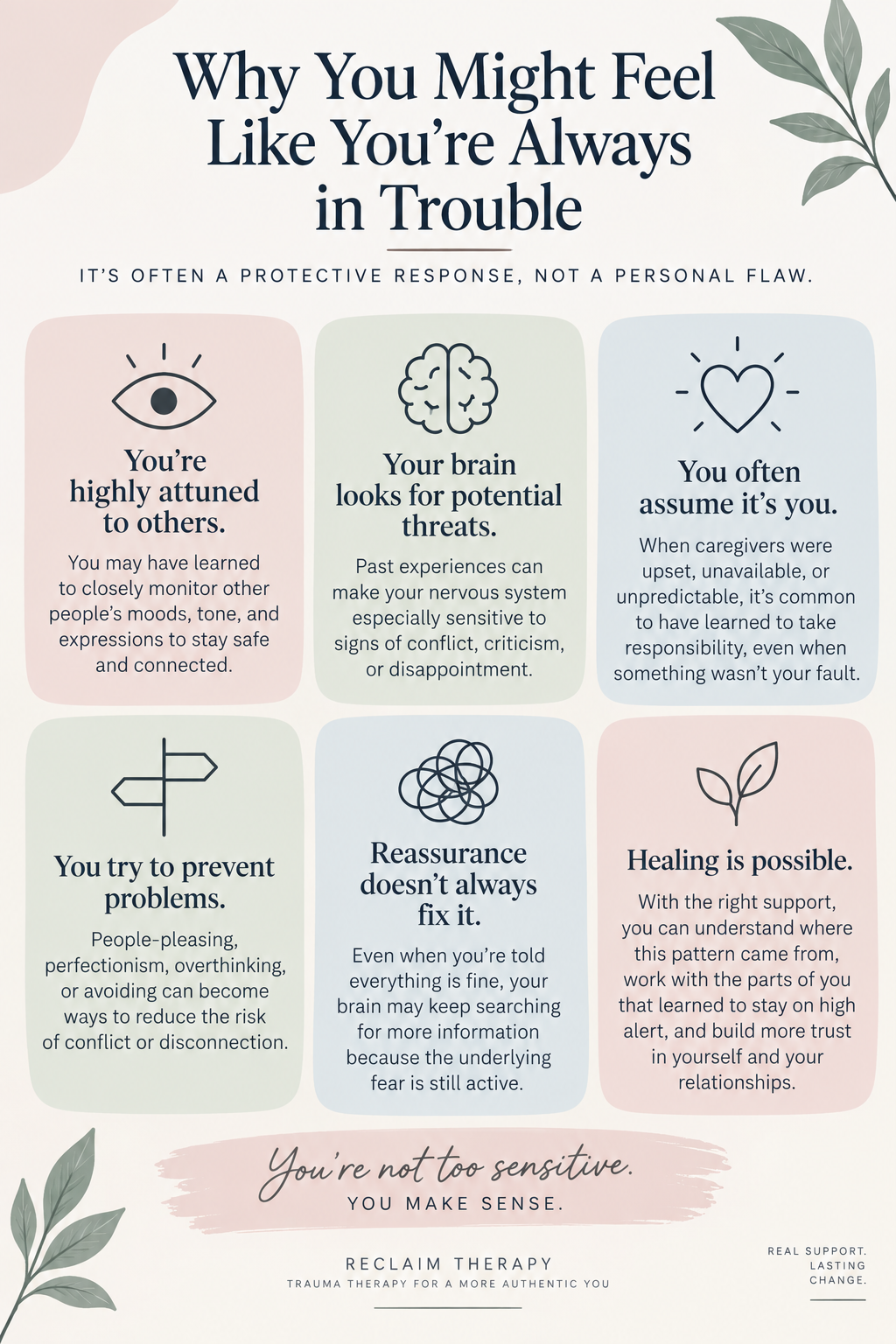
Feeling like you're always in trouble can develop when you learned to closely monitor other people's moods, reactions, or approval.
If anger, criticism, withdrawal, unpredictability, or disappointment carried significant consequences when you were growing up, subtle changes in other people may still get your attention very quickly as an adult.
Someone's tone changes.
Their face looks different.
They take longer to respond.
They say, “We need to talk.”
Before you have much information about what is actually happening, your mind may already be asking:
What did I do?
This experience can be associated with childhood trauma, emotional neglect, anxiety, chronic shame, hypervigilance, and complex PTSD. It doesn't automatically mean you have any particular diagnosis.
But if you spent a lot of your childhood monitoring other people in order to know whether things were okay, it makes sense that your attention might still go there now.
Where the “I’m in Trouble” Feeling Can Come From
Not everyone who carries this fear grew up in a home that looked obviously traumatic from the outside.
Sometimes there was yelling, punishment, volatility, or frightening behavior.
Other times, the consequences were much harder to name.
Maybe mistakes were treated like character flaws rather than normal parts of being a kid.
Maybe a parent's mood changed the atmosphere of the entire house, and everyone adjusted accordingly.
Maybe anger wasn't explosive, but disappointment, withdrawal, criticism, or the silent treatment felt enormous.
Maybe you had a parent who loved you but had very little capacity for your emotions. Your sadness overwhelmed them. Your anger was disrespectful. Your needs were inconvenient. Your mistakes became about how they felt.
Or maybe you became the kid who was especially good at reading the room.
You could tell from the way someone closed a cabinet whether this was a good time to ask for something. You knew which version of a parent had walked through the door. You learned when to talk, when to help, when to disappear, and when being especially agreeable might make things easier.
Children are remarkably good at adapting to the relationships they depend on.
The problem is that some of those adaptations can follow you into adulthood, long after the original environment has changed.
You don’t have to figure this all out on your own.
We offer trauma informed therapy for adults navigating the lasting impact of childhood trauma, emotional neglect and complex PTSD.
In Horsham, PA and online throughout Pennsylvania.
Why Someone’s Tone Can Feel Like Such a Big Deal
People sometimes make fun of how much they analyze tone.
“I know it was just a text, but something felt off.”
And sometimes, yes, a text is just a text.
But humans are relational. We naturally notice changes in facial expression, voice, posture, behavior, and communication. Your brain uses previous experiences to help interpret what those changes might mean, and the amygdala reacts to perceived threats based on past experiences.
If subtle changes in someone's mood historically preceded criticism, anger, withdrawal, conflict, or disconnection, especially in childhood environments shaped by unpredictability, you may have become particularly good at detecting them.
The problem isn't necessarily that you're noticing tone, humans are supposed to notice changes in other people.
The exhausting part is when your system has learned that those small changes require immediate investigation.
Your partner sighs, and your attention snaps toward them.
Your boss sounds slightly less friendly, and you're reviewing everything you've done that week.
Your friend doesn't use their usual emoji, and part of you is already wondering whether you've upset them.
When your system expects threat, even a neutral facial expression can register as a cue of disapproval or danger.
Sometimes you're right. People do get annoyed, disappointed, distracted, or upset.
But when you've learned to anticipate relational threat, your brain may have trouble waiting for more information before deciding what the cue means.
And very often, the conclusion becomes: it must be me.
Why You Automatically Assume You Did Something Wrong
Children have limited ways of understanding the adults they depend on.
A young child usually isn't thinking, My parent has limited emotional capacity and is struggling to regulate their own distress.
They experience what happens much more personally.
Mom is upset. What did I do?
Dad stopped talking to me. I must have done something wrong.
They're disappointed. I need to fix this.
When caregivers have difficulty taking responsibility, repairing after conflict, tolerating a child's emotions, or separating their own needs from their child's, children can end up carrying responsibility that never really belonged to them.
Over time, something is wrong and I did something wrong can start to feel almost interchangeable.The situation may be happening in the present, but the meaning you make from it has a much longer history.
The Connection Between Complex PTSD and Feeling Like You’re in Trouble
For some people, constantly feeling like they're in trouble is part of a larger pattern associated with complex trauma.
Complex PTSD can involve difficulties with emotional regulation, chronic shame, negative beliefs about yourself, relational difficulties, hypervigilance, and deeply ingrained survival responses.
You may be especially sensitive to cues of rejection, criticism, anger, or disappointment because those cues carry more emotional weight for you than they appear to carry for other people.
This can also overlap with what trauma therapist and author Pete Walker describes as emotional flashbacks.
When people hear the word “flashback,” they often imagine vividly seeing a traumatic event again. Emotional flashbacks can look different. A current experience may activate an intense emotional state associated with earlier experiences, even when you aren't consciously remembering a specific event.
Suddenly you feel small.
Ashamed.
Afraid.
Desperate to explain yourself.
Certain that someone is angry with you.
You may know you're a capable adult sitting in your office, kitchen, or therapist's waiting room. But the emotional intensity feels much bigger than what is happening in front of you.
Not every intense emotional reaction is an emotional flashback, and not everyone who fears being in trouble has complex PTSD. But this framework can be useful for understanding why some present-day interactions seem to carry so much more emotional weight than expected.
What the Fear of Being in Trouble Can Look Like in Adulthood
Sometimes the pattern is obvious.
You panic when someone says, “Can we talk?”
But often it gets woven into ordinary life.
You may overexplain perfectly reasonable decisions because a simple answer doesn't feel like enough.
You might rehearse conversations repeatedly before having them, trying to make sure you don't say anything that could be misunderstood.
You apologize quickly, sometimes before you are even sure you have done something wrong.
You monitor facial expressions during conversations to figure out how the other person is responding to you.
You struggle with authority figures even when they have given you no reason to believe you're in trouble.
You may feel an intense need to resolve conflict immediately because waiting for repair feels unbearable.
Perfectionism can become part of this too.
If mistakes historically came with criticism, shame, anger, or disconnection, doing everything correctly can begin to feel like a way to prevent the entire experience.
If I don't make a mistake, nobody can be disappointed.
If everyone is happy with me, I'm okay.
If I anticipate what people need, maybe there won't be a problem.
People-pleasing can serve a similar purpose. You become incredibly skilled at anticipating other people's needs because disappointing someone feels much bigger than simply disappointing someone.
And not everyone moves toward the perceived problem.
Some people avoid it entirely.
You don't open the email.
You let the voicemail sit there.
You put off checking the message.
You avoid the conversation because, for a little while, not knowing feels easier than confirming whatever your mind has already decided must be wrong.
Different response. Similar fear underneath it.
Why Reassurance Doesn’t Always Make the Feeling Go Away
If you've ever repeatedly asked someone, “Are you mad at me?” you probably know that reassurance can work beautifully.
For about eleven minutes.
They tell you everything is fine. Your body settles. Then they're quiet at dinner. Or they respond differently to a text. Or you notice their face. And suddenly you're back to wondering.
This doesn't mean you're intentionally being needy or refusing to believe them.
Reassurance can reduce anxiety in the moment without necessarily changing the underlying expectation that you need to keep checking for signs that something is wrong. These kinds of compulsions can bring temporary relief while reinforcing the ocd cycle.
If your attention has become organized around monitoring relationships, chronic worry can start to function like a default problem-solving mode.
Part of healing may involve learning to tolerate the uncomfortable space between I feel like something is wrong and I actually know something is wrong.
That isn't the same as ignoring your instincts. When this pattern is part of OCD, it can involve compulsive behaviors, create significant distress, and interfere with daily life.
Sometimes something really is off.
The work is becoming better able to distinguish between what you're noticing in the present and what your history is predicting will happen next. Exposure and Response Prevention is an effective treatment for OCD and helps reduce reliance on compulsions over time.
How Trauma Therapy Can Help With the Fear of Being in Trouble
Trauma therapy isn't about convincing you that nobody will ever be upset with you again.
People will be disappointed sometimes.
Someone's tone will change.
You'll make mistakes.
Relationships will have conflict.
A boss may actually want to talk about something you did.
The goal isn't to create a life where none of those things happen. It's to help those experiences stop carrying quite so much power over how you see yourself.
In trauma therapy, you might begin by noticing what activates the “I'm in trouble” response and what happens next.
What happens in your body? Grounding techniques can signal safety to the nervous system, especially when feeling safe does not always match the nervous system's perception of safety.
What thoughts appear?
Do you feel an immediate urge to apologize, explain, fix, hide, leave, or make the other person feel better?
Do you become very young or small inside?
Do you shut down?
Do you start building a case against yourself?
Understanding the sequence can help make something that previously felt instantaneous a little more visible, and therapy can help differentiate past triggers and threats from present situations.
Therapy can also involve working with the shame underneath these reactions and exploring the parts of you that learned to appease, perform, perfect, hide, or take responsibility for other people's feelings; self-compassion can help reduce the sense that you're in trouble.
For some people, EMDR therapy may be useful for processing traumatic experiences or relational memories connected to current triggers. Somatic approaches may help you become more aware of how the response unfolds in your body without forcing you to stay with sensations that feel overwhelming. Parts-based approaches can help you understand protective responses with more curiosity and less shame. If OCD symptoms are also part of the picture, Exposure and Response Prevention therapy can help reduce them. This may be relevant with harm ocd, where intrusive thoughts about causing harm to others can trigger the fear of being a bad person.
And sometimes some of the most important work happens in the therapy relationship itself.
You misunderstand your therapist.
You worry they're frustrated with you.
You disagree.
You say something didn't feel helpful.
You have a rupture and discover that the relationship can survive talking about it.
Those experiences can matter when so much of your history taught you that conflict, disappointment, or getting something wrong threatened connection.
What Does Progress and Self Compassion Look Like?
Progress doesn't necessarily mean the I'm in trouble feeling disappears completely.
It may mean your boss asks to meet and you notice the immediate drop in your stomach, but you can also recognize, I don't actually know what this meeting is about yet. Anxiety can flare when current reality conflicts with old internal beliefs.
Someone's tone changes and you notice yourself searching for what you did wrong, but you don't immediately apologize.
Your partner is disappointed in a decision you made, and you let them have their feelings without automatically changing your decision. Psychological safety and physical safety don't always line up right away.
You make a mistake and repair it without spending the next three days attacking yourself for having made it.
You notice that someone seems upset and ask about it because there is actual information suggesting something is wrong, rather than because their text contained one fewer exclamation point.
You start realizing that another person's mood can exist in the same room as you without automatically becoming your responsibility.
Uncertainty can still create anxiety in safe environments, especially when your mind is anticipating the possibility of future problems.
And maybe, eventually, you stop treating the feeling that you're in trouble as proof that you are.
You’re Allowed to Wait for More Information
If you have spent years anticipating what might go wrong in relationships, waiting can feel surprisingly difficult.
Your mind wants an answer. For some people, especially with ocd, the fear of making mistakes can become excessive and create an urgent need for certainty right away.
Are they mad?
Did I mess up?
Is something wrong?
Do I need to fix this?
But feelings aren't always evidence.
The sensation of being in trouble can be very real without the danger your mind is predicting being real in the present. Sometimes the work is noticing the old alarm without immediately organizing your entire behavior around it.
You can gather more information.
You can ask a question.
You can let someone have a mood.
You can make a mistake and repair it.
You can disappoint someone without automatically deciding you've harmed them.
And you can learn, slowly, that something feels wrong does not always mean I did something wrong.

Complex PTSD Therapy in Horsham, PA
At Reclaim Therapy in Horsham, Pennsylvania, we work with adults who understand intellectually that they are no longer living in their childhood environment but still find themselves reacting to conflict, criticism, disappointment, relationships, or mistakes as though the stakes are much higher than they appear to be.
Our therapists specialize in complex PTSD, childhood emotional neglect, attachment wounds, dissociation, eating disorders, body image concerns, and the survival patterns that can develop alongside these experiences.
Trauma therapy may incorporate EMDR,somatic approaches, parts work, and other trauma-informed therapies depending on your history, needs, and goals, and when OCD symptoms are part of the picture, Exposure and Response Prevention can help reduce them through exposure therapy and response prevention. Treatment isn't about teaching you to stop having reactions. We want to understand why those reactions make sense and help you have more options when they show up.
We offer in-person trauma therapy and EMDR therapy in Horsham, PA, for clients throughout Montgomery County and surrounding communities, as well as virtual trauma therapy throughout Pennsylvania.
If you're tired of feeling like you're constantly waiting to find out what you did wrong, it may be worth getting curious about where that expectation came from.
You weren't born believing every change in someone else's mood was yours to fix.
And you don't have to spend the rest of your life assuming it is.
🧡,

Why do I always feel like I’m in trouble even when I did nothing wrong?
Feeling like you're in trouble without knowing what you did can be connected to anxiety, hypervigilance, chronic shame, childhood trauma, or emotional neglect. If you learned to closely monitor caregivers' moods or reactions growing up, your brain may continue looking for signs of anger, disappointment, or conflict in adult relationships. The feeling itself can be intense even when there isn't evidence that you've done anything wrong.
Can childhood trauma cause a fear of getting in trouble as an adult?
Childhood trauma can contribute to a persistent fear of making mistakes, upsetting others, or getting in trouble as an adult. This may be especially relevant when mistakes, conflict, anger, or disappointment felt threatening to connection or emotional safety growing up, and the pattern persists into adulthood because early protective learning can continue even when the original environment is no longer present. However, this fear can have other causes too, and experiencing it does not automatically mean you have a trauma disorder.
Why do I panic when someone’s tone changes?
A change in someone's tone can become a powerful cue if you learned that subtle changes in other people's moods sometimes preceded conflict, criticism, withdrawal, or anger. Your reaction may occur before you consciously understand what feels different. Trauma therapy can help you explore what these cues mean to you and become better able to distinguish present-day information from expectations shaped by earlier experiences.
Why do I always think people are mad at me?
Frequently assuming people are angry with you can be related to anxiety, people-pleasing, rejection sensitivity, hypervigilance, shame, or earlier relational experiences. If you became responsible for monitoring other people's emotions growing up, you may automatically look for signs that someone is upset and assume you caused it. Learning to let other people's emotions exist without immediately taking responsibility for them can be an important part of healing.
Is feeling like I did something wrong a symptom of complex PTSD?
Chronic shame, hypervigilance, negative beliefs about yourself, and difficulties in relationships can occur with complex PTSD and may contribute to frequently feeling as though you've done something wrong. OCD can also involve obsessions, including a fear of being a bad person, along with compulsive behaviors meant to avoid perceived threats and reduce guilt. However, the feeling of being in trouble is not specific to complex PTSD and can occur for many reasons. A qualified mental health professional can help you understand your symptoms in the context of your broader history and experiences.
Can EMDR help with the fear of being in trouble?
EMDR may be helpful when the fear of being in trouble is connected to traumatic experiences, distressing relational experiences, or memories that continue to shape present-day reactions. EMDR may help with trauma-related drivers of the fear, while cognitive behavioral therapy using Exposure and Response Prevention is an evidence based approach when OCD is a significant part of the pattern and is highly treatable. With complex trauma, EMDR often requires thoughtful pacing and attention to dissociation, attachment, and a person's capacity to remain connected to the present. Whether EMDR is appropriate depends on your individual history and treatment needs.
Sarah Herstich, LCSW, SEP, is a trauma therapist, Somatic Experiencing Practitioner, and founder of Reclaim Therapy in Horsham, Pennsylvania. With more than 17 years of clinical experience, Sarah specializes in complex PTSD, childhood emotional neglect, attachment trauma, dissociation, eating disorders, and body image. Her work integrates EMDR, Somatic Experiencing, parts work, and other trauma-informed approaches, with a focus on helping people understand how past experiences continue to shape their nervous system, relationships, and sense of self.