
Why Are Eating Disorder Behaviors So Hard to Stop Even When You Want To?
One of the most painful parts of eating disorder recovery can be knowing exactly what you want to change and still finding yourself pulled toward the same behaviors.
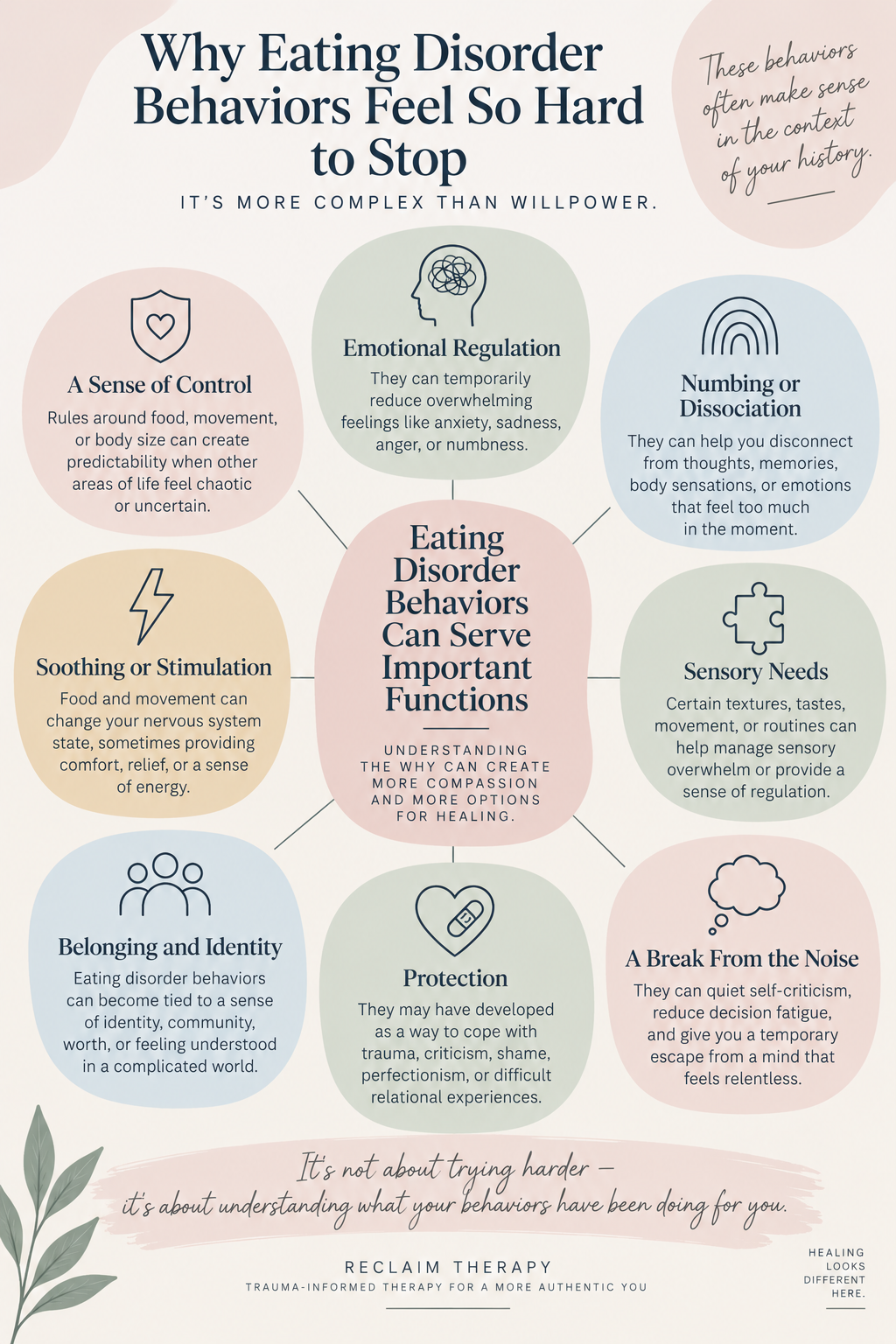
Eating disorder behaviors are often hard to stop not because you do not want recovery, but because those behaviors can become tied to emotional regulation, predictability, relief, numbing, identity, sensory needs, body image, and ways of managing distress or uncertainty that developed over time. You can understand that something is hurting you and still feel pulled toward it when you're overwhelmed, anxious, disconnected, ashamed, uncertain, or having a particularly hard day.
You can understand that something is hurting you.
You can be exhausted by how much space food, movement, weight, or your body takes up in your mind.
You can genuinely want a different relationship with food.
And still, the eating disorder behavior can feel incredibly difficult to resist, especially when insight alone does not touch the short-term relief it has been providing. This is for people living with an eating disorder, teens and adults navigating recovery, people with complex trauma, and anyone trying to understand why these patterns can persist even when the costs are clear.
This is where people often start blaming themselves.
If I really wanted to recover, wouldn't I just stop?
Why do I keep doing this when I know better?
Why am I still struggling after all the work I've done?
But knowing that a behavior is harmful and no longer needing what that behavior has provided are two very different things. This piece looks at the emotional and psychological functions of eating disorder behaviors, the role of trauma, ambivalence in recovery, shame cycles, identity, body image and cultural pressure, why knowledge alone rarely stops the behavior, and what treatment can look like, including trauma-informed care and EMDR.
Understanding that doesn't make an eating disorder harmless. It does make recovery easier to approach with less self-blame and more useful support, because moving beyond "just stop" or rigid food rules starts with seeing what the behavior has been doing for you.
Why Are Eating Disorders With Certain Risk Factors So Hard to Recover From?
There isn't one reason eating disorders are difficult to recover from.
Eating disorders are complex mental health conditions influenced by biological, psychological, social, cultural, and environmental factors, and the exact cause is not fully understood because genetic, biological, psychological, and social factors can all contribute. Trauma can be one piece of that picture for some people, but it isn't the explanation for every eating disorder.
The behaviors themselves can also begin serving important functions.
Restricting may create predictability or narrow your focus when everything else feels overwhelming. Binge eating may provide temporary relief, comfort, stimulation, or a way to disconnect from difficult emotions. Purging or compulsive movement may become tied to attempts to reduce distress, manage anxiety, or respond to intense fears about food or the body. These eating behaviors can become maladaptive coping mechanisms for emotional distress and may also reinforce altered brain chemistry and reward systems, which helps explain why stopping is hard.
And sometimes what looks like an eating disorder behavior from the outside is tangled up with something else entirely, including sensory differences, executive functioning challenges, food insecurity, gastrointestinal symptoms, or difficulty recognizing hunger and fullness cues.
There is no single emotional explanation that applies to everyone.
That's part of why “just eat” and “just stop doing that” have never been particularly useful approaches to eating disorder recovery.
The behavior is what you can see.
Understanding what surrounds it usually requires looking much deeper.
Wanting to Recover Doesn't Mean Every Part of You Is Ready to Give Up the Eating Disorder
Ambivalence is incredibly common in eating disorder recovery.
You can want your life back and be terrified of what will happen if you change.
You can hate what the eating disorder has cost you and still feel safer following its rules.
You can know that a behavior isn't sustainable and still reach for it when everything feels like too much.
Those experiences aren't mutually exclusive.
From a parts-based perspective, it can be useful to get curious about that conflict rather than assuming it means you're resistant to recovery.
One part of you may desperately want freedom around food.
Another may be convinced that changing your body will make you safer, more accepted, or more worthy.
Another may rely on eating disorder behaviors to create structure when life feels chaotic.
Another may be terrified of feeling emotions that become more accessible when the behavior isn't available.
If the eating disorder has been part of your life for years, giving it up may involve much more than stopping a behavior.
You may also be losing something that has helped you cope.
That deserves to be taken seriously.
Eating Disorder Behaviors Can Provide Short-Term Relief
This is one of the uncomfortable realities of eating disorders.
If a behavior never did anything for you, you probably wouldn't keep returning to it.
That doesn't mean it actually solves the problem underneath it. It means that, in the short term, something changes.
Maybe your attention narrows.
Maybe you feel less.
Maybe you feel more.
Maybe the anxiety settles temporarily.
Maybe you get a brief sense of control.
Maybe following familiar rules reduces the uncertainty of deciding what, when, or how much to eat.
Maybe the behavior gives you somewhere to put anger, shame, fear, grief, or restlessness that you don't know what to do with otherwise.
The relief may be brief and followed by even more distress. But the brain can still learn the association:
When I feel this, doing this changes something.
Over time, that pattern can become deeply ingrained.
This is one reason insight alone often isn't enough.
You can understand exactly why you developed an eating disorder and still need support developing other ways of responding when the same distress shows up.
Sometimes Predictability Feels Safer Than Flexibility
Eating disorders often come with rules, and some of those rules are reinforced by social pressures and messages about control, discipline, and thinness.
Rules about what you can eat.
When you can eat.
How much.
Which foods are acceptable.
What your body should look like.
How much movement is enough.
What you're allowed to do after eating.
Those rules can become incredibly restrictive, but they can also create a sense of certainty. And certainty can feel very appealing when uncertainty has historically been difficult to tolerate.
If your childhood environment was unpredictable, if you learned to stay highly aware of other people's moods, or if you rarely knew what version of someone you were going to get, controlling something concrete may have offered a sense of steadiness.
Food and body rules can become one place where the answer appears to be clear, especially when diet culture reinforces rigid eating habits and control over body weight.
Do this.
Don't do that.
Follow the rule.
Avoid the uncertainty.
Of course, the safety those rules promise often becomes smaller and smaller over time. More foods become frightening. More situations require planning. More mental energy goes toward avoiding whatever the eating disorder has labeled unacceptable.
What began as an attempt to feel more in control can eventually control a significant amount of your life.
Eating Disorders (Like Binge Eating Disorder) Aren’t Always About Wanting to Be Thin
Body image absolutely matters in many eating disorders, and so do related body image issues.
So do weight stigma, diet culture, anti-fat bias, beauty standards, gender expectations, and the enormous amount of social value our culture attaches to certain bodies.
We shouldn't erase those influences by saying an eating disorder “isn't really about food or weight.”
Sometimes it very much is.
But body image isn't the entire story for everyone.
Eating disorders affect individuals of all ages and backgrounds, and they are not limited to one look or body size.
Eating disorder behaviors can also become connected to managing emotions, sensory experiences, identity, belonging, perfectionism, trauma, self-punishment, executive functioning, interoception, or the need for predictability.
For some people, several of those factors are happening at once.
This matters because recovery shouldn't be based on a simplistic story about why you developed an eating disorder.
It should be based on understanding your eating disorder.
Trauma Can Make the Relationship With Food and the Body More Complicated
Not everyone with an eating disorder has a trauma history, and not everyone with trauma develops an eating disorder.
But there is meaningful overlap for some people.
If your body has been a place where you experienced fear, shame, violation, criticism, unwanted attention, or disconnection, having a relationship with that body can become complicated.
Food can become complicated too.
Eating requires noticing needs.
Receiving nourishment.
Experiencing sensations inside your body.
Taking up time and space to care for yourself.
Tolerating fullness, hunger, satisfaction, desire, preference, and uncertainty, and for some people body changes in recovery can trigger intense fear or intense anxiety.
Those experiences can carry meanings that aren't immediately obvious.
For someone who learned to ignore their needs, eating consistently may bring up more than hunger.
For someone who survived by disconnecting from their body, increased attention to internal sensations may feel unfamiliar or overwhelming.
For someone whose body was heavily criticized, monitored, objectified, or controlled, body changes can bring up fear and vulnerability, and fear of weight gain can become a major barrier to recovery that isn't resolved by being told to “love your body.”
This is one reason trauma-informed eating disorder recovery needs nuance.
The goal isn't to blame everything on trauma, it's to make room for trauma when it is actually part of the story.
Why “Knowing Better” Doesn’t Always Change the Behavior
People with eating disorders are often incredibly knowledgeable about their eating disorder.
They know the behavior isn't helping long term.
They know the rule is rigid.
They know avoiding one food is making that food even scarier.
They know their body needs nourishment.
They may have spent years in therapy and be able to explain exactly where a pattern comes from.
And then the moment arrives.
The anxiety spikes.
Something happens in a relationship.
Their body feels different.
They feel out of control.
They are exhausted, overstimulated, ashamed, numb, lonely, or overwhelmed.
And suddenly everything they understand intellectually feels very far away.
That isn't proof that the insight was useless.
It's evidence that information and capacity aren't the same thing.
Eating disorder recovery often involves being able to access different responses while the distress is actually happening, not only understanding those responses when you feel relatively safe and grounded.
That takes practice, support, adequate nourishment, and time.
Shame Can Keep the Cycle Going
Eating disorders generate an enormous amount of shame.
You engage in a behavior you promised yourself you wouldn't do.
Then you feel ashamed that you did it.
Then you decide the behavior proves something terrible about you.
You're weak.
You're failing.
You're not trying hard enough.
You should be further along.
That shame creates even more distress, and distress can increase the pull toward whatever has historically helped you manage it.
The eating disorder behavior happens again. Then comes more shame.
Recovery becomes much harder when every struggle turns into evidence against you.
Accountability matters in recovery. So does honesty about behaviors that are harming you.
But shame is not the same thing as accountability.
Understanding why a behavior happened gives you more information about what needs support the next time you reach that point.
What If the Eating Disorder Has Become Part of Your Identity?
Sometimes recovery creates another uncomfortable question:
Who am I without this?
This can be especially difficult when the eating disorder has been present for years or began during adolescence.
Maybe being disciplined became part of how you understood yourself.
Maybe your body became closely connected to your sense of identity or worth.
Maybe the eating disorder gave you language for distress you couldn't otherwise explain.
Maybe it created community.
Maybe people finally noticed that you were struggling.
Maybe it became something you were “good at” during a time when you felt inadequate everywhere else.
Recovery can involve grieving these things too.
You aren't only changing behaviors. You may be figuring out who you are without rules and roles that once gave you a sense of structure.
That can feel exciting and terrifying at the same time.
Recovery Isn't About Becoming Better at Controlling Food
Eating disorder recovery can easily get repackaged as another set of rules.
Eat perfectly intuitively.
Never emotionally eat.
Always recognize your hunger.
Love your body.
Never care what you look like.
Exercise only for the “right” reasons.
That can become the eating disorder wearing slightly different clothes.
A more flexible relationship with food leaves room for being human.
Sometimes you eat because you're hungry.
Sometimes because something tastes good.
Sometimes because it's convenient.
Sometimes because everyone else is eating.
Sometimes because food is comforting.
Sometimes you don't know exactly what your body is asking for.
Body image can fluctuate too. Recovery doesn't require looking in the mirror every morning and feeling delighted by what you see.
The goal isn't perfection around food in a new direction, it's greater flexibility, adequate nourishment, less fear and preoccupation, and more room for your life to be about things other than managing food and your body.
What Helps Eating Disorder Behaviors Become Less Necessary?
There isn't one replacement behavior that makes an eating disorder unnecessary.
Recovery usually involves addressing multiple layers at once.
Adequate and consistent nourishment matters because a brain and body that aren't getting enough energy will respond differently to food, emotions, concentration, decision-making, and perceived scarcity.
Understanding patterns matters too. What tends to happen before the behavior? What makes it more likely? What does the behavior change in the short term? What becomes difficult when you don't use it?
For some people, recovery also involves learning to recognize emotions and internal cues, building tolerance for uncertainty, working with perfectionism, addressing sensory needs, challenging internalized weight stigma, developing more flexible ways of responding to distress, and creating relationships where needs don't automatically feel burdensome.
And when trauma is part of the picture, trauma work may eventually become part of treatment too.
Not because trauma explains every eating disorder behavior.
Because sometimes the eating disorder is trying to manage something that food-focused work alone hasn't fully reached.
When Trauma Is Part of the Eating Disorder
If eating disorder behaviors are closely connected to traumatic experiences, body-based fear, chronic shame, dissociation, or attachment wounds, addressing those experiences may be an important part of recovery.
The timing matters.
Trauma processing shouldn't become another way of rushing someone through treatment or assuming that uncovering the “root cause” will make an eating disorder disappear.
Eating disorders are rarely that tidy.
But approaches such as EMDR for eating disorders may be incorporated into treatment when there are traumatic experiences, distressing memories, beliefs, or triggers that continue to contribute to the eating disorder.
Somatic work may help someone develop more capacity to notice internal experience without immediately becoming overwhelmed or disconnected.
Parts work can help make sense of the internal conflict between wanting recovery and fearing what recovery might require.
The goal isn't to strip away a coping strategy and hope for the best.
It's to understand what has made that strategy feel necessary and build enough support that something else becomes possible.
You Can Want Recovery and Still Struggle
Maybe this is the piece I wish more people understood.
Struggling with eating disorder behaviors does not tell us how badly you want to recover.
Recovery can include ambivalence.
It can include setbacks.
It can include knowing exactly what you “should” do and feeling unable to do it that day.
It can include being angry at the eating disorder and scared to live without it.
None of that makes the consequences of the eating disorder less serious.
Eating disorders can become life threatening, with serious complications including death and elevated suicide risk.
It means we need to stop treating motivation like an on/off switch.
You can want something deeply and still be afraid of it.
You can know a coping strategy is hurting you and still need help letting it go, and eating disorders can also coexist with depression, anxiety, or other mental health issues.
And sometimes recovery begins to shift when the question changes from:
Why can't I just stop doing this? to: What is making this so hard to stop?
The second question gives us somewhere to go.

Looking for More Support With Eating Disorder Recovery?
At Reclaim Therapy in Horsham, Pennsylvania, our therapists work with adults and teens navigating eating disorders, body image concerns, complex trauma, and the ways these experiences can overlap.
Our approach to eating disorder recovery is weight-inclusive, trauma-informed, and grounded in the understanding that eating disorders are complex. Treatment isn't about helping you become better at controlling your body or giving you a new set of food rules to follow.
Depending on your needs, therapy may include work around body image, perfectionism, emotional regulation, trauma, dissociation, attachment, and the functions eating disorder behaviors have served in your life. When trauma is part of the picture, approaches such as EMDR for eating disorders and somatic therapy may also be incorporated thoughtfully into treatment.
We offer in-person support in Horsham for clients throughout Montgomery County and surrounding communities, as well as virtual therapy across Pennsylvania.
Schedule a free consultation to get started with a member of our team.
🧡,

Frequently Asked Questions
Why can't I just stop my eating disorder behaviors?
Eating disorder behaviors can become connected to emotional regulation, predictability, relief, body image, identity, sensory needs, and other ways of coping with distress. Even when you understand that a behavior is harmful, your brain may continue reaching for something that has provided short-term relief or structure. Difficulty stopping is not evidence that you don't want recovery.
Why are eating disorders so hard to recover from?
Eating disorders are complex conditions shaped by multiple risk factors, including genetic and biological, psychological, social, cultural, and environmental influences, and eating disorders vary by type, so signs and maintaining factors may look different from person to person. Recovery may involve restoring adequate nourishment while also addressing fear, rigid rules, body image, emotional distress, social pressures, relationships, and other factors maintaining the eating disorder. For some people, trauma or neurodivergence is also part of the picture.
Are eating disorders always about body image?
No. Body image and weight concerns are important features of the most common eating disorders and other types of eating disorders, including common eating disorders like anorexia and bulimia, but they aren't the only factors that can contribute to disordered eating. Eating disorder behaviors may also be related to sensory differences, fear of certain consequences of eating, emotional regulation, trauma, predictability, executive functioning, or difficulty interpreting internal body cues; for example, avoidant restrictive food intake, also called restrictive food intake disorder, does not center fear of weight gain or body shape, and some people avoid certain foods or reduce food intake for sensory or fear-based reasons rather than trying to lose weight.
Can trauma contribute to an eating disorder?
Trauma can be one contributing factor for some people with eating disorders, but trauma does not cause every eating disorder, and most eating disorders cannot be explained by one factor alone. When eating disorders diagnosed and treated early, outcomes are often better, especially for adolescents, and family-based treatment can help when appropriate. Anorexia nervosa involves an unhealthy low body weight; bulimia nervosa includes binge eating followed by purging; binge eating disorder involves eating large amounts quickly without purging. When trauma and disordered eating overlap, treatment may need to address both the eating disorder itself and the ways traumatic experiences continue to affect the person's relationship with food, their body, emotions, or relationships.
Why do eating disorder behaviors sometimes feel calming?
Some eating disorder behaviors may temporarily change emotional or physiological distress, narrow attention, provide predictability, or create a sense of relief. That short-term effect can make the behavior more likely to be repeated even when it causes significant problems over time. Recovery often involves understanding what the behavior is doing in those moments rather than assuming it exists because someone lacks motivation.
Can EMDR be used as part of eating disorder recovery?
EMDR may be incorporated into eating disorder treatment when traumatic experiences, distressing memories, or trauma-related triggers are contributing to someone's symptoms. It isn't a replacement for appropriate eating disorder care, including nutritional or medical support when needed. Whether and when EMDR is appropriate should be determined based on the individual's needs, stability, and overall treatment plan.
Sarah Herstich, LCSW, SEP, is a trauma therapist, Somatic Experiencing Practitioner, and founder of Reclaim Therapy in Horsham, Pennsylvania. With more than 17 years of clinical experience, Sarah specializes in complex PTSD, childhood emotional neglect, attachment trauma, dissociation, eating disorders, and body image. Her work integrates EMDR, Somatic Experiencing, parts work, and other trauma-informed approaches, with a focus on helping people understand how past experiences continue to shape their nervous system, relationships, and sense of self.