
Why Postpartum Rage Happens and What Can Help
The baby is crying. Someone is touching you. Your partner is asking where the clean bottles are, and you cannot understand how you became the person responsible for knowing where everything is.
Your chest gets hot. Your jaw tightens. You hear yourself yelling before you have had a chance to decide what to say.
Then comes the guilt.
Why did I react like that?What is wrong with me?Is this the kind of mother I am going to be?
You expected exhaustion. Deinfitley some crying. What you didn’t expect was to feel this angry.
Postpartum rage describes intense anger or irritability after having a baby, and it often happens because physical recovery, broken sleep, hormonal shifts, unmet needs, overwhelming responsibility, and sometimes a trauma history all pile onto a nervous system that is already stretched thin. It is not a standalone diagnosis, but it is an experience worth taking seriously. Cleveland Clinic explains postpartum rage here.
If this is happening to you, or you are trying to understand and support a partner who seems constantly on edge after childbirth, it helps to know what postpartum rage can look like, why it can feel so sudden, how trauma can intensify it, what it can do to relationships, and which treatment and coping options can help, including safety planning and EMDR therapy. Because postpartum rage is common and often hidden, naming it early can reduce shame, protect your relationships, and make it easier to get the right support before anger turns into isolation or fear.
There needs to be room to talk about the anger before it becomes something you feel you have to hide, and we hope that this blog post helps with that.
What Is Postpartum Rage?
Postpartum rage is a term for anger after childbirth that feels unusually intense or difficult to manage. It can happen alongside postpartum depression or anxiety, but feeling rage does not automatically mean you have either condition.
You might feel constantly on edge or experience sudden outbursts followed by shame. The word “rage” may fit your experience. Or you may describe it as having no patience left.
You can love your baby deeply and be struggling with how you feel.
You can be grateful and desperately need something about your day to change.
What Can Postpartum Rage Look Like?
Experiences can include:
Feeling intensely irritable or easily overwhelmed.
Yelling or snapping more than you usually would.
Feeling an urge to slam doors or throw something.
Having trouble settling after something upsets you.
Feeling frightened by how quickly your temper changes.
About 21–31% of new mothers report significant anger postpartum.
These are reasons to talk with a healthcare professional, not just a checklist for diagnosing yourself.
Maybe you manage to hold it together around other people. You answer the texts. You smile at the pediatrician. You tell everyone you are tired but doing okay.
At home, one more question might just feels unbearable.
That difference can make it harder to explain what is happening, but it does not mean the struggle is less real.
Why Am I So Angry After Having a Baby?
There are several things to understand when it comes to postpartum anger and rage, rather than one explanation.
Sleep Deprivation: Your body is recovering while the demands keep coming
During the postpartum period, physical recovery, disrupted sleep, and hormonal changes can contribute to postpartum mood difficulties, and postpartum rage can show up anytime from the first six weeks to the first year after birth. Sleep deprivation can make it harder to regulate emotions and contribute to increased anger. Depression can also involve irritability, frustration, or restlessness, rather than only sadness.
Meanwhile, the laundry still exists. Someone needs to eat. There is another appointment to schedule. Sensory overload from a newborn’s constant demands can trigger a fight-or-flight response.
Being told to “take care of yourself” can feel almost insulting when you cannot reliably finish breakfast or sleep more than a couple of hours (if you’re lucky!). Nutrient depletion and not getting enough sleep can worsen mood changes during the postpartum stage.
Your needs keep coming last
Who notices when you have not eaten?
Who knows when you last slept for more than a few hours?
Who takes responsibility without waiting for you to assign the task, explain the task, and check whether it happened?
In a small qualitative grounded theory study of mothers after childbirth, researchers examined women's anger and found that maternal anger was linked to unmet needs, violated expectations, insufficient appropriate support, and feeling overwhelmed. The researchers emphasized the importance of sleep and social support. Read the study on women’s anger after childbirth.
This matters because the conversation cannot stop at your reaction, it also needs to include the mental load that you are being asked (and expected) to carry.
You have very little space that belongs to you
Maybe your day involves feeding, holding, rocking, pumping, and responding. By evening, even an affectionate touch feels like another request.
You might miss being able to decide when someone touches your body. Or going somewhere without calculating how long you have before someone needs you.
Those are things you are allowed to name and grieve.
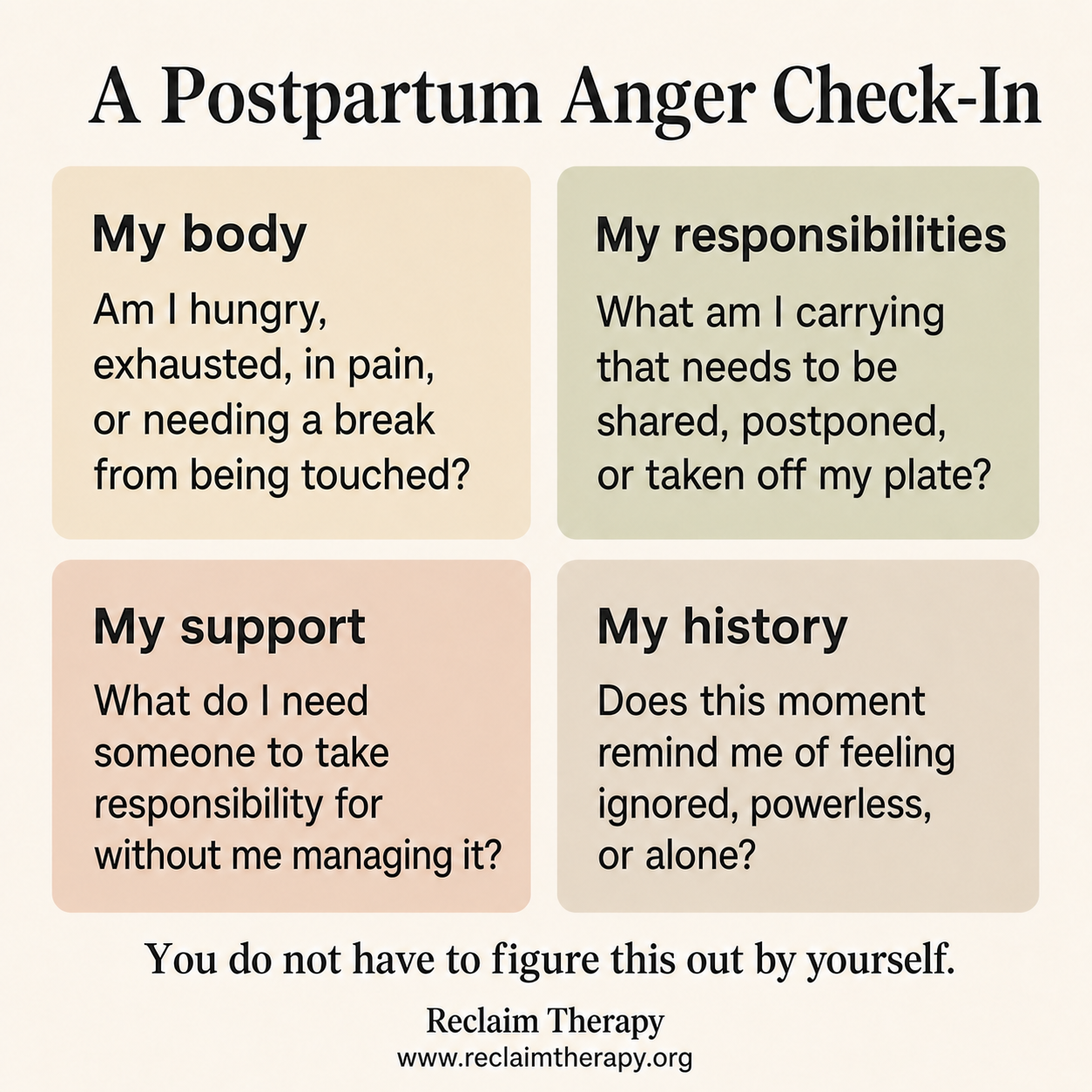
Loving your family does not eliminate your need for privacy, choice, or a break.
How Can Trauma Contribute to Postpartum Anger?
Trauma is not the explanation for every experience of postpartum rage. But when there is a trauma history or broader mental health concerns, it deserves consideration and to be brought into the coversation.
Anger can be part of a trauma response, particularly when situations bring up danger, helplessness, or betrayal. For someone with PTSD, the body’s threat response can remain highly reactive even when the immediate situation is different from the original trauma. The National Center for PTSD explains the connection between anger and trauma.
Other risk factors can include a personal or family history of mental illness, including bipolar disorder; this family history may make postpartum women more vulnerable to postpartum mood disorders.
A trauma-informed therapist can help you explore whether that connection fits your experience.
When needing help has never felt comfortable
Maybe you grew up being the easy one.
The helpful one. The one who did not need much. The one who noticed everyone else’s mood before saying anything about your own.
If that sounds familiar, consider what happens now when you need support.
Do you ask directly?
Do you tell yourself you should be able to manage?
Do you wait until you are so overwhelmed that the request comes out as anger?
These are questions to explore, not proof that childhood experiences caused your postpartum symptoms.
There may also be grief here.
Why was I expected to handle so much alone? Why does needing care still make me feel guilty?
Therapy can make room for those questions while helping you address what is happening in your household today.
Sometimes the birth experience still feels close and still feels painful
Perhaps you keep returning to a moment, or a series of moments before, during or after the birth.
Something frightening happened. You did not understand what was happening to your body. You felt ignored, powerless, or afraid.
If birth memories are still distressing, we encourage you bring them into the conversation with your provider. Anger alone does not establish PTSD, but a broader assessment can help clarify whether trauma symptoms need treatment.
You can also read more about when you cannot stop thinking about your birth experience.
We want you to know that you never have to decide whether your experience was “bad enough” before asking for help.
Why Am I So Angry at My Partner?
Sometimes the answer includes a very real imbalance.
You are tracking the feeds, appointments, supplies, and sleep. Your partner asks how they can help, but you are still responsible for figuring out what needs to happen, carrying the mental load of the household planning.
Sometimes there are older relational questions worth exploring too.
Can I count on you?Will you notice when I am struggling?Do my needs matter without a crisis?
Both deserve attention. Exploring your history should not become a way of dismissing a current, very real problem.
Therapy should not teach you to tolerate an unsustainable arrangement more independently.
A useful conversation might move from “I need more help” toward something specific:
“I need you to take responsibility for washing and preparing the bottles every evening, including noticing when we need supplies.” Emotional support and practical help from partners or family members can make a huge difference.
Or:
“We need a plan for my sleep that does not depend on me reaching a breaking point, with protected rest and, when possible, a stretch of uninterrupted sleep.”
The follow-through matters as much as the conversation.
Can EMDR Help With Postpartum Rage?
EMDR Therapy, or Eye Movement Desensitization and Reprocessing, is an evidence-based treatment for PTSD. Its evidence for PTSD should not be interpreted as proof that it treats every form of postpartum anger.
When trauma appears to be contributing to your distress, a therapist may discuss EMDR as one treatment option.
The starting point is an assessment. What is happening now? Are there distressing memories or trauma symptoms? What support do you have? What would make treatment manageable alongside caring for a baby?
Questions you might explore together include:
Does a current situation remind you of an earlier experience of being powerless or unsupported?
Are birth memories still especially upsetting?
What do you find yourself believing about yourself when the anger happens?
What would you need in order to feel ready for trauma-focused work?
You might notice thoughts such as:
I’m all on my own.
My needs do not matter.
If I am not in control, something terrible will happen.
Those thoughts are starting points for understanding your experience, where they might be rooted, and how treatment can support you to resolve past trauma and birth trauma.
You can learn more about EMDR therapy at Reclaim here.
And, the practical pieces still matter. Trauma treatment does not replace sleep, childcare, medical care, or another adult taking responsibility.
How Long Does Postpartum Rage Last?
There is no established timeline for how long postpartum rage lasts. The course depends on what is contributing to it and the support or treatment a person receives. Cleveland Clinic’s guidance on duration.
You do not need to wait for a particular month to ask for help.
If you are searching this while your baby approaches their first birthday, or later, tell a provider what is happening now. Let the assessment guide the explanation instead of assuming it must still be hormones.
A more useful question than “shouldn’t this be over already?” may be: “what has changed, what has not, and what support am I still missing?”
How to Deal With Postpartum Rage
The immediate priority is safety, for you, your family and your baby. Then there is the work of understanding what keeps bringing you to this point.
Make a plan for moments when you feel close to losing control
If you are holding your baby and becoming overwhelmed, place them on their back in a safe, empty crib and step away briefly. Ask a trusted adult to take over when available. The CDC advises checking on your baby every five to ten minutes while taking a break. Never shake or hit a baby.
If you cannot keep yourself or your baby safe, seek emergency help immediately. If you have self harm urges, suicidal thoughts, or thoughts of harming the baby, get urgent help right away through the national suicide prevention lifeline at 988.
Planning for these moments is a responsible step. You really don’t have to wait for another frightening incident to make that plan with someone.
Notice what happens before the anger
When you have some space, look back at episodes of intense emotions with curiosity rather than a running commentary about what a terrible mother you are.
Had you eaten?
Were you in pain?
Were you sleep deprived or overwhelmed by intense feelings?
Had you been trying to get a break for hours?
Did you feel dismissed?
Did you notice intrusive thoughts, intense frustration, or other mood disruption building before the outburst?
Was there a reminder of something frightening?
The goal is to identify what needs attention earlier, not to find a reason to excuse harmful behavior, and this kind of pattern-tracking can help you manage stress earlier.
Ask for support that actually changes your day
“Let me know if you need anything” leaves a lot of work with you.
Where possible, make support concrete:
A family member brings dinner and handles the dishes.
Your partner takes ownership of a recurring household task.
A trusted person cares for the baby while you attend an appointment.
You make a realistic plan for protected rest.
Support groups can help many mothers feel less alone, and Postpartum Support International is one place to seek support and find them.
If those resources are limited, say that directly to your provider. Recommendations need to offer appropriate support that fits the life you are living.
Tell a professional what is happening without softening it
It can be hard to describe the anger out loud, especially when you already feel ashamed of it. You might find yourself saying you have been “a little stressed” when what you mean is, “I keep getting so angry that it scares me, and afterward I feel awful.” You don’t need to know whether it is depression, anxiety, trauma, exhaustion, or some combination before asking for help.
Sorting that out is part of what a provider can help you do.
Be specific about what happens during those moments, including whether your behavior has frightened or hurt someone. That can be uncomfortable to acknowledge, but it helps your provider understand what support you need and make a plan for safety. There is room to understand where the anger comes from while also taking responsibility for how you respond to it.

Postpartum Therapy in Horsham and Throughout Pennsylvania
You really don’t need to make the anger sound nicer before bringing it into therapy.
There is room to talk about uncontrollable anger. Slamming doors. Feeling like a bad mom after an outburst. The birth experience you keep replaying. The discomfort of needing help when you have spent years being the person who handles everything.
At Reclaim Therapy, we offer postpartum therapy in Horsham and online throughout Pennsylvania.
Postpartum rage does not have an official diagnosis of its own, but providers do recognize it as part of postpartum mental health care.
Together, we can explore what is contributing to your distress, what needs to change in your daily life, and whether trauma-focused treatment belongs in your care.
You can schedule a consultation to talk about what you are experiencing and the support you are looking for.
🧡,

Common Questions About Postpartum Rage
Can I have postpartum rage without postpartum depression?
Yes. You can experience intense anger after childbirth without feeling depressed, and it can happen on its own or alongside postpartum depression, postpartum anxiety, or other postpartum mood disorders. Mom rage is not an official diagnosis, but it is a real experience that deserves care. You do not need to feel sad for your distress to deserve attention. Tell your provider about the anger itself, including how often it happens and whether it feels difficult to control.
What if I am still experiencing postpartum anger a year after giving birth?
There is no established timeline for when postpartum rage ends. If anger continues beyond the first year, a provider can assess what is contributing rather than assuming it is still related to postpartum changes. You have not missed your opportunity to get help because your baby is older.
How do I know when postpartum anger needs professional support?
Reach out if the anger feels intense, difficult to control, or is affecting your relationships or daily life; common symptoms can include when you feel anger more often, react with sudden outbursts, or feel unable to express anger safely. You do not have to wait until someone gets hurt. If you develop feelings of wanting to hurt yourself, your baby, or anyone else, get urgent help right away. Feeling scared by your reactions is enough reason to start the conversation, even if you are unsure how to explain them.
How do I know whether EMDR is right for me?
Start with an assessment, rather than choosing a treatment based on anger alone. EMDR is an evidence-based treatment for PTSD. If distressing birth memories or other trauma symptoms are part of what you are experiencing, a qualified therapist can discuss whether it fits your needs. It is not automatically the right treatment for everyone experiencing postpartum rage.
What should I say when I reach out for postpartum therapy?
You can start with what has been hardest: “Since having my baby, I get angry much faster than I used to, and it is affecting how I feel about myself, my relationships, and my daily life with these intense emotions.” You do not need a diagnosis or a polished explanation. During the postpartum period, you can ask for mental health support and ask about the therapist’s experience with postpartum concerns, whether they work with birth trauma, and what getting started would look like.
New moms are not the only ones who experience postpartum rage; partners can also experience postpartum rage and may need to seek support.
Sarah Herstich, LCSW, is the founder of Reclaim Therapy in Horsham, Pennsylvania, a Certified EMDR Therapist, EMDRIA approved consultant, and a Somatic Experiencing Practitioner. She specializes in complex trauma, eating disorders, and toxic shame. Her writing explores how past experiences can shape relationships, self-trust, and the ways we respond when life feels overwhelming.