
Written by Sarah Herstich, LCSW, Certified EMDR Therapist, EMDRIA-Approved Consultant, Somatic Experiencing Practitioner, and owner of Reclaim Therapy in Horsham, PA
EMDR for birth trauma is a research-supported therapy that helps your brain and body process a traumatic pregnancy, birth, or postpartum experience so the memory stops feeling like it's still happening. It can ease flashbacks, anxiety, and fear of future births, along with the beliefs birth trauma leaves behind, like "I failed" or "my body betrayed me."
Key Takeaways
Birth trauma is defined by how your nervous system experienced your birth, not by whether it looked like an emergency from the outside.
A healthy baby and a "normal" delivery don't rule out birth trauma, and partners can be affected too.
People who carry earlier trauma, including childhood trauma, are more likely to develop trauma symptoms after birth.
EMDR is recommended for PTSD after a traumatic birth in the UK's national guidelines, and research so far has not found it harmful during pregnancy.
Healing is possible, and it doesn't require you to prove your birth was bad enough to deserve support.
What Is Birth Trauma?
Birth trauma is the lasting emotional and physical impact of a pregnancy, birth, or postpartum experience that felt overwhelming, frightening, or out of your control. What makes an experience traumatic isn't only what happened medically. It's how your nervous system took it in, and whether you had the safety and support to process it afterward.
For some people, birth trauma comes from something that everyone agrees was scary, like an emergency cesarean, a hemorrhage, a baby whisked away to the NICU, or a moment when someone's life was at risk. For others, it comes from things that are harder to name. Maybe your pain wasn't taken seriously, or you were touched and examined without anyone explaining what was happening. Maybe you asked questions and felt brushed off, or lay there feeling completely alone while a room full of people moved around you.
Birth trauma can also follow a birth that went "by the book." Research has found that even a normal, on-time delivery with a healthy baby can lead to post-traumatic stress, because trauma is about what your body experienced, not what the chart says. And it isn't limited to the person who gave birth. Partners who witness a frightening birth, and who often feel helpless and out of control while it's happening, can develop trauma symptoms of their own.
Was My Birth Traumatic Enough to Count?
If your birth still affects how you feel, sleep, parent, or move through your day, it counts. There's no bar you have to clear before you're allowed to be impacted and it doesn't have to follow the typical definition of a traumatic event. Birth trauma can lead to post traumatic stress disorder whether you had a serious injury or not. Both experiences are valid.
We hear some version of this question all the time. "It wasn't that bad." "Other people have it so much worse." And the one that shuts down so many conversations before they start: "At least the baby is healthy." That last one is usually said with love, and it's true that a healthy baby is a gift. But your baby being okay and you being okay are two separate things, and one doesn't cancel out the other.
When the people around you are celebrating and you're lying awake replaying the moment the monitors started beeping, it can feel like something must be wrong with you. Nothing is wrong with you. Your nervous system went through something it couldn't fully process in the moment, and it's still trying to keep you safe from it. That's what trauma does. It isn't a competition, and it isn't a sign that you're ungrateful or weak.
What Are the Signs of Birth Trauma?
The most common signs of birth trauma are intrusive memories of the birth, avoiding reminders of it, and feeling on edge or disconnected in the weeks, months, or even years afterward. If you think you had a traumatic birth experience, you might recognize some of these:
Flashbacks, nightmares, or replaying specific moments of the birth
Dreading or avoiding OB appointments, hospitals, or even driving past the place you gave birth
Constant hypervigilance about your baby's safety, with a hard time letting anyone else help
Feeling numb, detached, or like you're watching your life from the outside
Struggling to feel connected to your baby, and feeling guilty about it
Intense fear of another pregnancy or birth
Anger, grief, or shame about how the birth went, or about how your body "handled" it
Changes in sleep, appetite, intimacy, or your relationship with your partner
A formal diagnosis of postpartum PTSD is less common than many people expect, averaging around 2% in published research. That same research found that significant trauma symptoms that fall short of a diagnosis show up in far more people, as many as about a third of those who give birth in some studies. You don't need a diagnosis to deserve care. If these signs sound familiar, they're worth taking seriously.
All of these responses make sense. Your nervous system learned that birth, hospitals, or your own body might not be safe, and it's doing its best to protect you from ever feeling that way again. The goal of healing isn't to argue with that protection. It's to help your system learn that the danger is over.
Why Can Birth Trauma Hit Harder When You Carry Complex Trauma?
Birth trauma and childbirth related PTSD can hit harder when you already carry complex or childhood trauma, because birth often recreates the exact experiences that were hardest for you growing up. Research has found that people with a history of earlier trauma, including childhood trauma, childhood maltreatment, sexual trauma, or previous trauma, are more likely to develop PTSD after giving birth.
Think about what birth asks of a person. You have very little control. You depend on other people to take care of you. Your body is exposed, touched, and moved by people you may have just met. If you grew up in a home where needing people wasn't safe, where your feelings were dismissed, or where your body didn't feel like your own, birth can press on every one of those old bruises at once.
This is especially true for people who learned to be the easy one, the capable one, the one who never needed much. Many of the people we work with describe birth as the first time in their adult lives they couldn't hold it all together, and that loss of control can feel terrifying in a way that's about much more than the birth itself. We write more about that pattern in The Hidden Cost of High-Functioning Trauma.
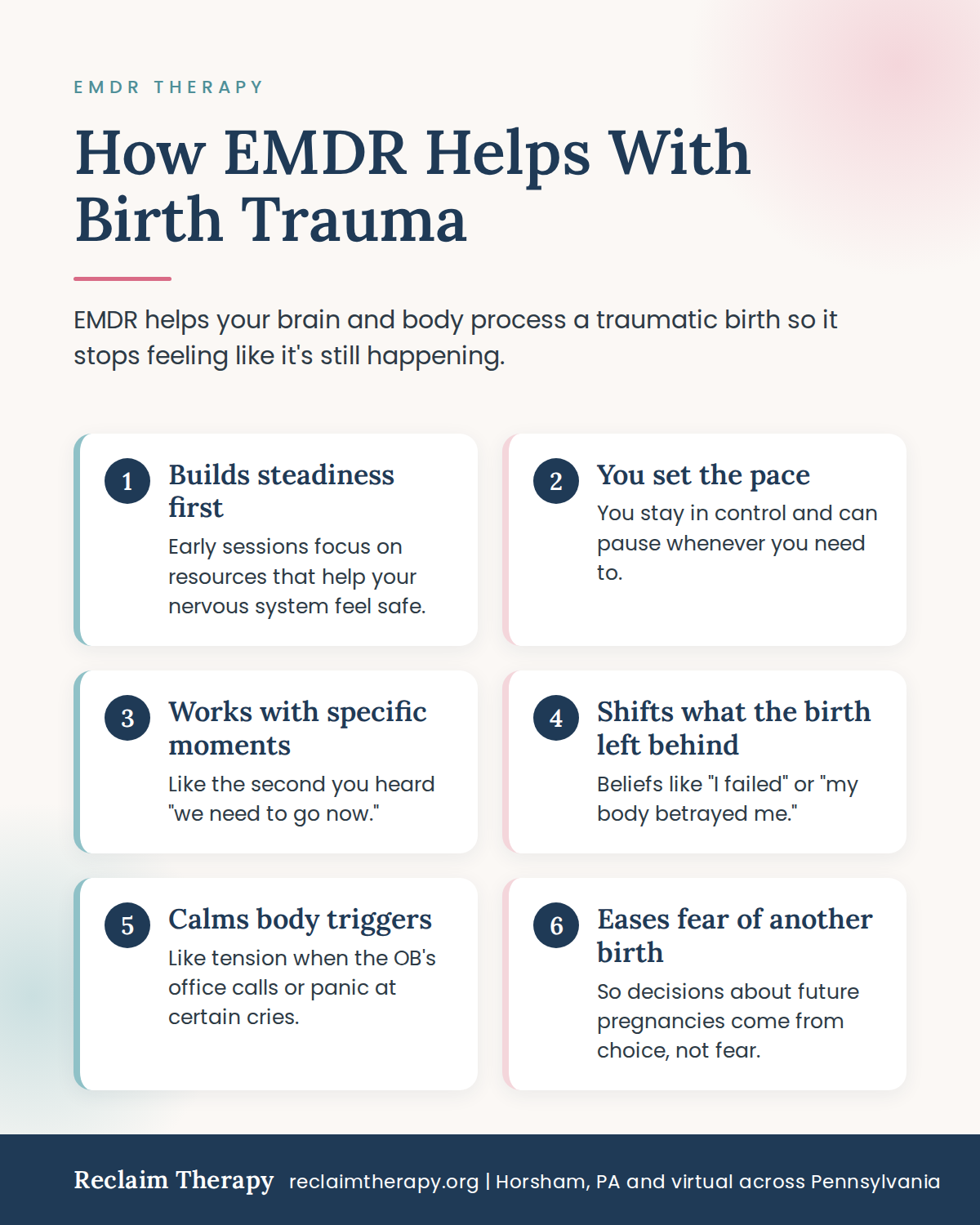
How EMDR for birth trauma works, starting with safety and moving at your pace.
Becoming a parent can also stir up your own early attachment experiences. Caring for a newborn who needs you completely can bring up grief for the care you didn't get, or fear that you'll repeat patterns you've worked so hard to break. None of this means you're doing parenthood wrong. It means your history is part of this experience, and it deserves care too. Our complex PTSD treatment looks at traumatic childbirth and birth trauma through that wider lens, so you're healing what's underneath, not just the most recent layer.
How Does EMDR Help With Birth Trauma?
EMDR helps with birth trauma by helping your brain reprocess the memories that got stuck during the birth, so they lose their emotional and physical charge and start to feel like something that happened in the past. EMDR stands for Eye Movement Desensitization and Reprocessing, and it uses bilateral stimulation, like eye movements, tapping, or tones, while you briefly bring up parts of the memory.
Here's the idea underneath it. When something overwhelming happens, your brain doesn't always get the chance to file it away like a normal memory. Instead, it stays stored with all the fear, sensations, and beliefs from that moment still attached. That's why a beeping monitor on TV or the smell of hospital soap can send your body right back to the delivery room. EMDR is a reprocessing therapy that can help your brain finish processing the memory, so you still remember what happened, but your body stops reacting as if it's happening now.
In EMDR therapy for birth trauma, we might work with:
Specific moments from the birth or childbirth events, like the second you heard "we need to go now" or the first time you saw your baby in the NICU
The beliefs the birth left behind, like "I failed," "I'm not safe," "my body betrayed me," or "I should have done something differently"
Body sensations and triggers, like tension when your OB's office calls or panic when your baby cries a certain way
Fears about the future, including fear of another pregnancy or birth
EMDR early interventions don't start with the hardest memory. The first phases focus on getting to know your history and building resources that help your nervous system feel steady, so you have support in place before any processing begins. You stay in control the whole time, you can pause whenever you need to, and you don't have to tell every detail of your story out loud for EMDR to help.
The research is encouraging. The UK's national guidelines for perinatal mental health recommend offering trauma-focused CBT or EMDR to women with PTSD after a traumatic birth. A small pilot trial of the EMDR Recent Birth Trauma Protocol found that a single EMDR session in the days after birth reduced post-traumatic stress symptoms more than usual care at six weeks postpartum. The researchers describe those results as preliminary, and larger studies are still underway, but they add to a growing body of evidence that EMDR can make a real difference for birthing people.
At Reclaim, we often pair EMDR with Somatic Experiencing, because birth trauma lives so much in the body. Somatic work helps you rebuild a felt sense of safety in the same body that went through the birth, which can make EMDR processing feel more manageable and reducing PTSD symptoms.
Is EMDR Safe During Pregnancy or Postpartum?
Research so far has not found EMDR to be harmful during pregnancy. A multi-center randomized controlled trial of pregnant women with fear of childbirth concluded that EMDR therapy did not adversely affect the pregnancy or the baby.
This question comes up a lot, especially from people who had a traumatic first birth and are now pregnant again. It's a completely understandable worry. Research on any kind of therapy during pregnancy is still growing, as Postpartum Support International points out. At the same time, unprocessed trauma and chronic stress are already affecting your body, so leaving them untreated isn't a neutral choice either.
A good EMDR therapist will pace the work around where you are. If you're pregnant and anxious, that might mean spending more time on stabilization and resourcing before any processing. If you're postpartum, EMDR can happen alongside feeding, sleep deprivation, and all the realities of life with a newborn, and virtual sessions can make it much easier to fit therapy in. It's always a good idea to keep your OB or midwife in the loop about the support you're getting.
What Does Healing From Birth Trauma Look Like?
Healing from birth trauma looks like the birth becoming a memory instead of something your body keeps reliving. It rarely happens all at once, and it doesn't mean pretending the birth was fine.
It might look like driving past the hospital without your chest tightening, or holding your baby without bracing for something to go wrong. It might look like telling your birth story, or choosing not to, without your whole body going back to that room. It can look like finally grieving the birth you hoped for, and making room for anger about what happened without turning that anger on yourself. For many people, it also looks like making decisions about future pregnancies from a place of choice instead of fear.
You don't have to earn healing by proving how bad your birth was. What you went through was real, and so is your capacity to heal from it.
Birth Trauma Therapy at Reclaim Therapy

Reclaim’s team of EMDR Therapists
At Reclaim Therapy, our trauma therapists support people healing from birth trauma, postpartum depression, and postpartum anxiety. We use EMDR, somatic therapy, and parts work to help you process what happened, reconnect with your body, and care for the parts of you that are still carrying the birth. Because we specialize in complex trauma, we also make space for the older experiences a birth can stir up, so you're not just managing symptoms but healing what's underneath them.
We see clients in person at our office in Horsham, PA, and virtually across Pennsylvania, which can make a real difference when leaving the house with a newborn feels like a whole expedition.
If any of this feels familiar, we'd be honored to support you. You can schedule a free consultation whenever you're ready.
🧡

Frequently Asked Questions
Can you have birth trauma if your baby was healthy?
Yes, because birth trauma is about how you experienced the birth, not only about the outcome. You can have a healthy baby and still be deeply affected by what you went through. Both things can be true at the same time.
Can partners experience birth trauma?
Yes, partners can experience birth trauma. Those who witness a frightening or complicated birth can develop trauma symptoms, especially when they felt helpless or out of control. Their experience deserves care too, and EMDR can help partners as well.
How many EMDR sessions does birth trauma take?
It depends on the person, the birth, and whether earlier trauma is also involved. Some people notice relief within a handful of processing sessions, while others, especially those with complex trauma histories, benefit from longer-term work that addresses older experiences too.
Can EMDR help with fear of giving birth again?
Yes, EMDR can help with fear of giving birth again. It can target fears about future pregnancies and births, and research has studied it specifically in pregnant women with fear of childbirth. Many people find it helps them make decisions about another pregnancy from choice rather than fear.
Is birth trauma the same as postpartum depression?
Birth trauma and postpartum depression aren't the same, although they can happen together. Birth trauma is centered on a frightening experience and often shows up as flashbacks, avoidance, and hypervigilance, while postpartum depression is centered on low mood and loss of interest. A therapist can help you sort out what you're experiencing and treat both if needed.
Do I need a PTSD diagnosis to get help for birth trauma?
You don't need a PTSD diagnosis to get help. Many people carry significant trauma symptoms after birth without meeting the full criteria for PTSD. If your birth is still affecting your sleep, mood, relationships, or connection with your baby, that's reason enough to reach out for support.
Where can I find EMDR therapy for birth trauma in Pennsylvania?
Reclaim Therapy offers EMDR therapy for birth trauma in person in Horsham, PA, and virtually across Pennsylvania, and you can schedule a free consultation to see if it's a good fit. If you live outside Pennsylvania, EMDRIA's Find an EMDR Therapist directory and Postpartum Support International's provider directory can help you find a therapist trained in EMDR who understands perinatal mental health.