
One of the strange things about trauma therapy is that you can be making real progress and still have a terrible Tuesday.
You can still get triggered. Still people-please when you wish you had said no. Still shut down during conflict. Still overthink a conversation for hours afterward. You can understand exactly where a pattern comes from and then watch yourself do it again anyway.
At some point, you may start wondering: How do I know if trauma therapy is actually working? Often, trauma therapy progress shows up when you start noticing your triggers sooner, have more choice in how you respond, recover differently afterward, and begin trusting your own experience even if you still get triggered.
It’s a fair question, especially if you started therapy expecting progress to mean that the things you struggle with would eventually stop happening.
With complex trauma, progress is often more complicated than that.
For adults navigating complex PTSD, childhood emotional neglect, attachment wounds, dissociation, eating disorders, body image concerns, and related survival patterns, some of the earliest signs trauma therapy is working have less to do with never getting triggered again and more to do with what happens when you are. You may notice what is happening sooner. You might have more choices in how you respond. You may recover differently afterward or recognize your own limits before you have pushed yourself well past them.
Over time, you may also begin to trust your own experience in ways that were much harder before.
These changes can be easy to miss because they don't always feel dramatic, which is exactly why so many people wonder whether therapy is helping when old trauma responses still show up. Looking at progress in complex PTSD therapy, EMDR therapy, or other forms of trauma treatment means paying attention to subtle signs of healing, what trauma recovery does and does not mean, how progress is measured, when it may be time to question whether therapy is effective or needs to shift, and what support may look like if you're seeking trauma therapy in Horsham, PA.
Why Trauma Therapy Progress Can Be Hard to Recognize
Most people have some idea of what it would mean to be "better."
Maybe you imagine that you won't feel anxious anymore. Conflict won't send you into a spiral. You won't freeze when someone is disappointed in you. You'll finally be able to rest without feeling guilty, set boundaries without second-guessing them, or stop feeling like you're somehow in trouble when nothing is actually wrong.
So when those reactions continue to show up, it can feel discouraging.
But many of the patterns associated with complex trauma developed over years, often in relationships and environments where you had very little control over what was happening.
People-pleasing may have helped preserve connection. Perfectionism may have reduced the risk of criticism. Hyper-independence may have made needing other people feel less dangerous. Dissociation may have helped you get through experiences that felt overwhelming or inescapable.
These aren't habits you picked up because you misunderstood a coping skills worksheet. They developed for reasons.
Trauma therapy is often less about getting rid of these responses on command and more about helping you recognize when they are happening, understand what they have been doing for you, and gradually have access to something other than the same automatic response.
That can make progress much harder to measure, because healing from trauma is not a straight line and there is no set timeline. It often shows up as gradual changes over time, with ups and downs rather than obvious, immediate results.
9 Signs Trauma Therapy Is Working, Even If You Still Get Triggered
1. You Notice What's Happening Sooner
One of the most overlooked signs of trauma therapy progress is simply becoming aware of your response earlier.
Maybe you used to realize you were overwhelmed only after you completely shut down. Now you notice the tension building in your body before you get there.
Maybe you used to automatically say yes and feel resentful three days later. Now there is a moment when you hear yourself agreeing and think, I actually don't want to do this.
Or maybe you recognize the familiar feeling that someone is upset with you and realize that your mind has already started searching for what you did wrong.
The reaction may still happen. The difference is that you are beginning to recognize it while it is happening.
That awareness gives you information you didn't have access to before, and over time it can mean reduced trauma symptoms and stronger emotional regulation.
In somatic trauma therapy, we may pay attention to similarly small changes in body awareness. You might notice that you are starting to dissociate, recognize when your breathing changes, realize you're exhausted before you hit complete shutdown, or notice the urge to leave a conversation instead of overriding it automatically.
You don't have to be perfectly connected to your body or aware of every internal sensation for therapy to be working.
Sometimes progress is noticing overwhelm at a six instead of discovering it at a ten, and later that may show up as fewer nightmares or panic responses.
2. There's More Space Between a Trigger and What Happens Next
Complex trauma responses can feel incredibly fast.
Someone's tone changes, and you're apologizing.
Someone pulls away, and you're trying to repair something you aren't even sure you did.
You make a mistake, and within seconds your mind has turned it into evidence about who you are as a person.
As trauma therapy progresses, there may be a little more space between what happens and the response that follows.
Not necessarily a huge, peaceful pause where you calmly select the healthiest option from a menu of coping skills.
Sometimes it is just a few seconds, and that small pause can mean anxiety feels less intense over time.
You notice the urge to send the text, explain yourself, fix the other person's feelings, work harder, withdraw, or turn your anger against yourself.
And occasionally, you do something different.
That ability to have more than one possible response is important. The goal isn't to eliminate every trauma response. It's to build emotional flexibility, so you have more choice when those old responses get activated, and more space can look like feeling calmer even in stressful moments during therapy.
3. You Recover Differently After Getting Triggered
Getting triggered doesn't mean therapy isn't working.
A better question may be: what happens after the trigger now?
Maybe something that once took you several days to recover from now takes an afternoon. Maybe you can recognize an emotional flashback sooner instead of spending hours convinced that everything you are feeling reflects what is happening right now. And maybe past experiences carry less emotional intensity over time.
Or perhaps the biggest change isn't how long the trigger lasts at all.
Maybe there is less shame afterward.
Instead of immediately going to Why am I still like this? I've been in therapy for years, you have a little more understanding of why your system responded the way it did, and you may start to see the past differently instead of treating every reaction as proof that something is wrong with you.
You may be able to orient back to the present, reach out to someone safe, give yourself space, or recognize what you need.
Progress isn't always having fewer hard moments. Sometimes it is becoming less lost inside them.
4. Safe Choices Still Feel Uncomfortable, but You're Making Them Anyway
This one surprises people.
We tend to assume that if something is healthy for us, it will eventually feel good.
That isn't always true, especially at first.
A boundary may be appropriate and still make you feel guilty.
Rest may be necessary and still leave you feeling agitated.
A consistent relationship may be safe and still make part of you suspicious.
Receiving help may feel much more vulnerable than being the person everyone else depends on.
When you've spent years adapting to particular relational dynamics, familiar and safe aren't necessarily the same thing.
One sign trauma therapy is working is that discomfort stops being the only information you use to decide whether something is wrong.
You can feel guilty after setting a boundary without automatically deciding the guilt means you were selfish.
You can feel anxious about disappointing someone without rushing back to make everything okay, or by doing something you used to avoid because it reminded you of what happened.
You can recognize that something feels unfamiliar, even if it feels uncomfortable, without immediately deciding it is unsafe, which over time can support clearer boundaries and more trust in relationships.
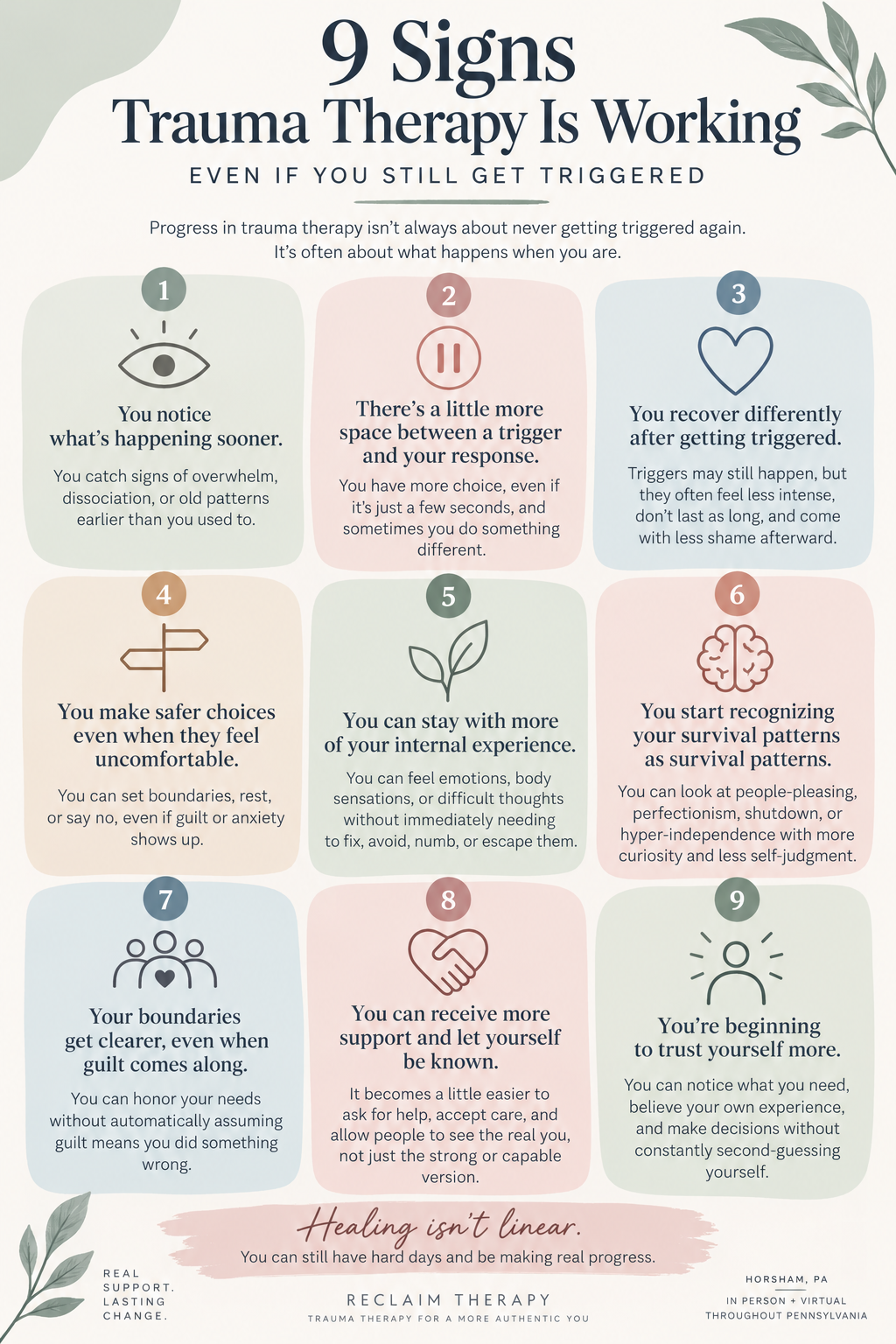
5. You Can Stay With More of Your Internal Experience
Trauma therapy isn't supposed to turn you into a person who is calm all the time.
It also isn't a competition to see how long you can sit with uncomfortable sensations.
For people with complex trauma, increased capacity can look much subtler.
You might be able to feel emotions you used to numb or avoid, like fear or sadness, without immediately pushing them away. You might recognize anger before turning it inward. You may notice a body sensation that previously would have felt intolerable and stay connected to the present while it is there.
For someone who dissociates, progress might mean noticing that disconnection is beginning and finding your way back a little sooner.
For someone who tends toward hyperarousal, it may mean recognizing activation before it becomes overwhelming.
Trauma therapy should not require forcing yourself to stay present with more than you can tolerate. It often involves exploring difficult emotions or painful memories gradually rather than forcing them, and mindfulness practices can help manage emotional responses while you stay oriented to the present. Staying with more internal experience can sometimes bring up difficult emotions, a temporary increase in distress, traumatic memories, or other signs of past trauma, and that can be part of the healing process rather than a setback. At times, working directly with trauma memories or other traumatic experiences may be one of the more intense parts of therapy. In fact, learning that you are allowed to slow down, pause, orient to the present, or tell your therapist that something is too much can be part of the work itself.
The goal isn't to prove how much discomfort you can handle.
It's to gradually have more capacity to be with yourself.
6. You Start Seeing Survival Patterns as Survival Patterns
There is a significant difference between thinking:
Why do I always do this?
and being able to wonder:
What happens in me when this situation comes up?
People-pleasing, perfectionism, overworking, shutting down, hyper-independence, controlling what you can, avoiding conflict, or becoming highly attuned to other people's moods can all make sense in the context in which they developed.
That doesn't mean every survival strategy is still helping you now.
It means shame doesn't have to be the starting point for understanding it.
As trauma therapy progresses, you may become better at recognizing these patterns without immediately turning them into character flaws, which supports greater emotional regulation and self-compassion.
You can be curious about why a part of you is desperate to keep everyone happy without deciding that you're weak for people-pleasing, and that can soften self blame.
You can notice the urge to control every detail without reducing yourself to "I'm just a control freak" or automatically believing every stream of negative thoughts.
You can recognize functional freeze without accusing yourself of being lazy because you can't seem to start something.
That shift can create room to work with the pattern rather than constantly fighting yourself for having it.
7. Your Boundaries Get Clearer, Even When Guilt Comes Along
If you grew up in a family where your role involved keeping the peace, being easy, anticipating other people's needs, or not asking for too much, boundaries can feel incredibly complicated, especially when family dynamics shaped why saying no felt unsafe.
You may know intellectually that you are allowed to say no and still feel like you have committed a small interpersonal crime every time you do it.
Progress doesn't always mean the guilt disappears first.
Sometimes you set the boundary while the guilt comes with you.
You stop turning every "no" into a five-paragraph explanation. You give yourself time before answering. You become more aware of when you're agreeing because you genuinely want to and when you're agreeing because you can't tolerate the possibility of someone being disappointed.
Eventually, the question can shift from How do I make sure nobody is upset with me? toward What actually feels okay for me here?—a sign of meaningful shifts in how you relate to yourself and other people.
For many survivors of childhood emotional neglect, that is a significant change.
When your feelings, preferences, or instincts weren't consistently taken seriously growing up, trusting your own internal experience can be difficult in adulthood. You may automatically give more weight to what someone else wants or believes than to what you know about yourself.
Part of trauma recovery can involve taking your own signals seriously again.
8. You Can Receive More Support and Let Yourself Be Known
Hyper-independence gets praised a lot.
You handle things. You don't need much. You're the reliable one. When life falls apart, you're usually the person other people call.
But being extremely capable and feeling safe depending on someone are two different things.
For people with attachment wounds or childhood emotional neglect, receiving care can feel surprisingly vulnerable. You may feel more comfortable helping than being helped. You might worry about owing someone, being a burden, needing too much, or losing control.
Progress in trauma therapy may look like letting someone do something kind for you without immediately trying to repay them.
It may mean telling someone that you're having a hard time before you've already handled it yourself. Accepting help and seeking support can make it easier to feel more hopeful about the future.
It can also mean allowing yourself to be known more honestly instead of presenting the version of you that feels easiest for everyone else to be around, which can help you begin to feel hope that healing is possible.
Healthy connection doesn't require giving up independence. It means independence isn't your only safe option.
9. You're Beginning to Trust Yourself More
For many people recovering from complex trauma, this may be one of the biggest changes of all: increased self-awareness starts helping you learn to trust yourself.
You start believing yourself.
You recognize when you're tired and respond to it.
You notice when something doesn't feel right without needing to build a court case explaining why.
You know you don't want something even when another person doesn't understand.
You can make a decision without polling five people first.
And when you aren't sure what happened, what someone meant, or whether your memory is completely accurate, uncertainty doesn't automatically require abandoning your own experience.
These are often small moments of self-trust, built through self-awareness rather than dramatic breakthroughs.
Self-trust doesn't mean assuming you're always right.
It means your thoughts, feelings, needs, perceptions, and limits get a seat at the table too.
For someone who learned early to organize themselves around everyone else's experience, that can represent a profound shift, and trusting yourself more is part of moving forward even when the process isn't perfect.
Does Trauma Therapy Have to Feel Worse Before It Gets Better?
Not necessarily.
It is true that trauma therapy can bring up emotions, memories, sensations, grief, or patterns that you have spent a long time avoiding or not fully recognizing, and early sessions may surface avoided emotions and memories without immediately processing trauma. Increased awareness can sometimes make it feel like things are getting worse when you are actually noticing more of what was already happening.
You may also reach a point where an old coping strategy doesn't feel as automatic or effective as it once did, but the newer response doesn't feel natural yet.
That middle ground can be uncomfortable.
But "therapy gets worse before it gets better" should never be used as a blanket explanation for ongoing destabilization.
If you are consistently leaving sessions overwhelmed, functioning significantly worse, feeling pressured to talk about or process experiences before you are ready, or finding that your concerns about treatment aren't being taken seriously, those things deserve attention. Effective trauma work should help you process painful material without reliving painful memories in an overwhelming way.
Good trauma therapy should have room for that conversation.
What Can Progress in EMDR Therapy for Traumatic Memories Look Like?
People sometimes come into EMDR therapy expecting that successful processing means a memory disappears or no longer bothers them at all.
That isn't necessarily what happens.
In EMDR therapy, or Eye Movement Desensitization and Reprocessing, progress may involve being able to remember something without experiencing the same level of activation, recognizing that what happened then is not happening now, or having access to information and perspectives that were much harder to feel connected to before.
You may know intellectually that something wasn't your fault long before that belief feels emotionally accessible.
You may understand that you're safe in the present while your body still responds as though an old threat is happening again.
Trauma processing can help those pieces become more integrated.
Eye movement desensitization is one effective option for processing trauma and PTSD, while a different therapeutic approach may be a better fit for some people; for example, Cognitive Processing Therapy helps explore trauma-related thoughts, and Prolonged Exposure Therapy gradually confronts avoided memories as part of trauma focused approaches.
This is particularly important when using EMDR for complex PTSD. Complex trauma often requires thoughtful pacing, attention to dissociation and present-day capacity, and a therapist who understands that trauma treatment is not simply about getting through a list of memories as quickly as possible.
Progress may be happening both inside and outside formal memory processing.
What Trauma Healing Does Not Mean
Healing from trauma does not require becoming impossible to trigger.
It doesn't mean you never feel anxious, shut down, dissociate, people-please, get angry, struggle with body image, experience an eating disorder urge, or fall back into an old survival strategy.
It doesn't mean you're regulated all the time.
And it definitely doesn't mean you become endlessly calm while everyone around you continues doing whatever they want.
Sometimes healing actually makes certain things harder to tolerate because you are more aware of what they cost you.
You may notice relationships that depend on you having no boundaries. You may recognize how exhausted you are from constantly overfunctioning. You might become more aware of anger that you previously turned against yourself.
That awareness isn't the whole of healing, but it can be part of it.
The more useful question is often not Do I still have trauma responses?
It's Do I have more ways to respond to myself when they happen? — not because old wounds are erased, but because you may reach a place of acceptance where trauma no longer controls your life in the same way.
What If I Don't Think Trauma Therapy Is Helping?
Sometimes people aren't missing subtle signs of progress.
Sometimes therapy really isn't helping.
It is worth being honest about that possibility, and expectations about pace and duration can vary depending on the person and the therapy process.
You should be able to ask questions about your treatment. You should have some understanding of what you and your therapist are working toward and why you're using a particular approach. Good trauma therapy often begins with creating safety before moving into deeper trauma work. Your therapist should be able to hear that something feels too fast, isn't making sense, or doesn't feel helpful without treating your concern as resistance that needs to be overcome.
If you're unsure about your progress, it may help to ask yourself:
Do I feel respected and taken seriously in therapy?
Can I tell my therapist when something feels like too much?
Do I understand what we're working on and why?
Has anything changed in how I relate to my emotions, body, relationships, or survival patterns?
Does therapy help me build coping strategies and a stronger sense of safety?
Does my therapist adjust the pace when I become overwhelmed or disconnected?
Can we talk openly about whether the approach we're using is helping?
Sometimes the therapeutic relationship isn't the right fit. Sometimes a different trauma therapy approach makes more sense. Sometimes another level of care or additional support is needed.
That doesn't mean you failed therapy.
It means therapy should be responsive to the actual person sitting in the room.
How Do You Measure Healing From Complex Trauma?
There probably isn't one clean measure.
Healing from complex trauma can show up in how quickly you notice yourself disappearing into an old pattern. It can show up in your ability to recognize what you need before reaching complete exhaustion. It may be the first time you set a boundary without immediately taking it back, or the moment you realize someone else's disappointment doesn't automatically mean you did something wrong. In other words, making progress is not just about symptom reduction, but also about functional recovery and how steadily you can use your therapy tools in daily life.
It can be grieving what you didn't receive instead of continuing to convince yourself that it shouldn't matter.
It can be allowing someone safe to get closer.
It can be recognizing when you need space with more consistency across different parts of your life.
It can be knowing that you're triggered and still remembering that you have choices, or doing something that previously felt overwhelming and noticing it is more manageable now.
And over time, there may be a growing sense that you don't have to leave yourself every time something difficult happens.
That is worth paying attention to.
Complex PTSD and Trauma Therapy in Horsham, PA
At Reclaim Therapy in Horsham, Pennsylvania, our therapists work with adults navigating complex PTSD, childhood emotional neglect, attachment wounds, dissociation, eating disorders, body image concerns, and many of the survival patterns that can develop alongside them.
Our approach to trauma therapy recognizes that insight matters, but understanding why you do something doesn't always change what happens when your nervous system is activated. Depending on your needs, treatment may incorporate trauma-informed therapy, EMDR therapy, somatic approaches, parts work, and other modalities as part of our therapy services to address both what happened and how those experiences continue to affect your life now.
We provide in-person trauma therapy and EMDR therapy in Horsham, PA, serving clients throughout Montgomery County and surrounding communities, as well as virtual therapy for clients across Pennsylvania.
If you've been wondering whether trauma therapy is actually working, that question itself is worth bringing into the room. You don't have to pretend something is helping when it isn't, and you don't have to dismiss the smaller changes simply because you aren't "done" healing.
Sometimes progress becomes easier to see when you know what you're looking for.

Complex PTSD and Trauma Therapy in Horsham, PA
At Reclaim Therapy in Horsham, Pennsylvania, our therapists work with adults navigating complex PTSD, childhood emotional neglect, attachment wounds, dissociation, eating disorders, body image concerns, and many of the survival patterns that can develop alongside them.
Our approach to trauma therapy recognizes that insight matters, but understanding why you do something doesn't always change what happens when your nervous system is activated. Depending on your needs, treatment may incorporate EMDR therapy, somatic approaches, parts work, and other trauma-informed therapies to address both what happened and how those experiences continue to affect your life now.
We provide in-person trauma therapy and EMDR therapy in Horsham, PA, serving clients throughout Montgomery County and surrounding communities, as well as virtual therapy for clients across Pennsylvania.
If you've been wondering whether trauma therapy is actually working, that question itself is worth bringing into the room. You don't have to pretend something is helping when it isn't, and you don't have to dismiss the smaller changes simply because you aren't "done" healing.
Sometimes progress becomes easier to see when you know what you're looking for.
🧡,

Frequently Asked Questions About Trauma Therapy Progress
How long does it take for trauma therapy to start working?
There isn't a set timeline for trauma therapy. How long it takes can depend on your history, current circumstances, treatment goals, the type of therapy you're doing, and whether you're working with a single traumatic event or more longstanding complex trauma. Early progress may show up as increased awareness, recognizing triggers sooner, or recovering differently before you notice major changes in symptoms.
How do I know if EMDR therapy is working?
Signs that EMDR therapy is working can include feeling less activated when you think about a traumatic experience, being more able to recognize that the event is in the past, or noticing that old beliefs about yourself no longer feel as convincing. With complex PTSD, EMDR progress may also happen outside of memory processing as you build greater capacity to stay present, recognize dissociation, and respond differently when triggered.
Is it normal to still get triggered after trauma therapy?
Yes. Getting triggered does not automatically mean trauma therapy isn't working. Progress may look like noticing a trigger sooner, understanding what is happening, having more options for responding, experiencing less shame afterward, or recovering more quickly. The goal of trauma therapy is not necessarily to eliminate every trauma response.
Can trauma therapy make you feel worse at first?
Trauma therapy can sometimes bring more awareness to emotions, memories, body sensations, or patterns that were previously avoided or difficult to access. That can feel uncomfortable, but ongoing destabilization should not automatically be treated as evidence that therapy is working. If therapy consistently leaves you overwhelmed or functioning significantly worse, it's important to talk with your therapist about pacing, approach, and whether additional support is needed.
How do I find a trauma therapist for complex PTSD in Horsham, PA?
Look for a therapist who has specific training and experience working with complex trauma, not only PTSD after a single event. Depending on your needs, you may also want to ask about experience with EMDR, dissociation, attachment trauma, childhood emotional neglect, somatic therapy, or parts work. At Reclaim Therapy in Horsham, PA, our therapists provide trauma therapy for complex PTSD and related concerns in person in Montgomery County and virtually throughout Pennsylvania.
Sarah Herstich, LCSW is a trauma therapist, Somatic Experiencing Practitioner, and founder of Reclaim Therapy in Horsham, Pennsylvania. With more than 17 years of clinical experience, Sarah specializes in complex PTSD, childhood emotional neglect, attachment trauma, dissociation, eating disorders, and body image. Her work integrates EMDR, Somatic Experiencing, parts work, and other trauma-informed approaches, with a focus on helping people understand how past experiences continue to shape their nervous system, relationships, and sense of self.