
Written by Sarah Herstich, LCSW, Certified EMDR Therapist, EMDRIA-Approved Consultant, Somatic Experiencing Practitioner, and owner of Reclaim Therapy in Horsham, PA
The symptoms of burnout include exhaustion that rest doesn't fix, growing cynicism or detachment from work, and a drop in how effective you feel. In high achievers, these symptoms often hide behind productivity. They show up as numbness to your wins, guilt when you rest, and a body that falls apart the minute you slow down.
Key Takeaways
The World Health Organization defines burnout as a syndrome caused by chronic workplace stress that hasn't been successfully managed, marked by exhaustion, cynicism, and reduced effectiveness.
High achievers often miss the symptoms of burnout because they keep performing well on the outside while feeling depleted and numb on the inside.
Rest alone often doesn't fix burnout, because a nervous system that learned productivity equals safety can experience stillness as a threat.
Therapy for burnout works best when it addresses both the symptoms of burnout and their roots, using approaches like somatic therapy, EMDR, and parts work.
What Does Burnout Feel Like When You're a High Achiever?
You're still showing up. You're still answering the emails, hitting the deadlines, remembering the birthdays, and saying "no problem" when it is, in fact, a problem. From the outside, you look fine. You might even look great. People still come to you when something needs to get done, because you're the one who always gets it done.
On the inside, it feels like you're running on fumes that ran out a while ago. You wake up tired. You finish a big project and feel nothing, or maybe a flicker of relief before your brain hands you the next thing. You notice yourself getting short with people you love and checked out during conversations that used to matter to you. You took the vacation everyone told you to take, and you came back just as fried as when you left, plus a few hundred unread messages.
If that sounds familiar, we want you to hear this first. You are not lazy, ungrateful, or bad at handling stress. What you're describing has a name, and it makes a lot of sense once you understand what's happening in your nervous system. In our practice, we see this pattern constantly in the people who are the most capable, the most responsible, and the least likely to ask for help.
If you’re reading this and thinking… “ok, but how do I actually get my body to believe it’s safe to slow down?” thats exactly the work we do.
Our burnout therapy helps high achievers come out of survival mode at a pace that feels doable.
In-person in Horsham, PA and virtually across Pennsylvania.
What Are the Symptoms of Burnout?
The symptoms of burnout fall into three main areas: deep exhaustion, growing cynicism or distance from your work, and a drop in how effective you feel.
The World Health Organization includes burnout in the ICD-11 as an occupational phenomenon rather than a medical condition, and it describes those same three features. This framework comes largely from the decades of research by psychologist Christina Maslach, whose work shaped how burnout is understood and measured today.
The WHO uses the term burnout specifically for chronic stress at work. In real life, the people we work with rarely experience it as a work-only problem. When you're the person holding everything together at work, at home, and in your family, the depletion tends to spill into every part of your life. For high achievers, the signs of burnout are also easy to miss, because they show up dressed as dedication. Here are the burnout symptoms we see most often in people who keep performing well while they're running on empty.
Tired After Resting
Ordinary tiredness gets better with sleep, a weekend, or a vacation. Burnout exhaustion doesn't. You can sleep eight hours and still wake up feeling like you need a nap before your feet hit the floor. Many people describe it as a bone-deep tiredness that rest doesn't seem to reach.
Numb to Your Wins
You hit the goal, get the promotion, or finally finish the thing, and it lands completely flat. High achievers often notice this one last, because the accomplishments keep coming. Feeling numb to your own wins is a sign that your system is too depleted to take in anything good, including the things you worked hardest for.
Growing Cynicism
Work you used to care about now makes you irritable or detached. You might catch yourself rolling your eyes at things that once felt meaningful, or going through the motions on autopilot. This mental distance is one of the core features of burnout, and it often feels confusing and a little shameful for people who used to love what they do.
Guilt When You Stop
Resting feels lazy, indulgent, or even unsafe, so you keep going. When you do try to slow down, you feel restless, anxious, or guilty, and you end up reorganizing a closet instead of sitting on the couch. For a lot of high achievers, this guilt is the clearest clue that burnout is connected to something deeper than workload.
More Effort, Less Output
You're working harder than ever, but your focus, memory, and effectiveness keep slipping. Tasks that used to take an hour now take an afternoon. Because you're a high achiever, your response is usually to push harder, which deepens the depletion and keeps the cycle going.
Your Body Sends the Bill
Burnout lives in the body. Headaches, jaw tension, stomach issues, trouble sleeping, and getting sick the minute you finally slow down are all common. In our practice, we hear about the vacation cold all the time, where someone makes it to the first day of time off and their body immediately falls apart. Your body has been holding on for a long time, and it often lets go the second it gets the chance.
Is It Burnout, Depression, or Functional Freeze?
Burnout, depression, and functional freeze can look a lot alike, and they often overlap. Here's a simple way to tell them apart.
If you recognize yourself in more than one column, you're not alone. Long-term burnout can slide into depression, and many high achievers live in functional freeze for years before they have a name for it. It's also worth checking in with a medical provider, since physical issues like thyroid problems or anemia can mimic burnout. A therapist can help you sort out what's going on so you get the right kind of support.
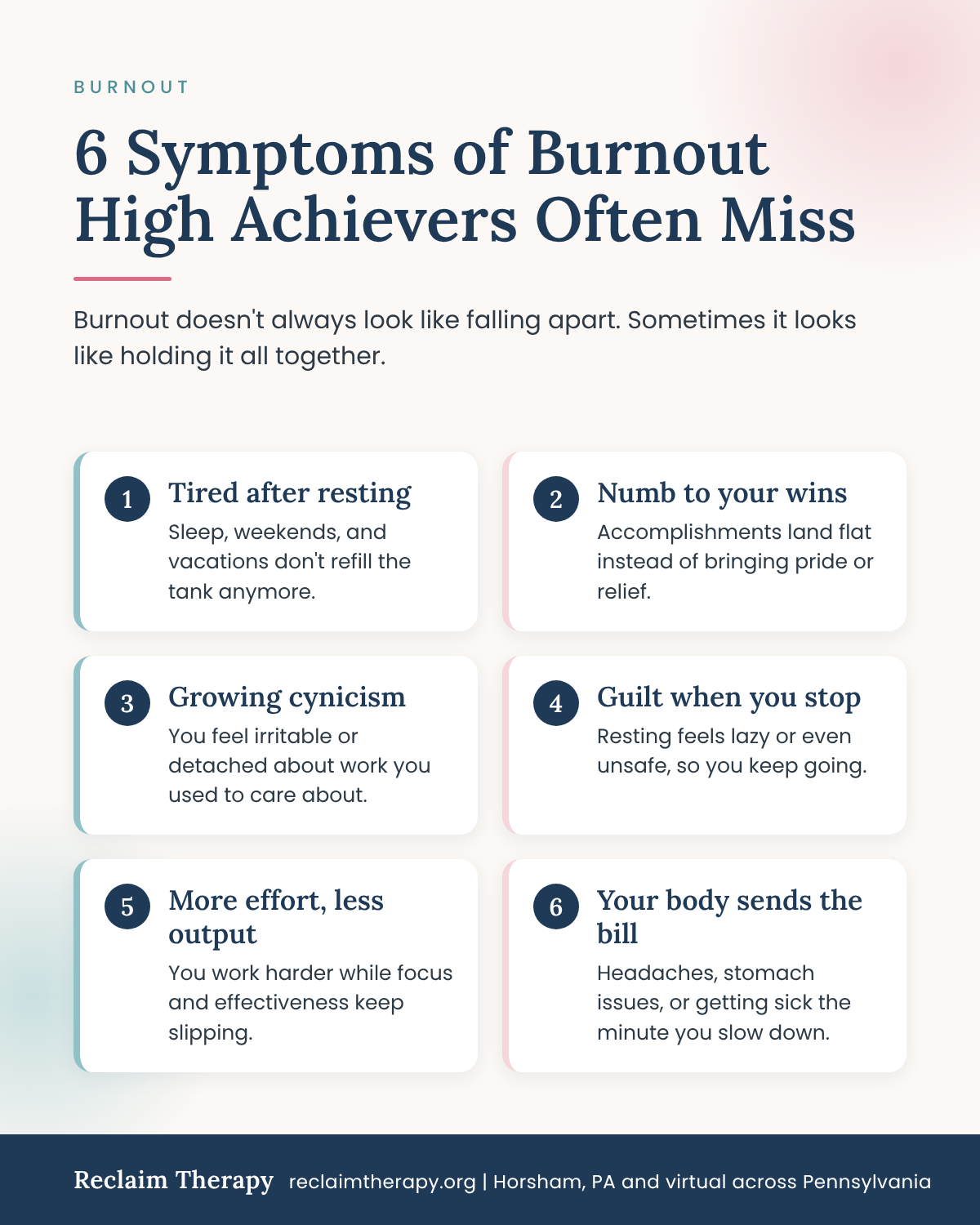
Six symptoms of burnout that high achievers often miss, because they keep performing well while running on empty.
Why Do High Achievers Burn Out?
High achievers burn out because the same strategies that made them successful often started as ways to stay safe. When achievement becomes the main way you feel worthy, loved, or secure, slowing down stops being an option, and your body eventually has to force the issue.
Maybe you grew up as the easy kid, the one who didn't cause waves and didn't seem to need much. Maybe you grew up in a home where things were unpredictable, and being responsible, organized, and helpful kept things a little calmer. Maybe love felt conditional, and the good grades and the gold stars were the moments you felt seen. Psychiatrist Marlynn Wei describes this in Psychology Today as a learned survival strategy, where performance becomes tied to belonging and safety.
Your nervous system drew a very logical conclusion from those experiences. If you keep doing, keep helping, and keep achieving, you'll be okay. Over time, that strategy shows up as perfectionism, people pleasing, and what we call the overfunctioning trauma response. It often traces back to childhood emotional neglect, where your feelings and needs didn't get much room, so you learned to set them aside and get things done.
None of this means something is wrong with you. Those survival strategies protected you, and many of them are the reason you're so good at what you do. They were just never designed to run forever. This is a big part of the hidden cost of high-functioning trauma. The world rewards the strategy, so nobody notices how much it's costing you, sometimes including you.
It's also worth saying that burnout isn't only about your history. Some jobs ask for more than any human can give, and some workplaces run on understaffing and unrealistic expectations. Christina Maslach's research has long pointed to workplace conditions as a major driver of burnout. Good therapy for burnout looks at both what's happening inside you and what's happening around you.
Why Doesn't Rest Fix Burnout?
Rest often doesn't fix burnout because burnout isn't only a shortage of sleep or time off. It's a nervous system that has been stuck in survival mode for so long that it no longer knows how to shift into real rest. For many high achievers, stillness itself registers as a threat.
Here's what that looks like in your body. Most high achievers spend years running on sympathetic energy, the fight-or-flight state that keeps you alert, driven, and ready to handle whatever comes next. That state is useful in short bursts. When it becomes your baseline, your system eventually tips into the opposite direction, a shutdown state where you feel flat, foggy, heavy, and disconnected. If you want to understand these two states more, our post on hyper vs hypo arousal walks through them.
A lot of burned-out high achievers bounce between those two states. You push in high gear until you crash, then you rest just long enough to get back to high gear. What's often missing is the regulated middle, where you feel calm and connected without having to earn it.
When productivity has been your way of staying safe, rest can feel genuinely uncomfortable. Your body might read the couch as danger, which is why you end up scrolling, cleaning, or making a list of everything you should be doing instead. That isn't a lack of discipline. Your nervous system is doing exactly what it learned to do, and it needs new experiences of safety before rest can actually feel restful.
What Is the Best Therapy for Burnout?
The best therapy for burnout depends on what's driving it. Research on burnout treatment has mostly studied approaches like cognitive behavioral therapy, acceptance and commitment therapy, and mindfulness-based programs, and these can help reduce symptoms and build coping skills. When burnout grows out of long-standing survival patterns, trauma-informed therapy that works with the nervous system tends to reach the roots. You can learn more about how we approach this on our burnout therapy page.
Skills like boundaries, time management, and self-care absolutely have a place. The trouble is that most high achievers already know them. You could probably teach a workshop on boundaries. Knowing what to do and having a nervous system that lets you do it are two different things, and that's where burnout therapy that includes the body becomes so important. At Reclaim Therapy, our trauma therapy often weaves together a few approaches.
Somatic Experiencing for Burnout
Somatic Experiencing, developed by Dr. Peter Levine, is a body-based therapy that helps your nervous system complete stress responses and build capacity over time. In burnout recovery, Somatic Experiencing helps you notice when you're revving in high gear or sinking into shutdown, and it helps you find your way back to the middle in small, manageable doses. Slowly, your body learns that it's safe to soften, and rest starts to feel like rest.
EMDR for the Beliefs Underneath Burnout
EMDR (Eye Movement Desensitization and Reprocessing) is a well-researched therapy for processing distressing memories, and it has strong evidence for treating PTSD. Research on EMDR for burnout specifically is still limited. Where EMDR helps with burnout is in processing the experiences that taught you beliefs like "I'm only worth what I produce" or "If I stop, everything falls apart." When those beliefs soften, the pressure to keep pushing often softens with them.
Parts Work for the Part That Won't Let You Stop
Parts work, including Internal Family Systems, helps you get to know the different parts of you that drive your behavior. Most burned-out high achievers have a hardworking part that refuses to let them rest. That part isn't the enemy. It usually took on its job a long time ago to protect you, and parts work helps you understand what it's afraid would happen if it slowed down. Once that part feels understood, it often becomes willing to share the load.
When burnout is tangled up with long-standing patterns from childhood, it can also be connected to complex PTSD. A trauma-informed therapist can help you understand whether that's part of your picture.
What Does Recovering From Burnout Actually Look Like?
Recovering from burnout looks less like a big breakthrough and more like thousands of small shifts. It's noticing you're tired before you hit empty. It's leaving one email until tomorrow and finding out the world keeps spinning. It's feeling a flicker of joy about something that has nothing to do with being productive.
Recovery isn't linear, and it isn't always comfortable at first. When high achievers start slowing down, feelings that have been on hold for years often show up, including grief, anger, and a tender kind of tiredness. That's not a sign you're going backward. It's a sign your system finally feels safe enough to feel.
Healing from burnout also doesn't mean you stop being driven, capable, or ambitious. The difference is that you get to choose when to push and when to rest, instead of your survival patterns choosing for you. Your value is not your output, and it never was. You were never meant to carry everything at full speed forever, and you don't have to keep proving that you can.

Getting Support for Burnout in Horsham, PA and Across Pennsylvania
If you recognized yourself in these symptoms of burnout, you don't have to figure out the way back on your own. At Reclaim Therapy, our team of trauma therapists works with high achievers, cycle breakers, and the people who hold it together for everyone else.
We offer burnout therapy in person at our office in Horsham, PA, serving Montgomery County, Bucks County, and Philadelphia, and virtually across Pennsylvania. Our clinicians bring together EMDR, Somatic Experiencing, and parts work to help you recover from burnout at the root, not just manage it until the next crash.
If you're tired of running on empty and ready for something different, we'd love to talk with you. Schedule a free consultation to see whether working with Reclaim Therapy feels like a good fit.
🧡,
Frequently Asked Questions
Can therapy help with burnout?
Yes, therapy can help with burnout by reducing exhaustion, rebuilding a sense of meaning, and changing the patterns that led to depletion in the first place. For high achievers, therapy that addresses the nervous system and beliefs about worth often creates more lasting change than stress management alone.
What kind of therapist should I see for burnout?
Look for a licensed therapist who understands both burnout and trauma, especially if you've always been the responsible one or felt your worth was tied to achievement. Therapists trained in approaches like EMDR, Somatic Experiencing, or parts work can help with the roots of burnout as well as the symptoms.
What are the first symptoms of burnout?
The first symptoms of burnout are often exhaustion that doesn't improve with rest, irritability, and pulling away from work you used to care about. High achievers may also notice that their accomplishments feel flat and that resting brings guilt instead of relief.
What's the difference between burnout and depression?
Burnout is tied to chronic stress, especially at work, while depression is a mental health condition that affects mood and enjoyment across all areas of life. The two can overlap, and untreated burnout can lead to depression, so it helps to talk with a professional who can assess what's going on.
Can childhood trauma make you more likely to burn out?
Childhood experiences can shape how vulnerable you are to burnout, especially if you learned that being productive, helpful, or easy was the way to stay safe and loved. Those survival strategies make it hard to rest or set limits, which keeps your nervous system running until it crashes.
How long does it take to recover from burnout?
Recovery from burnout varies from person to person, and it often takes months rather than weeks. Things like how long you've been depleted, what's driving the burnout, and whether your circumstances can change all affect the timeline, and steady support makes a real difference.