
Written by Sarah Herstich, LCSW, Certified EMDR Therapist, EMDRIA-Approved Consultant, Somatic Experiencing Practitioner, and owner of Reclaim Therapy in Horsham, PA
Hypervigilance after trauma is a state where your nervous system stays on high alert, constantly scanning for danger, even when you are safe. It is a core symptom of PTSD and complex PTSD, and it often develops in childhood, when staying alert to other people's moods was the safest way to get through the day.
Key Takeaways
Hypervigilance is your nervous system staying in threat-detection mode after the danger has passed, and it is listed as a core symptom of PTSD in both the DSM-5-TR and the ICD-11.
Hypervigilance doesn't only look like scanning for physical danger. For many people with complex trauma, it looks like reading faces, tone of voice, and the mood of a room.
Hypervigilance was a survival strategy first. It developed because, at some point, paying very close attention kept you safer.
You can't think your way out of hypervigilance, because it lives below conscious thought, in your body's sense of safety.
Trauma therapy, including EMDR and Somatic Experiencing, helps your nervous system learn that it is allowed to rest.
What is hypervigilance after trauma?
Hypervigilance after trauma is a heightened state of alertness in which your brain and body keep watching for threat long after the threat is gone. Your internal alarm system, the one designed to keep you alive, gets stuck in the "on" position.
Clinically, hypervigilance is a big deal. The DSM-5-TR places it within the cluster of PTSD symptoms related to arousal and reactivity, and the World Health Organization's ICD-11 describes a persistent sense of current threat, often showing up as hypervigilance or a heightened startle response, as one of the core features of PTSD. It can also appear in other mental health conditions, including anxiety disorders such as generalized anxiety disorder, not only post traumatic stress disorder. Complex PTSD, which the ICD-11 also recognizes, includes those same core features along with difficulties in emotional regulation, self-worth, and relationships.
Underneath all of that is something researcher Stephen Porges calls neuroception, which is your nervous system's constant, below-awareness scan for cues of safety and danger. Deb Dana has written beautifully about understanding hypervigilance through how neuroception shapes ordinary moments in our lives. When you live with hypervigilance, your neuroception keeps landing on the same answer, which is "not safe yet," even when the evidence in front of you says otherwise.
What does hypervigilance feel like?
Hypervigilance often feels less like fear and more like being permanently on duty. Maybe you’re experiencing hypervigilance as a constant state of scanning for potential threats in everyday life. Maybe you walk into a room and know within seconds who is upset, who is annoyed, and who is about to be. Maybe a text that says "Can we talk later?" takes over your entire afternoon. Maybe you always choose the seat facing the door at a restaurant, and you couldn't really tell anyone why.
Maybe you get to the end of a day where nothing technically happened and you feel like you ran a marathon. Your body has basically been working a second job as a security guard, and nobody is paying it overtime; that kind of strain can drain emotional energy too. The physical symptoms and emotional symptoms can include chronic irritability, rapid breathing, or sweating even when no clear danger is present.
A lot of people we work with don't recognize this as hypervigilance at first. They call it being observant, being a planner, or being "just wired this way." From the outside, it often looks like competence. From the inside, it feels like never fully exhaling.
What causes hypervigilance in the nervous system?
Hypervigilance is caused by experiences that taught your nervous system that danger could show up at any moment and that you needed to be ready for it. Sometimes that starts after a traumatic event, like a car accident, an assault, or a medical emergency, and sometimes it builds through chronic stress rather than one incident. After an experience like that, your brain may register perceived danger, and the nervous system can stay in fight or flight mode as it starts watching for the next one.
For many people with complex trauma, though, hypervigilance started much earlier and much more gradually. Maybe you grew up with a parent whose mood could change in a second, a parent who drank, or a home shaped by instability, including substance abuse, that formed lasting trauma responses. Maybe you learned to read the sound of footsteps, the way the car door closed in the driveway, or the tone of someone's "hi" when they walked in the door.
That kind of attention is a skill, and kids develop it because they need it. If your safety depended on noticing a shift before it turned into yelling, silence, or withdrawal, your nervous system did exactly what it should have done. This is also why so many people with childhood trauma feel like everyone is mad at them. The scanning never really stopped, because the system learned to watch for perceived threats or potential danger long after the original situation had passed.
Signs of hypervigilance you might be missing
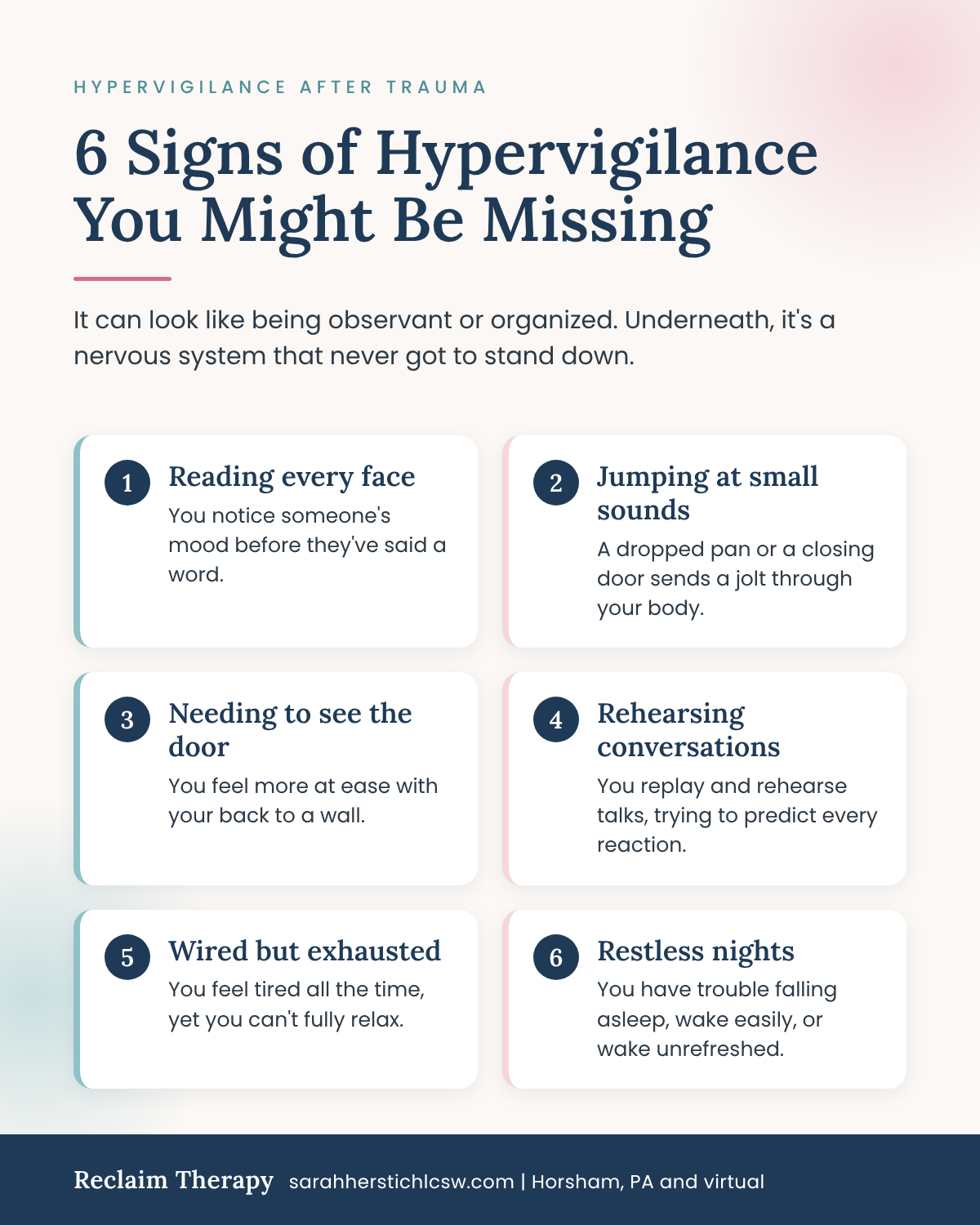
Hypervigilance shows up in the body, in relationships, and in everyday habits. Some signs are obvious, like jumping at loud noises. Others are so woven into daily life that they feel normal. Here are some of the signs we see most often in our practice.
Reading every face and tone of voice
You track facial expressions, tone, and body language closely, becoming hyper-aware of subtle shifts in tone or responsiveness, and you often notice someone's mood before they've said a word. This is one of the most common signs of relational hypervigilance, and it's especially common in people who grew up having to stay one step ahead of a caregiver's emotions. That constant alert can make some people avoid social situations when reading the room feels too exhausting or risky.
Jumping at small sounds
A dropped pan, a door closing, or someone coming up behind you sends a jolt through your whole body. An exaggerated startle response is one of the clearest physical signs that your nervous system is braced for impact, and sudden noises can trigger an exaggerated response with rapid breathing or excessive sweating.
Needing to see the door
You feel more at ease with your back to a wall, you notice where the exits are, or you feel uneasy in crowded spaces. Your body is mapping escape routes in the background, even when your mind knows you're at a birthday party.
Rehearsing conversations
You replay conversations after they happen and rehearse them before they happen, trying to predict every possible reaction. Rehearsing can feel like preparation, but it's often your nervous system trying to make relationships feel predictable enough to be safe.
Feeling wired but exhausted
You feel tired all the time, and yet you can't fully relax. Constant scanning creates constant stress, which can leave you depleted physically and emotionally, not just keyed up. That strain can spill into physical health, contributing to chronic fatigue and sleep disturbances. Caffeine or alcohol can intensify this wired-but-tired pattern and make it harder for your body to settle.
Having restless nights
You may experience sleep disturbances, like trouble falling asleep, waking easily, or sleeping lightly and waking up unrefreshed. Sleep requires your body to let its guard down, which is one of the hardest things for a hypervigilant nervous system to do, and sleep deprivation can intensify feelings of threat and leave you exhausted the next day.
If you’re reading this and thinking, “Okay, this is me,” you don’t have to keep carrying it alone
Our trauma therapists work with hypervigilance every day, in person in Horsham, PA, and virtually across Pennsylvania. Schedule a free consultation to talk with us about what support could look like for you.
In person in Horsham, PA, and virtually across Pennsylvania.
Is it hypervigilance or anxiety?
Hypervigilance and anxiety overlap a lot, and they often show up together. Anxiety tends to show up as worried thoughts about what might happen in the future. Hypervigilance is more of a body-level state of scanning for threat right now, and it's usually rooted in what has already happened to you.
You don't need to sort this out perfectly on your own. It can also overlap with other mental health conditions, including panic disorder, so identifying the underlying cause matters for treatment and your broader mental health. A trauma-informed therapist can help you understand what's driving what. It's also worth checking in with your doctor if this is new for you, since things like thyroid issues, sleep problems, and certain medications can also increase that keyed-up feeling.
Why hypervigilance made sense
Six signs of family secrets trauma that often show up in adulthood, long after the secret itself stopped being talked about.
Hypervigilance is not a flaw. It's evidence of how hard your body has worked to protect you. At some point in your life, paying close attention to everyone and everything kept you safer, and your nervous system learned that lesson really, really well.
We often see hypervigilance hiding inside traits people get praised for. It can look like attention to detail, being the one who notices when a friend is off, or being great in a crisis. That's part of what makes high-functioning trauma so hard to spot.
The problem isn't that your body learned to keep watch. The problem is that your life may have changed more than your nervous system knows. Your body is still protecting you from a situation you might not be living in anymore.
How do you stop being hypervigilant? Coping Strategies Explained
You don't stop hypervigilance by forcing yourself to relax. You lower it by giving your nervous system repeated, felt experiences of safety, slowly, over time. Insight helps, but hypervigilance lives below thought, so it usually needs more than understanding to shift.
Here are a few places to start.
Try orienting. As one of several grounding techniques that help calm the nervous system, let your eyes move slowly around the room and land on things that are neutral or pleasant. Notice the color of a pillow or the light through the window. Orienting gives your nervous system information about the present moment, which is often all it's been missing.
Let the part of you that keeps watch have its seat. If sitting facing the door helps you settle, sit facing the door. Working with the part of you that stays alert, instead of fighting it, often helps it soften faster.
Notice your exhale. You don't need a complicated breathing technique. Simply noticing a slightly longer exhale can send a small signal to your body that it's okay to downshift.
Practice deep breathing. Try a slow inhale through your nose, a brief pause, and a longer exhale through your mouth to ease the fight or flight response.
Lean on co-regulation. Time with a calm, safe person helps your nervous system borrow some of their steadiness. This is one of the oldest ways humans learn safety.
Keep steady rhythms. Consistent meals, sleep, or wind-down rituals can help the nervous system relearn that this moment is safe.
Practice self-compassion. If your body stays on guard, treat it as protection rather than failure.
Move some of the energy through. Regular exercise or gentle movement can help discharge activation and reduce hypervigilance symptoms over time.
Reduce the scanning load. Turning off notifications or putting your phone in another room for an hour gives your system fewer things to monitor.
Here's something nobody tells you. When you start to relax, it can feel scary. Many people with trauma histories notice a spike of anxiety the moment they let their guard down, because for a long time, letting your guard down wasn't safe. If that happens, it doesn't mean you're doing it wrong. It means your body is meeting something unfamiliar, and it needs more time and smaller doses. Understanding your window of tolerance can help you find the right pace, and if your mind is the part that won't stand down at night, our post on how to shut your brain off has more ideas.
Slow is fast here. Healing hypervigilance is thousands of small moments where your body gets to learn something new.
How trauma therapy helps hypervigilance

Trauma therapy helps hypervigilance by working with the experiences that taught your nervous system to expect danger and by helping your body build a new felt sense of safety. At Reclaim Therapy, we use a few approaches that work well together.
EMDR therapy helps process the memories that are still fueling your alarm system. When those memories feel less charged, many people notice that their body doesn't brace as hard in everyday situations. Somatic Experiencing works directly with your body, in small, manageable doses, to help your nervous system release the protective energy it has been holding and return to a more settled state. Parts work helps you get to know the part of you that keeps watch, so it can trust that it doesn't have to work alone anymore.
If your hypervigilance comes from years of relational or developmental trauma, our complex PTSD therapy is built for exactly that. You can also learn more about the difference between being keyed up and being shut down in our post on hyper vs. hypo arousal.
We offer trauma therapy in person at our office in Horsham, PA, and virtually across Pennsylvania, including Montgomery County, Bucks County, and Philadelphia.
Your body learned to keep watch because it had to. With time and the right support, it can also learn that it gets to rest now.
If your nervous system has been on duty for as long as you can remember, you don't have to figure out how to let it stand down by yourself. Schedule a free consultation with our team, and we'll help you find the right therapist for you.
🧡

Frequently Asked Questions
Is hypervigilance a symptom of post traumatic stress disorder (PTSD)?
Yes. Hypervigilance is one of the core symptoms of post-traumatic stress disorder (PTSD) and complex PTSD, and it is listed in both the DSM-5-TR and the ICD-11. Clinicians also assess symptoms of hypervigilance alongside other PTSD symptoms such as irritability, sleep problems, and trouble concentrating. You can also experience hypervigilance without meeting full criteria for PTSD, especially if you grew up in an unpredictable or unsafe environment.
Can childhood trauma cause hypervigilance?
Yes. Childhood trauma, including emotional neglect and growing up with an unpredictable parent, is one of the most common roots of hypervigilance. Kids in those homes learn to read moods and track danger to stay safe, and the nervous system often keeps doing that into adulthood.
Is hypervigilance the same as anxiety?
Not exactly. Anxiety often shows up as worried thoughts about what might happen, while hypervigilance is a body-level state of scanning for threat that is usually rooted in past experiences. It is also often linked to anxiety disorders such as generalized anxiety disorder or panic disorder, especially when the body is stuck in an ongoing fight or flight response. The two often overlap, and a trauma-informed therapist can help you sort out what is driving what.
Can hypervigilance go away?
Yes, hypervigilance can ease significantly with the right support. It usually doesn't disappear overnight, because your nervous system needs repeated experiences of safety to update what it expects, but many people find their baseline shifts in ways they can really feel.
Why am I so exhausted when nothing happened today?
Hypervigilance takes a lot of energy, even when nothing visible is happening. If your nervous system spent the day scanning faces, sounds, and messages for danger, your body has been working hard, and the exhaustion is real. That strain can also affect concentration and emotional well being, even when nothing obvious happened externally.
Can EMDR help with hypervigilance?
Yes, Eye Movement Desensitization and Reprocessing (EMDR) can help with hypervigilance by processing the memories that taught your nervous system to expect danger. EMDR is a well-researched treatment for PTSD, and reprocessing traumatic memories can reduce constant alertness in everyday life and make a meaningful difference over time, so many people notice their body doesn't brace as hard in everyday situations.