
Written by Sarah Herstich, LCSW, Certified EMDR Therapist, EMDRIA-Approved Consultant, Somatic Experiencing Practitioner, and owner of Reclaim Therapy in Horsham, PA
Family secrets trauma is the lasting impact of growing up in a home where something important was hidden, denied, or never allowed to be spoken. Whether the secret was abuse, sexual abuse, addiction, an affair, mental illness, or money, the secrecy itself shapes a child's nervous system, their trust in their own perception, and how safe it feels to be known as an adult.
Key Takeaways
Family secrets affect children even when no one ever tells them the details, because kids read tension, silence, and shifts in a parent's face long before they have words.
The body learns to keep secrets too, through bracing, held breath, a tight throat, and freeze responses.
Survival responses like fawn, freeze, flight, and fight often form around protecting a family secret.
In adulthood, family secrets trauma can look like self-doubt, chronic shame, trouble with intimacy, overexplaining, and guilt about finally talking.
Healing happens at your own pace, and you get to decide what you share, with whom, and when.
What does it feel like to grow up with family secrets?
Growing up with family secrets often feels like living in a house with a room nobody is allowed to go into. You might not know what's in there. You just know you're supposed to walk around it, and you learn to do that so well that you stop noticing you're doing it at all.
Maybe you grew up hearing "what happens in this house stays in this house." Maybe nobody ever said it out loud, and you just knew. Maybe there was a relative everyone was strangely polite around, a parent who "was tired" a lot, or a holiday that went sideways and was never mentioned again. Maybe you knew something you were very clearly not supposed to know, and you carried it alone.
A lot of the people we work with describe it the same way. They say something like, "Nothing that bad happened, but I always felt like I was holding my breath." That feeling matters. It's your nervous system telling the truth about what it was like to live there.
What counts as a family secret?
A family secret is any important truth that a family hides, denies, or forbids people from talking about, either from outsiders or from each other. Common family secrets include:
Physical, emotional, or sexual abuse, including abuse by a family member or someone close to the family
A parent's addiction to alcohol, drugs, gambling, or something else
Affairs, hidden relationships, or a parent's double life
Mental illness, suicide, or a family member's hospitalization
Money problems, debt, or financial control
Adoption, donor conception, or questions about who someone's biological parent is
The unspoken rules, like "we don't talk about Dad's temper" or "we don't cry in this family"
That last one is important. Not every family secret is a single fact. Sometimes the secret is a whole category of feelings that weren't allowed. If anger, sadness, or fear had to be hidden, you grew up keeping a secret about yourself.
Childhood sexual abuse deserves its own mention, because secrecy is often part of how the abuse itself works. A child may be told directly not to tell, or may be groomed to believe that telling would hurt the family. If that's part of your story, our post on sexual abuse signs in adults goes deeper into what survivors often carry.
If reading this brings up a lot, please take breaks. You can call or text 988, or reach RAINN's National Sexual Assault Hotline at 1-800-656-4673, any time.
How do kids absorb family secrets they were never told?
Children absorb family secrets through their bodies and their relationships, not through information. Kids are wired to stay attuned to their caregivers because their survival depends on it, so they pick up on tension, silence, and shifts in a parent's tone or face long before they understand what's happening.
You may not have known that your mom was terrified about money. You still felt how her shoulders went up when the mail came. You may not have known why your uncle was never invited over anymore. You still noticed that the room went cold when someone said his name.
This creates a double reality. There's what you sense is true, and there's what everyone says is true. When those don't match, a child usually decides the problem must be them. "Maybe I'm making it up." "Maybe I'm too sensitive." That isn't a flaw in how you think. It's the most logical conclusion a kid could reach, because a child needs their caregivers to be right in order to feel safe.
Psychologist Jennifer Freyd describes a related idea she calls betrayal blindness. When a child depends on the person causing harm or keeping the secret, it can be safer to not fully know what's happening. It explains why so many adults say, "I knew, but I didn't know."
If you're reading this list and thinking, "wait, that's me," you're not alone.
Our team at Reclaim Therapy works with adults who grew up keeping family secrets and are recovering from trauma and complex trauma.
In person in Horsham, PA, and virtually across Pennsylvania.
How does the body keep family secrets?
The body keeps family secrets by holding back the impulse to speak, cry, reach out, or react. Over time, that holding becomes a physical pattern. Many people who grew up with family secrets notice a tight throat, a clenched jaw, shallow breathing, a braced belly, or shoulders that live somewhere up near their ears.
Think about what it physically takes to not say something. You swallow it. You hold your breath. You tighten your face so nothing shows. A child who does that once is coping with a hard moment. A child who does that for years is building a nervous system around it.
Clients are often surprised that their body reacts before their mind catches up. Your throat might tighten when someone asks a simple question about your childhood, or you might feel suddenly exhausted at family gatherings for no reason you can name. That's not random. That's your body remembering the job it used to do.
What survival responses form around family secrets?
Survival responses are automatic ways the nervous system protects you when it senses danger. In homes with secrets, those responses often organize around one goal, which is keeping the secret safe so the family stays together. Each one made complete sense at the time.
Freeze when someone gets close to the truth
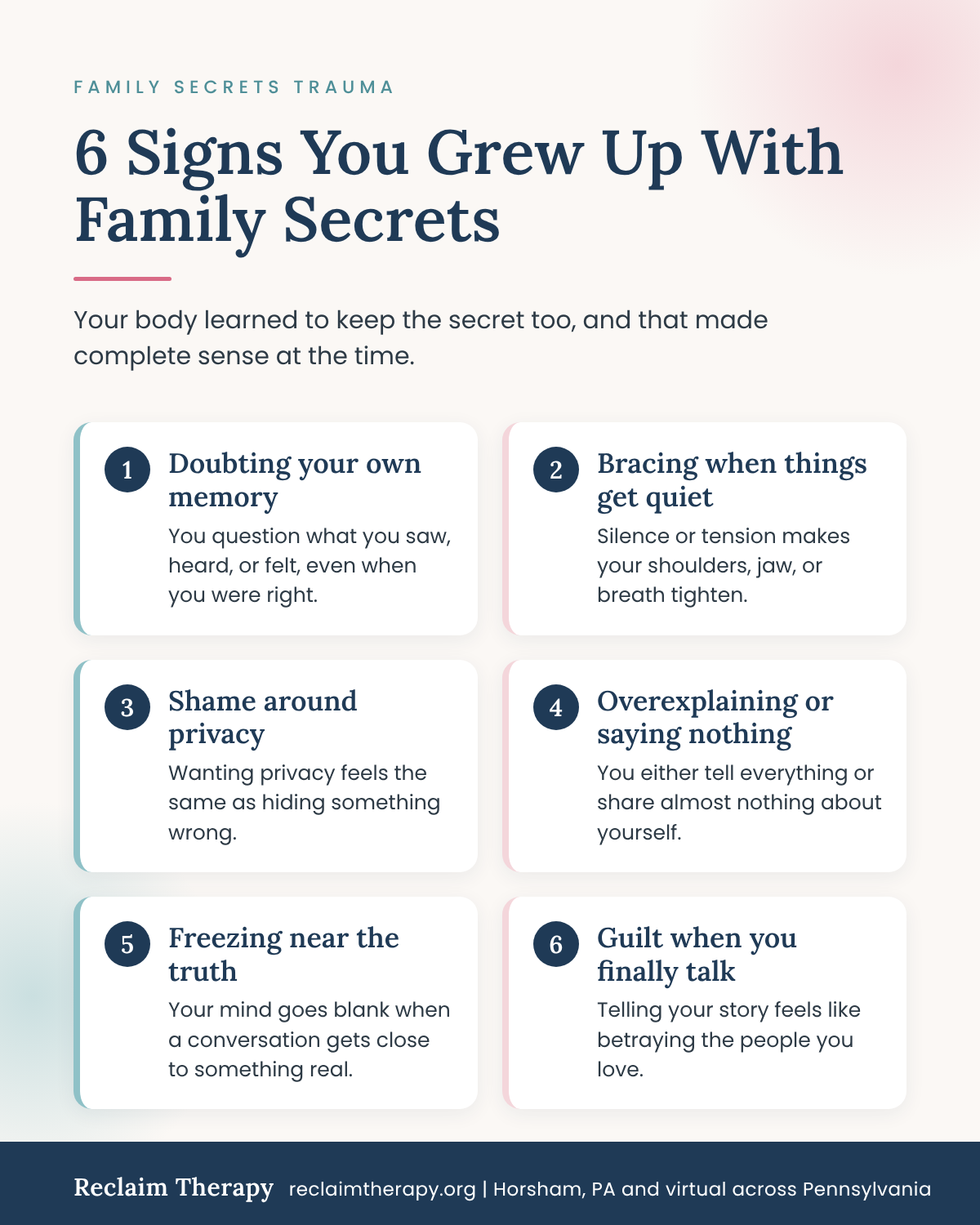
Six signs of family secrets trauma that often show up in adulthood, long after the secret itself stopped being talked about.
The freeze response shows up when your system decides the safest move is to go still. For a kid holding a secret, freeze might have looked like going blank when a teacher asked how things were at home.
Fawn to keep the peace
The fawn response protects you by keeping everyone else comfortable. If your family's stability depended on nobody rocking the boat, you may have become the easy kid, the funny one, or the helper who smoothed things over before anyone could get upset.
Flight into busyness and independence
Flight doesn't always mean running away. Sometimes it means running toward achievement, staying busy, or leaving home early and never looking back. Many people who grew up with secrets become fiercely self-reliant, because needing people means letting them close enough to see things.
Fight when someone pushes on it
Fight can show up as anger, defensiveness, or shutting someone down hard when they ask the wrong question. If you've ever snapped at a partner for asking something innocent about your family and then wondered where that came from, this might be it. Your system learned that questions were dangerous, and it's still guarding the door.
How does intergenerational trauma from family secrets show up in adulthood?
Family secrets trauma often shows up in adulthood as self-doubt, shame, difficulty with closeness, and a constant low hum of feeling like you're hiding something, even when you aren't. Here are some of the ways we see it most often.
Doubting your own memory
You question what you saw, heard, or felt, even when you were right. You might replay conversations to check whether you overreacted, which makes sense when your earliest reality was constantly being edited by others. Our post on complex trauma and chronic self-doubt goes deeper into this.
Bracing when things get quiet
Silence or tension makes your shoulders, jaw, or breath tighten. A partner going quiet after work can send your body into high alert, because in your family silence often meant something was being hidden.
Shame around privacy
Wanting privacy feels the same as hiding something wrong. Healthy privacy is your right, while secrecy is built on shame and fear, but when you grew up with secrets the two can feel identical.
Overexplaining or saying nothing
You either tell everything or share almost nothing about yourself. Some people overexplain so no one could ever accuse them of hiding something, and others stay so guarded that even close friends don't know much about their life. Both are ways of managing the same old fear of being found out.
Freezing near the truth
Your mind goes blank when a conversation gets close to something real. You might lose your train of thought in therapy or suddenly feel sleepy. That's your nervous system doing what it learned to do, and it deserves curiosity, not frustration.
Guilt when you finally talk
Telling your story feels like betraying the people you love. Families with secrets often teach that loyalty means silence, so speaking up can bring a wave of guilt, even when what you're sharing is true and you were the one who got hurt. Judith Herman wrote in Trauma and Recovery about how secrecy and silence protect the people who cause harm. Your guilt is real, and it's also a sign of how deeply that rule was taught.
Why does my body react when I finally talk about family secrets?
Your body reacts when you start talking about family secrets because disclosure can set off the same alarm the secret was built to avoid. For years, your nervous system learned that saying the thing meant danger. So when you finally say it, even in a safe room with someone you trust, your body may respond as if something terrible is about to happen.
That can look like shaking, nausea, a racing heart, crying that seems to come from nowhere, going numb, or feeling like you need to leave immediately. Some people feel a wave of panic the day after a big session, and others feel strangely flat, like nothing happened at all.
Those reactions are not a sign that telling was a mistake. They are a sign that your body is catching up to something new. This is why pacing matters so much in trauma therapy. We work to keep you within your window of tolerance, so that sharing happens in doses your nervous system can actually take in.
How do you heal from family secrets trauma?
Healing from family secrets trauma means slowly teaching your nervous system that the truth can be spoken and you can still be safe. When secrecy grows around unresolved trauma, transgenerational trauma can take hold, and those responses can echo across generations, affecting descendants of trauma survivors with symptoms like depression, anxiety, and other mental health struggles. It doesn't require you to tell everyone everything, confront your family, or rewrite your whole story at once. Healing often includes:
Naming what happened, even if only to yourself at first
Learning to trust what you sensed as a child, and what you sense now
Noticing where your body holds the secret, and letting it soften a little at a time
Grieving the family you needed and didn't get
Learning the difference between privacy and secrecy, so you can choose what is yours to keep
Healing doesn't have to mean confronting your family. Some people choose to talk to their family, some choose distance, and some heal without the family ever knowing. Plenty of families keep the secret no matter what you say, and you can still heal. Your healing doesn't depend on anyone else admitting the truth, though breaking the cycle often does require trauma-informed mental healthcare.
You get to decide what you share, who you share it with, and when. That choice is exactly what you didn't have as a kid, and getting it back is a big part of the healing.

How can therapy help with family secrets trauma and mental health?
Trauma therapy helps with family secrets trauma by giving you a relationship where the truth is welcome and by helping your body process what it has been holding. At Reclaim Therapy in Horsham, PA, and through virtual therapy across Pennsylvania, our clinicians work with adults who grew up in homes with secrets, abuse, addiction, and emotional neglect.
Some families are also living with intergenerational trauma or generational trauma, where overwhelming experiences in one generation shape the next through learned patterns, attachment, parenting, and sometimes the body's stress response. Trauma is common overall—about 70% of adults report at least one traumatic experience—and these effects may touch more than one generation, sometimes discussed as affecting up to three generations or future generations. Researchers are also studying epigenetic changes and gene expression, meaning trauma may influence how genes work without changing DNA itself; studies suggest trauma can alter stress-related genes in descendants, but evidence in humans remains limited. The Dutch famine study is one example often cited in this conversation, linking maternal stress to obesity in descendants, while stronger evidence for inherited epigenetic effects comes from animal models.
EMDR therapy can help reprocess specific memories and the beliefs that came with them, like "it's my fault" or "if I tell, something bad will happen." Somatic Experiencing works directly with the bracing, freezing, and holding in your body. Parts work makes room for the part of you that still feels loyal to your family and the part of you that needs the truth to be told, without forcing either one to win.
For many people, family secrets trauma is also a form of complex trauma, and our CPTSD treatment looks at those patterns as a whole.
We go slowly, on purpose. Slow is fast in this work, especially when your body learned that speaking up was dangerous.
If any of this felt familiar, you don't have to sort through it alone. You can schedule a free consultation with our team to see if Reclaim is a good fit. You get to decide what you share and when. That's always been yours.
🧡,

Frequently Asked Questions
What is family secrets trauma?
Family secrets trauma is the lasting emotional and physical impact of growing up in a home where important truths were hidden or forbidden. It often shows up as self-doubt, shame, and a body that stays braced, even long after the secret itself stopped being talked about.
Can family secrets cause trauma even if I never knew the details?
Yes. Children sense tension, silence, and fear in their caregivers even without knowing the facts, and their nervous systems adapt to that environment. Many adults only learn what the secret was years later and realize their body knew all along.
Why do I feel guilty talking about my family's secrets?
Many families teach that loyalty means silence, so speaking up can feel like betrayal even when what you're sharing is true. That guilt is a learned survival rule, and it can soften as your nervous system learns that telling the truth is safe now.
Why does my body react when I talk about my family in therapy?
Your nervous system learned that speaking about the secret was dangerous, so disclosure can trigger shaking, nausea, numbness, or panic. These reactions are normal and are a sign your body is catching up to something new, which is why trauma therapy goes at a careful pace.
Do I have to confront my family to heal?
No. Some people choose to talk with their family, some choose distance, and some heal without their family ever knowing. Your healing does not depend on anyone else admitting what happened.
How does EMDR help with family secrets trauma?
EMDR, often used in trauma-informed mental health treatment, can also help people with post-traumatic stress disorder or another stress disorder linked to family experiences or other trauma reprocess memories connected to family secrets and the beliefs that formed around them, like "it's my fault" or "if I tell, something bad will happen." Over time, those memories can feel less charged and those beliefs can loosen.