
Written by Sarah Herstich, LCSW, Certified EMDR Therapist, EMDRIA-Approved Consultant, Somatic Experiencing Practitioner, and owner of Reclaim Therapy in Horsham, PA
Body image and trauma are connected because a body that once felt unsafe, criticized, or unwanted often becomes the place a person tries to manage fear and earn acceptance. For many trauma survivors, body image struggles are survival strategies for staying safe and staying connected, not vanity or a lack of willpower.
Key Takeaways
Body image struggles after trauma are often doing two jobs at once, which are keeping you safe and keeping you connected to the people you needed.
Research links insecure attachment and a strong need for approval to higher body dissatisfaction.
Shrinking, controlling, or hiding your body can be a nervous system strategy rather than a character flaw.
Body love often feels impossible after trauma because your nervous system still believes it needs the old protection.
Trauma-informed therapy such as EMDR, Somatic Experiencing, and parts work helps by addressing what body image has been protecting you from.
What is the connection between body image and trauma?
Body image and trauma overlap because your body is where your nervous system stores what it learned about safety, love, and belonging. If your body was criticized, watched, compared, or hurt, it makes sense that it became the place where your fear and shame now show up.
Maybe you already know, somewhere in the back of your mind, that this isn't really about your stomach or your arms. You might even be able to explain the whole thing to a friend, beautifully and compassionately, and then turn around and spend twenty minutes picking apart a photo of yourself from a birthday party. That gap between what you know and what you feel is one of the clearest signs that something deeper is going on.
In our practice, we see this all the time. Someone comes in wanting help with their body image, and as we get curious together, we find that the body has been carrying two very old jobs. The first job is keeping you safe. The second job is keeping you close to the people you needed. Once we can see those jobs clearly, the harsh voice about your body starts to make a lot more sense, and it becomes a lot less personal.
Why do I hate my body after trauma?
Many people hate their body after trauma because body image is a multidimensional construct that includes thoughts, emotions, beliefs, and lived experience in the body, not just how someone looks. When something painful happened that you couldn't control, your mind may have decided that the problem was you, and the most concrete version of "you" is your body.
This is such a human move. Children in particular need the adults around them to be good and safe, so it often feels less frightening to believe "something is wrong with me" than to believe "the people I depend on are hurting me." That can happen after physical abuse, emotional abuse, or sexual abuse, especially when a child copes by disconnecting from the body as a survival mechanism. Over time, that can fracture self image and self worth, distort self perception, and create negative feelings that harden into a distorted body image, making it hard to feel at home in your own skin.
Researchers who study trauma and the body have described this same pattern, where blame for what happened gets misplaced onto the body instead of the person who caused the harm. If your body is the problem, then at least there is something you can fix.
That's why body hatred can feel strangely comforting and exhausting at the same time. It gives you a project and a sense of control, and it also keeps you at war with the one place you live. If you're curious about which childhood experiences tend to shape body image in the first place, our post on complex PTSD and body image walks through them.
How does body image become a way to stay safe after trauma?
Body image becomes a safety strategy when changing, controlling, or monitoring your body helps your nervous system feel less exposed to danger. The logic is simple and very old, and it goes something like this: if I can manage my body, I can manage what happens to me.
Making yourself smaller or less noticeable
For some people, wanting a smaller body is less about beauty and more about being less visible. Taking up less space can feel like protection when being noticed once led to criticism, teasing, or unwanted attention. Some survivors of sexual trauma describe the opposite pull, where they want to change their body in whatever way makes them feel less looked at. Both of these make sense as attempts to feel safer in a world that didn't feel safe.
Controlling your body when nothing else felt controllable
If you grew up in a home that was chaotic, unpredictable, or emotionally volatile, controlling food, exercise, or your body's shape may have been the one place you got to decide something; wanting a smaller body can also reflect discomfort in your own skin, not just a wish to change body weight or body shape. That control can bring real relief to a nervous system that spent years bracing. Your nervous system found the only steering wheel it could reach, and it held on tight.
After sexual abuse or other trauma, even attention to appearance can feel threatening when the goal is safety rather than attractiveness. Over time, body image disturbance can reshape eating habits and pull you toward restrictive eating or compulsive exercise as disordered eating behaviors that can disrupt daily life, harden into disordered eating patterns, reinforce unhealthy behaviors, and sometimes lead to severe symptoms or self-harm used to manage emotional pain. When that grip on food and exercise starts taking up more of your life than you want it to, eating disorder therapy can help you loosen it without taking away your sense of safety.
Staying one step ahead of criticism
Body checking, scanning photos, comparing yourself to everyone in the room, rehearsing what people might say about your body, and trying to control food through restrictive eating or shifts in eating habits, or control your body through movement that turns into compulsive exercise, are all forms of hypervigilance pointed at appearance. If you learned early that criticism could come at any moment, your nervous system may have decided that the safest plan is to find every flaw before anyone else does. That control can bring real relief at first, but these unhealthy behaviors can deepen body image disturbance and, over time, lead to more severe symptoms or disrupt daily life. It's exhausting, and it's also incredibly loyal.
Leaving your body altogether
Sometimes the safest option for a nervous system is to not be fully in the body at all, which can mean checking mirrors or other reflective surfaces and trying to fix or hide perceived flaws before anyone else notices them. For some people, this can start to resemble body dysmorphic disorder symptoms, including excessive grooming around a perceived defect. Feeling numb, floaty, or disconnected can make it easier to judge one's body from the outside, like it's an object instead of your home.
That distance can function as a survival mechanism, especially when traumatic memories are still getting triggered, and it's a big part of why so many survivors feel unsafe in their body after trauma. A healthy body image is more grounded and proportionate, where appearance does not take over self-worth or daily life.
How EMDR for birth trauma works, starting with safety and moving at your pace.
How does body image become a way to belong?
Body image becomes a belonging strategy when the shape, size, or appearance of your body feels like the ticket to being loved, approved of, or included, and leaving the body can become a survival mechanism when traumatic memories or overwhelm make being present in it feel unsafe. This is the part of the conversation that often gets missed, and it's where many of our clients feel the most recognition.
The research backs up what we see in session. In a 2010 study of 586 outpatients with eating disorders, insecure attachment showed up across every eating disorder group, and the need for approval was the strongest predictor of body dissatisfaction, more than personality traits. Another 2010 study of university students found that among women, body dissatisfaction fully explained the link between attachment anxiety and disordered eating. And a 2013 study in Child Abuse & Neglect found attachment insecurity to be one of the pathways between childhood maltreatment and eating disorder symptoms. More broadly, disorders research shows a two-way relationship here: adolescent body dissatisfaction raises later eating disorder risk, and body image disturbance can also intensify symptoms and relapse risk. This pattern also helps explain why these struggles so often show up alongside other mental health concerns, a point echoed in psychosomatic research.
In plain language, when connection feels uncertain, many of us try to make ourselves more acceptable, and the body is often where that effort goes. Grounding exercises can help manage trauma-related dissociation and support a steadier return to the body.
Earning love in a family that noticed bodies
Maybe your family talked about bodies constantly. Maybe changes in body weight got praise or criticism from family members, or there was an aunt who always had something to say at the holidays. Children are brilliant at figuring out what earns warmth, and if your body was part of that equation, it makes sense that body image concerns can become tied to self-esteem and self worth before you can relax. Studies also link this kind of scrutiny with low self esteem, and disorders research has found that body dissatisfaction in adolescence increases later eating disorder risk.
Fawning with your body
The fawn response is a trauma response where you stay safe by pleasing, accommodating, and becoming whatever other people seem to want. Many people fawn with their words and their behavior, and many people also fawn with their body. Shaping your body to match what your family, partner, or community approves of can be a way of saying "please keep me" without ever saying it out loud.
When your body got noticed and your feelings didn't
If you grew up with emotional neglect, your feelings may have gone unnoticed while your appearance got attention. When the only reliable way to be seen is how you look, the body can become your main connection to approval. Many adults who grew up this way notice that their sense of worth rises and falls with how their body looks on a given day. That kind of invisibility is lonely in a way that's hard to put words to, and it shows up again and again in people who grew up feeling unseen.
Belonging in a culture with narrow rules
Belonging isn't only about family. We live in a culture with a lot of weight stigma and very narrow ideas about which bodies are acceptable. For people in larger bodies, and for anyone whose appearance differs from dominant ideals around body shape, body weight, facial features, or skin tone, repeated media exposure can fuel body image concerns so self-worth and self-esteem start to rise and fall with the body's appearance, which can erode self-image over time and affect mental health. They show up in doctor's offices, in clothing stores, and in the way people get treated. When your nervous system picks up on those messages, it's reading the room correctly, and that deserves care rather than blame.
What are the signs your body image is connected to trauma?
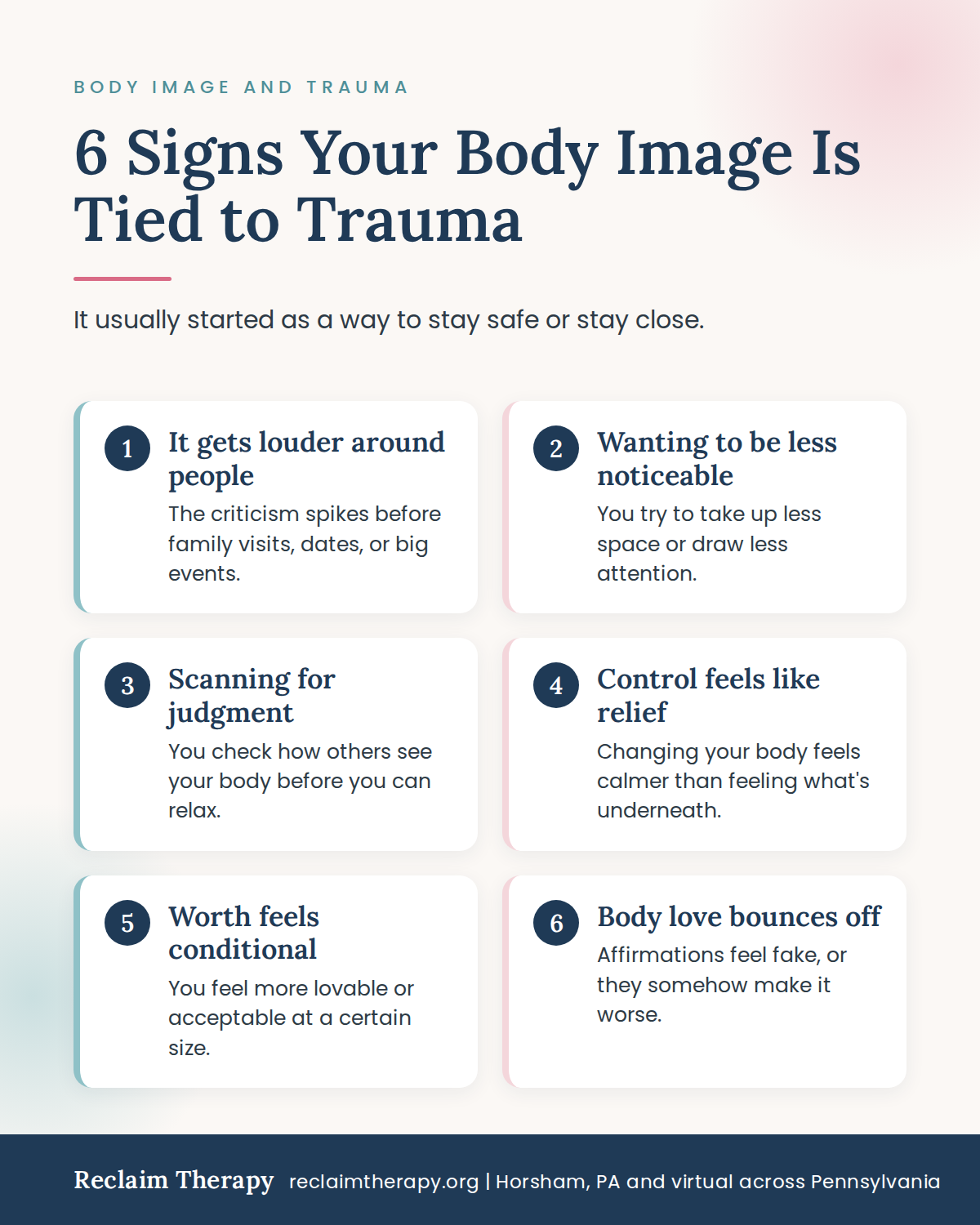
Body image struggles may be connected to trauma when they get louder around people, feel tied to safety or approval, and don't budge with logic or affirmations. Some common signs include:
Media exposure can intensify these patterns by promoting narrow ideals about body shape, facial features, skin tone, and body weight, which can worsen body image disturbance and affect mental health in daily life.
It gets louder around people. The criticism spikes before family visits, dates, or big events.
Wanting to be less noticeable. You try to take up less space or draw less attention.
Scanning for judgment. You check how others see your body before you can relax.
Control feels like relief. Changing your body feels calmer than feeling what's underneath.
Worth feels conditional. You feel more lovable or acceptable at a certain size.
Body love bounces off. Affirmations feel fake, or they somehow make it worse.
None of these signs means something is wrong with you. They're clues about what your body image has been protecting, and if they start shaping how you eat, cope, or function, professional support can help.
Why doesn't "just love your body" work after trauma?
""Just love your body" often doesn't work after trauma because it asks your nervous system to drop a protection it still believes it needs. If being critical of your body has been keeping you safe or keeping you connected, letting go of that criticism can feel less like freedom and more like danger, and these patterns can start interfering with daily life or mental health too.
Stephen Porges, who developed polyvagal theory, uses the word neuroception to describe how your nervous system constantly scans for safety and threat below the level of conscious thought. Deb Dana has done beautiful work translating this into everyday language. The takeaway for body image is that you can't talk a nervous system out of a threat it still perceives. You have to help it experience safety, often through self compassion and compassionate support.
That's why you can follow every body-positive account on the internet and still feel awful in a fitting room. You're not failing. You're trying to put a sticker over an alarm that is still going off.
Judith Herman, in her foundational work on trauma recovery, describes establishing safety as the first stage of healing, and that applies to your relationship with your body too. A healthy body image is not about loving every inch of yourself all the time; it means your thoughts about appearance stay in proportion and do not define your whole worth. In that sense, positive body image is less a demand to feel amazing about how you look and more an accepting, grounded relationship with your body.
What does healing body image after trauma actually look like?
Healing body image after trauma usually looks like slowly building safety in your body, understanding what your body image has been protecting, and giving yourself new ways to feel secure and connected. It tends to be much less about adoring your reflection and much more about being able to live in your body without a constant fight.
For a lot of people, the first shift is noticing when the body commentary gets loud and asking what's actually happening in that moment. You might realize the criticism shows up right before you see your mom, or after a conversation where you felt left out. Your nervous system is pointing you toward the places where it still feels unsafe.
Over time, healing can look like body neutrality, where your body is just your body on a Tuesday. It can look like wearing the shorts, eating the meal with friends, or letting someone take your picture without spiraling for the rest of the night. Slow is fast here. Thousands of small moments of safety add up. For a gentle, body-based way to begin, you can try some of the practices in a somatic approach to healing body image.
You get to choose how you relate to your body now. The strategies that kept you safe and close deserve respect, and you also get to decide whether you still need them.
How does trauma-informed body image therapy help?
Trauma-informed body image therapy helps by treating the trauma and attachment wounds underneath body image struggles, rather than only targeting thoughts about appearance. At Reclaim Therapy, our clinicians specialize in trauma, complex trauma, and eating disorders, so we look at body image through that lens from the very first session to help you build a healthier relationship with your body, not feel perfect about it.
EMDR therapy can help reprocess the specific traumatic memories tied to body shame, like a comment from a parent, a moment of bullying, or an experience that made your body feel unsafe. Somatic Experiencing helps your nervous system build capacity to feel safe in your body again, slowly and at a pace that respects your system. Parts work helps you get to know the part of you that criticizes your body and understand what it has been trying to protect, creating more self compassion instead of harsh self-judgment. And attachment-focused work gives you a relationship where you can be fully seen without having to earn it, which can be especially important for people navigating both PTSD and body dysmorphic disorder symptoms that affect daily life and mental health.

Reclaim’s team of trauma and body image therapists
Reclaim Therapy can help you sort through body image issues.
We offer body image counseling and eating disorder therapy in person at our office in Horsham, PA, and virtually across Pennsylvania, including Montgomery County, Bucks County, and Philadelphia. When both are present, treatment may need to address PTSD and body dysmorphia together.
We are a weight-inclusive practice, which means your body will never be the problem we are trying to solve. Our clinicians can use approaches such as EMDR to help reprocess traumatic memories tied to body shame, bullying, or feeling unsafe in the body.
If any of this sounds like you, you don't have to keep fighting your body alone. Because body dysmorphic disorder symptoms can also come with severe anxiety and depression, getting professional support can matter for your mental health, eating, and daily life. We would be honored to offer compassionate support. Schedule a free consultation with our team, and we'll help you find the right clinician for you and build a healthier relationship with your body over time.
🧡

Frequently Asked Questions
Can trauma cause body image issues?
Yes. Trauma can shape how you see, feel, and treat your body, especially when the trauma involved criticism, unsafe relationships, or violations of your physical boundaries. For many people, negative body image develops as a way to manage fear, control, or the need to be accepted, which is why it often eases as the underlying trauma heals.
Why do I hate my body after trauma?
Hating your body after trauma often happens because the body becomes the place where fear and shame land. When what happened felt out of your control, the body can feel like the one thing you are allowed to blame or change. That hatred is usually a protective strategy, not a truth about your body.
Is body dysmorphia a trauma response?
Body dysmorphic disorder is its own diagnosis with several possible contributing factors, and childhood trauma, bullying, and appearance-based criticism are among them. Not everyone with body dysmorphia has a trauma history, but when trauma is part of the picture, treating it alongside the body image symptoms tends to help.
Can childhood emotional neglect affect body image?
Yes. When a child's feelings go unnoticed but their appearance gets attention, the body can become the main way they feel seen or approved of. As adults, many people who grew up with emotional neglect notice that their sense of worth rises and falls with how their body looks.
Do I have to love my body to heal my body image?
No. Many trauma survivors find body love feels out of reach or even unsafe at first, and that is okay. Healing often starts with body neutrality and a growing sense of safety in your body, and warmth toward your body tends to follow once your nervous system no longer needs the old protection.
Can EMDR help with body image after trauma?
Yes, EMDR can help when body image is connected to specific memories, such as comments about your body, bullying, or moments of shame. EMDR helps your brain reprocess those memories so they carry less charge, which can soften the beliefs about your body that grew out of them.
Where can I find trauma-informed body image therapy in Pennsylvania?
Reclaim Therapy offers trauma-informed body image therapy in person at our office in Horsham, PA, and virtually across Pennsylvania, including Montgomery County, Bucks County, and Philadelphia. Our clinicians specialize in trauma, complex trauma, and eating disorders, and we're a weight-inclusive practice, so your body is never the problem we're trying to solve.